The IEP meeting said "transition" — and now your child's future runs through three agencies that don't talk to each other
Your child's school district handles the IEP. Nebraska Vocational Rehabilitation handles job training and Pre-ETS. The Department of Health and Human Services handles adult developmental disability waivers. Each has its own eligibility process, its own paperwork, and its own deadlines. None of them will tell you what to do with the other two — and if you miss a step, the consequences don't surface until your child ages out of school services and the safety net disappears.
Nebraska adds two complications that generic transition resources miss entirely. First, Rule 51 requires transition planning to begin at age 14 — two years before the federal default. Second, Nebraska is one of the only states where educational rights do not transfer to the student at age of majority. Parents keep full IEP authority through the end of eligibility, which changes the guardianship calculus completely.
The Three-Agency Coordination System
The Nebraska IEP Transition to Adulthood Guide is built around the central challenge Nebraska families face: coordinating three independent state systems on a timeline that starts earlier than in most states and lasts through the school year your child turns 21. The guide maps every milestone across all three agencies into a single chronological workflow — so you can see which application to file, which consent form to submit, and which meeting to prepare for at each stage.
This isn't a generic IEP binder with federal-only requirements. Nebraska's age-14 trigger, its non-transfer of rights, its Enable Savings Plan, its iServe portal for waiver applications, and its recently eliminated DD waitlist (which still leaves 55% of families without active providers) are all built into the system. Every step references the specific Nebraska rule, statute, or agency process it corresponds to.
What's Inside
The full guide includes a 46-page walkthrough, a printable transition checklist, and 8 standalone worksheets — tools you can print and bring to IEP meetings, VR intake appointments, and DHHS application sessions.
- Rule 51 Transition Roadmap — every action item from the age-14 IEP trigger through age 21, mapped to the specific Nebraska administrative rule or statute that requires it, so you know whether your district is meeting its obligations at each milestone
- Graduation Pathway Decision Matrix — a clear breakdown of how a regular diploma terminates FAPE eligibility, how a certificate of attendance preserves services to age 21, and how Neb. Rev. Stat. § 79-770 lets your child walk at graduation while keeping transition services active
- VR and Pre-ETS Application Walkthrough — annotated instructions for the Consent & Release form, the five core Pre-ETS services available to students as young as 14 without a formal VR eligibility determination, and how to coordinate between your school, the local ESU, and the Nebraska VR office
- DHHS Waiver Navigation Guide — step-by-step instructions for the iServe portal and the DD-10 application, the documentation checklist for establishing eligibility under § 83-1205, and comparison tables for the CDD, DDAD, and Family Support waivers so you can evaluate which services fit your child's situation
- SSI, DAC, and Enable Savings Plan Coordination — the adult SSI application timeline, Disabled Adult Child benefit calculations, the impact of the Social Security Fairness Act (GPO and WEP are repealed as of January 2025), and Enable Savings Plan setup including the 2026 contribution limits, state tax deductions, and NEST 529 rollover rules
- Guardianship Alternatives Toolkit — because Rule 51 preserves your IEP advocacy rights without guardianship, the guide evaluates limited guardianship under § 30-2620, healthcare powers of attorney, educational releases, and representation agreements so you can choose the least restrictive support structure
- 18-to-21 Program Directory — verified contact information and program details for district-operated transition programs including OPS Transition, Lincoln Independence Academy, Kearney's community-based program, Bellevue B.E.S.T., Bennington 18-21 programming, and LifeLink-NE (ESU 13)
- Dispute Resolution Roadmap — Nebraska's state complaint procedures, mediation, and due process hearing options, with guidance on when to connect with PTI Nebraska or Nebraska Advocacy Services for additional support
Who This Guide Is For
- Parents whose child just hit the Rule 51 transition trigger at age 14 and want to start right
- Families in rural Nebraska where dedicated transition coordinators are stretched across entire ESU regions and you're effectively your own case manager
- Parents of young adults aged 18–21 who need to coordinate the shift from school services to DHHS waivers, VR, and SSI
- Families approaching the age-19 majority who want to understand why guardianship may not be necessary — and what alternatives exist
- Anyone trying to coordinate between the school district, Nebraska VR, and DHHS without paying an advocate or attorney
Why Free Resources Aren't Enough
Nebraska has useful free resources — the NDE's transition.ne.gov website, PTI Nebraska's parent training workshops, and Nebraska VR's Pre-ETS materials. The problem isn't quality. It's that they're siloed by agency.
The NDE's transition documents don't mention how to submit a VR Pre-ETS consent form. VR materials don't address DHHS waiver timelines. PTI Nebraska provides peer support but doesn't offer step-by-step application walkthroughs for iServe. And generic checklist templates on Teachers Pay Teachers or Etsy? They rely on federal IDEA baselines — age 16 transition start, rights transfer at 18 — and miss Nebraska's rules entirely.
The guide bridges those gaps. It takes what each agency publishes separately and organizes it into a single workflow where step 12 follows step 11 and you can see where all three systems intersect.
Special education attorneys charge $250+ per hour. Independent advocates run $80–$150 per hour. For families in outstate Nebraska — where PTI Nebraska's peer support staff may be hours away — the guide delivers the same level of planning detail, available the moment you download it.
100% Satisfaction Guarantee
If the guide doesn't help you take clear, informed action on your child's transition, email us and we'll refund your purchase. No conditions, no time limit.
Start With the Free Checklist — or Get the Full Guide
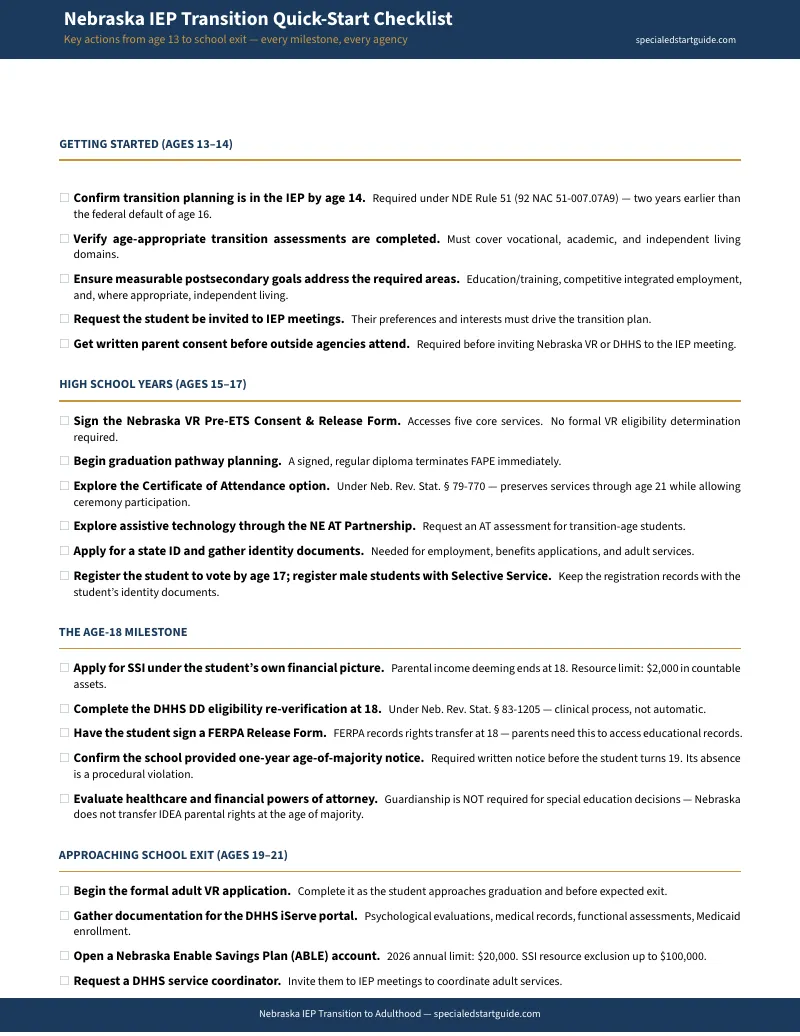
Download the free Nebraska Transition Planning Checklist to see the milestones and action items at a glance. When you're ready for the complete step-by-step system — with 8 printable worksheets, application walkthroughs, and the full Three-Agency Coordination timeline — the full guide is waiting.