Your child is approaching adulthood. Everyone says "get guardianship." Nobody is helping you figure out whether you actually need it.
The pediatrician mentioned something about HIPAA. The school transition coordinator brought up age-of-majority notices. A parent support group posted conflicting advice — some families hired attorneys for $2,500, others signed a couple of documents and moved on without any court involvement at all.
And then there's Nebraska's wrinkle: the age of majority here is 19, not 18. Your child can sign contracts and financial powers of attorney at 18, but can't execute a Healthcare Power of Attorney until 19. FERPA rights transfer at 18 even though state parental authority lasts another year. The school IEP team keeps asking what your plan is, but every resource you find covers one piece and ignores the rest.
The Dignity-First Decision Engine
This is not a "guardianship how-to" guide. It is a Dignity-First Decision Engine — a structured system for evaluating the full spectrum of legal tools available in Nebraska, choosing the combination that fits your child's actual abilities, and executing the paperwork with confidence.
The engine works because it starts where law firms and free resources do not: with your child's functional capacity across five specific domains — medical comprehension, financial management, residential safety, communication, and social judgment. Most families discover they need three or four targeted documents, not a single court order that strips every right at once. Nebraska law requires courts to impose the least restrictive arrangement, and this guide shows you how to build one.
What's Inside
- The Split-Age Majority Roadmap — Nebraska's age 18 vs. age 19 divide, mapped across contracts, healthcare consent, mental health treatment, FERPA, HIPAA, and special education rights. This is the chapter that stops you from filing the wrong document at the wrong time.
- The Supported Decision-Making Reality Check — Nebraska has no SDM statute (LB 1168 and LB 66 both failed), but courts and agencies still recognize informal SDM agreements. This chapter shows you how to draft a non-statutory SDM agreement and pair it with legally enforceable instruments so institutions actually honor it.
- The Power of Attorney Chapters — separate chapters for Durable Financial POA (executable at 18) and Healthcare POA (executable at 19), with execution requirements, key provisions to include, activation conditions, and worked examples showing how each one replaces a court-supervised arrangement.
- The Rule 51 Exception — Nebraska does not transfer IDEA parental rights at any age. You do not need a guardianship to attend IEP meetings or sign special education documents. This chapter explains why, what to do when school staff push guardianship anyway, and how to handle the FERPA gap at 18.
- The DHHS Waiver Transition Chapter — Nebraska cleared its DD waiver waitlist in August 2025, meaning families transition to active services at 19. If your child can't sign waiver plans independently, the entire service pipeline can stall. This chapter maps the signing authority solutions and the VR pre-employment transition timeline.
- The County Court Filing Walkthrough — if guardianship is necessary, every step from petition to post-appointment compliance: the four mandatory background checks ($85 fingerprinting, sex offender registry, credit report, DHHS central registry search), filing fees ($22–$44), sheriff notice service ($20–$50 per person), mandatory guardian education within 90 days, and annual reporting requirements ($5 filing fee per year).
- The Federal Benefits Chapter — SSI age-18 redetermination, the $2,000 resource limit, ABLE accounts (Enable Savings Plan, age threshold raised to 46 in 2026), the September 2024 food-rule ISM change, Disabled Adult Child benefits, and SSA Representative Payee setup. Plus how the WEP/GPO repeal under the Social Security Fairness Act affects Nebraska public employees' retirement and their children's auxiliary benefits.
- Emergency Guardianship — when to use it, the 90-day statutory limit, the LB 453 safeguards, and the mandatory path from temporary to permanent appointment.
- Seven Planning Worksheets — Functional Capacity Worksheet, Legal Authority Decision Flowchart, Transition Timeline Planner (12-month countdown to the 19th birthday), Court Filing Checklist, Agency Communication Log, Annual Reporting Reminder Checklist, and Lawyer-Ready Consultation Summary.
- The Nebraska Resource Directory — every state agency, advocacy organization, legal aid provider, and key court resource referenced in the guide, with direct links and contact information.
Who This Guide Is For
You are the parent of a Nebraska teenager with an intellectual, developmental, or psychiatric disability. The 18th or 19th birthday is somewhere between twelve months and a few weeks away. You need answers — not "it depends" answers from a forum thread, but structured, Nebraska-specific guidance that accounts for the legal, educational, financial, and medical dimensions all at once.
You may be a public school teacher or state employee whose retirement planning shifted when the WEP and GPO were repealed. You may be navigating the SSI age-18 redetermination and worrying about the $2,000 asset limit. You may be the parent whose DHHS service coordinator just asked who will sign the waiver renewal documents on your child's 19th birthday — and you don't have an answer yet.
This guide is built for all of those situations — and for the families who land somewhere in between.
Why Free Resources Fall Short
The Nebraska Judicial Branch publishes post-appointment reporting forms — but not the establishment forms you need to file the petition in the first place. Disability Rights Nebraska provides SDM templates and advocacy materials, but takes a strongly anti-guardianship posture that leaves families of children with severe cognitive impairments without a clear path forward. DHHS explains waiver eligibility without addressing the legal authority you need to sign waiver documents when your child lacks capacity.
None of them integrate the financial track with the legal track. None of them explain how Nebraska's split-age majority creates a two-step planning sequence that differs from every other state. None of them tell you that your IEP rights are already preserved under Rule 51 without any court action, or that the SSA's Representative Payee system operates completely independently of state guardianship courts.
The Dignity-First Decision Engine ties these systems together because Nebraska families do not experience them one at a time. The birthday triggers everything simultaneously.
100% Satisfaction Guarantee
If the guide does not help your family make a more confident, more informed decision about your child's transition to adulthood, email us for a full refund. No forms, no justifications, no time limit.
Start With the Free Checklist — or Get the Full Guide
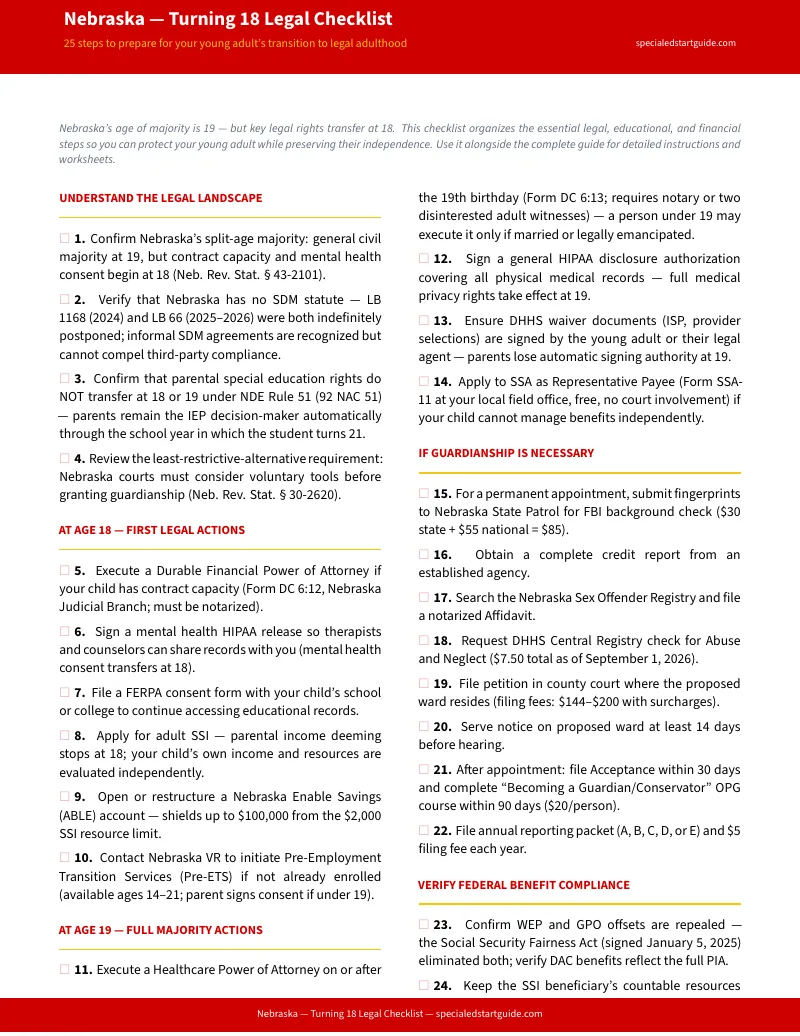
The free Nebraska — Turning 18 Legal Checklist gives you the sequenced action items. The full Nebraska Adult Guardianship & Alternatives Guide gives you the reasoning, the court filing walkthrough, the federal benefits chapter, the planning worksheets, and the 12-month transition timeline. Together, they replace the scattered browser tabs and conflicting advice with one clear path forward.
Frequently Asked Questions
What if the rules change after I buy?
We update the guide when the rules change. Email us any time, even years later, and we'll send you the current edition free.