Your child's IEP just said "transition." Now what?
You sit in the IEP meeting and the team starts talking about postsecondary goals, transfer of rights, and graduation pathways. You nod along, but inside you're thinking: when did the plan shift from helping my kid get through school to preparing them to leave it?
That shift is real, and in Minnesota it starts earlier than most parents expect — ninth grade or age 14, whichever comes first. From that point forward, your family is navigating three separate systems that don't coordinate with each other: the school district, DEED's Vocational Rehabilitation Services, and your county's human services department. Each one has its own application, its own eligibility rules, and its own timeline. None of them will tell you about the others.
The Transition Coordination System
The Minnesota IEP Transition to Adulthood Guide is a planning workspace built around Minnesota's actual transition structure — not generic federal IDEA summaries, not compliance checklists written for administrators. It maps every handoff point between the school IEP, VRS, and county services so you can see the full picture before you're standing in the gap between them.
Most free transition resources tell you what the law requires. This guide shows you what to do about it — which questions to bring to each meeting, which records to compile before your county assessment, and which decisions have permanent consequences for your child's eligibility.
What's Inside
- Grade-by-grade timeline from 9th grade through age 22 — every milestone mapped to what the school must do and what you should do, so nothing falls through the cracks during the years when the plan is quietly building
- Transition IEP construction chapter — how to write measurable postsecondary goals that actually reflect your child's interests, not the template language the school defaults to when nobody pushes back
- VRS and Pre-ETS referral walkthrough — the exact process for connecting your child to Pre-Employment Transition Services, when to request a formal VRS referral, and how the E1MN Common Referral Form works across agencies
- MnCHOICES and county waiver guide — how to request the county assessment, what documentation to bring, which waivers exist (DD, CADI, CAC, BI), and why your child's IEP eligibility has zero bearing on county eligibility
- Graduation pathway decision map — credit-based diploma vs. IEP-driven diploma, what happens to FAPE eligibility the moment your child accepts a regular diploma, and how "holding the diploma" works for 18–22 transition programs
- Transfer of rights at 18 — what the school's notification actually means, how Supported Decision-Making works as a real alternative to guardianship, and the specific legal changes that take effect on your child's birthday
- Federal benefits chapter — 2026 SSI thresholds ($994/month FBR, $1,690 SGA), the Student Earned-Income Exclusion ($2,410/month), and how Save with ABLE accounts protect up to $100,000 without jeopardizing SSI
- Dispute resolution roadmap — conciliation conferences, facilitated IEP meetings, and due process complaints, plus when each one is the right tool
- Eight standalone printable worksheets — transition record tracker, IEP meeting preparation form, MnCHOICES preparation checklist, agency communication log, Supported Decision-Making discussion guide, grade-by-grade transition timeline reference, key resources and contacts directory, and graduation pathway decision map
Who This Is For
This guide is for Minnesota families at three specific transition points:
- The first transition IEP (grade 9 / age 14) — you just learned the IEP has to include postsecondary goals and you need a system to track eight years of planning
- The transfer of rights notification (age 16–17) — you're deciding between Supported Decision-Making and guardianship, and you need to understand what each option means before the 18th birthday
- The service cliff (age 18–22) — your child is leaving or has left school and you're coordinating the handoff to county waivers, VRS employment services, and SSI
Why Not Just Use the Free State Resources?
PACER Center, MDE, and Disability Hub MN all publish excellent transition materials — and you should read them. The problem isn't that the information doesn't exist. The problem is that it exists in dozens of places, written for different audiences, using different terminology, with no single document that maps the sequence.
MDE's compliance documents are written for educators. PACER's guides cover individual topics in depth but don't connect them into a chronological workflow. VRS and county services each explain their own intake process without telling you how it relates to the school timeline. You end up with a stack of PDFs and no clear picture of what to do next.
This guide puts the sequence in one place — organized by your child's age and grade, connected across all three systems, with worksheets that help you prepare for each meeting before you walk in the door.
What This Guide Does Not Do
This guide does not provide legal advice, fill out official forms, or guarantee eligibility for any program. It cannot predict waiver availability or VRS acceptance. What it can do is help you organize your records, understand the right questions to ask, and prepare for intake meetings so you can advocate clearly and confidently for your child. For legal disputes, the guide directs you to the Minnesota Disability Law Center and PACER Center.
The Free Checklist
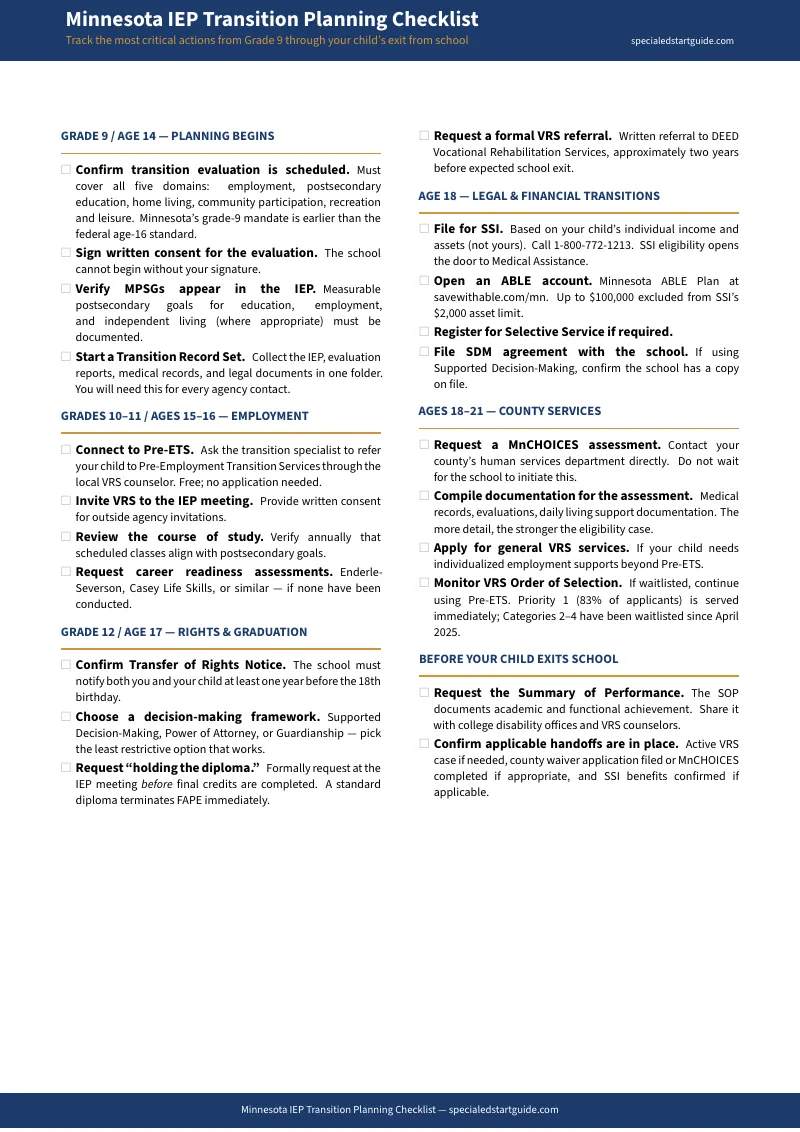
Not sure if you need the full guide? Start with the free Minnesota Transition Planning Checklist — a one-page milestone-by-milestone action list from grade 9 through age 22. It covers the key steps at each stage. The full guide expands every item into detailed chapters, worksheets, and agency-specific instructions.
Get the full Minnesota IEP Transition to Adulthood Guide and stop piecing together the transition plan from a dozen different sources. One workspace, every handoff, every deadline — organized around your child's timeline.