Your child's IEP just said "transition." Now what?
You sit in the meeting and the team mentions postsecondary goals, transfer of rights, graduation pathways. The school presents it like routine paperwork. But you know it isn't routine — because the decisions your family makes in the next few years will determine whether your child has structured support at 22 or is standing alone at the door of an agency that has never heard their name.
In Michigan, the gap between the school system and adult services is wider than it looks. Your child's IEP team manages their educational programming. Michigan Rehabilitation Services handles employment. Your county's Community Mental Health Services Program handles residential and behavioral health supports. Each agency has its own application, its own eligibility rules, and its own timeline. None of them will tell you about the others — and none of them will manage the handoff for you.
The Transition Coordination Workbook
The Michigan IEP Transition to Adulthood Guide is a chronological planning workspace built around Michigan's actual transition architecture — not generic federal IDEA summaries, not compliance checklists written for school administrators. It maps every handoff point between the IEP, MRS, and CMHSP systems so you can see the full picture before you're standing in the gap between them.
Most free transition resources explain what the law requires of the school. This guide shows you what to do about it — which questions to bring to each meeting, which records to compile before your county intake, and which decisions have permanent consequences for your child's eligibility.
What's Inside
- Age-by-age timeline from 14 through 25 — every Michigan-specific milestone mapped to what the school must do and what you should do, so nothing falls through the cracks during the years when the plan is quietly building
- Transition IEP construction chapter — how to write measurable postsecondary goals that actually reflect your child's interests, not the template language the school defaults to when nobody pushes back
- Michigan Merit Curriculum decision map — diploma vs. Certificate of Completion, the Personal Curriculum modification process, and the permanent consequence of accepting a regular diploma on special education eligibility
- MRS and Pre-ETS referral walkthrough — the exact process for connecting your child to Pre-Employment Transition Services at age 14, when to request a full VR case, and how the School Verification form (MRS-4.0b) works
- CMHSP and adult services guide — how to initiate the county intake, what documentation to bring, the 2026 MichiCANS and LOCUS assessment tools, and how MI Coordinated Health works for dual Medicare-Medicaid enrollees
- Transfer of rights at 18 — what the school's notification actually means, how Supported Decision-Making works as an alternative to guardianship, and the specific legal changes that take effect on your child's birthday
- Federal benefits chapter — 2026 SSI thresholds, the Student Earned Income Exclusion, and ABLE account rules including the expanded age-46 onset eligibility and ABLE-to-Work provisions
- Dispute resolution roadmap — facilitated IEP meetings, state complaints, mediation through SEMS, and due process hearings, plus when each tool is the right choice
- Ten printable planning tools — transition assessment tracker, Diploma vs. Certificate decision worksheet, transfer of rights planning worksheet, MRS/BSBP referral timeline, agency communication log, IEP meeting preparation checklist, SOP preparation checklist, SSI and benefits calculator worksheet, records retention checklist, and a fillable key contacts directory
Who This Is For
This guide is for Michigan families at three specific transition points:
- The first transition IEP (age 14–16) — you just learned that the IEP needs postsecondary goals and Pre-ETS eligibility is open, and you need a system to track years of planning across multiple agencies
- The transfer of rights notification (age 17) — you received the school's one-page notice and you need to understand your options before your child's 18th birthday changes the legal landscape
- The adult services cliff (age 18–25) — your child is in or nearing ISD Young Adult Services and you're coordinating the handoff to CMHSP, MRS employment services, SSI, and ABLE accounts
Why Not Just Use the Free State Resources?
Michigan Alliance for Families, Disability Rights Michigan, and the MDE all publish useful transition materials — and you should read them. The problem isn't that the information doesn't exist. The problem is that it exists in dozens of places, written for different audiences, using different terminology, with no single document that maps the sequence.
Michigan Alliance for Families publishes topic-specific PDFs and webinar recordings. Disability Rights Michigan provides legally thorough but compliance-focused guides designed for advocates, not families building a week-by-week plan. MDE compliance documents are written for district administrators. Each agency explains its own intake process without telling you how it connects to the school timeline or the other agencies.
You end up as the uncompensated case manager — assembling the chronology yourself from scattered PDFs, filling in gaps by trial and error, and hoping you haven't missed a referral window that closed while you were figuring out who to call.
This guide puts the sequence in one place — organized by your child's age, connected across all three systems, with worksheets that help you prepare for each meeting before you walk in the door.
What This Guide Does Not Do
This guide does not provide legal advice, fill out official forms, or guarantee eligibility for any program. It cannot predict waiver availability, MRS Order of Selection status, or CMHSP intake timelines. What it can do is help you organize your records, understand the right questions to ask at every meeting, and prepare for intake assessments so you can advocate clearly and confidently for your child. For legal disputes, the guide directs you to Disability Rights Michigan and Special Education Mediation Services (SEMS).
The Free Checklist
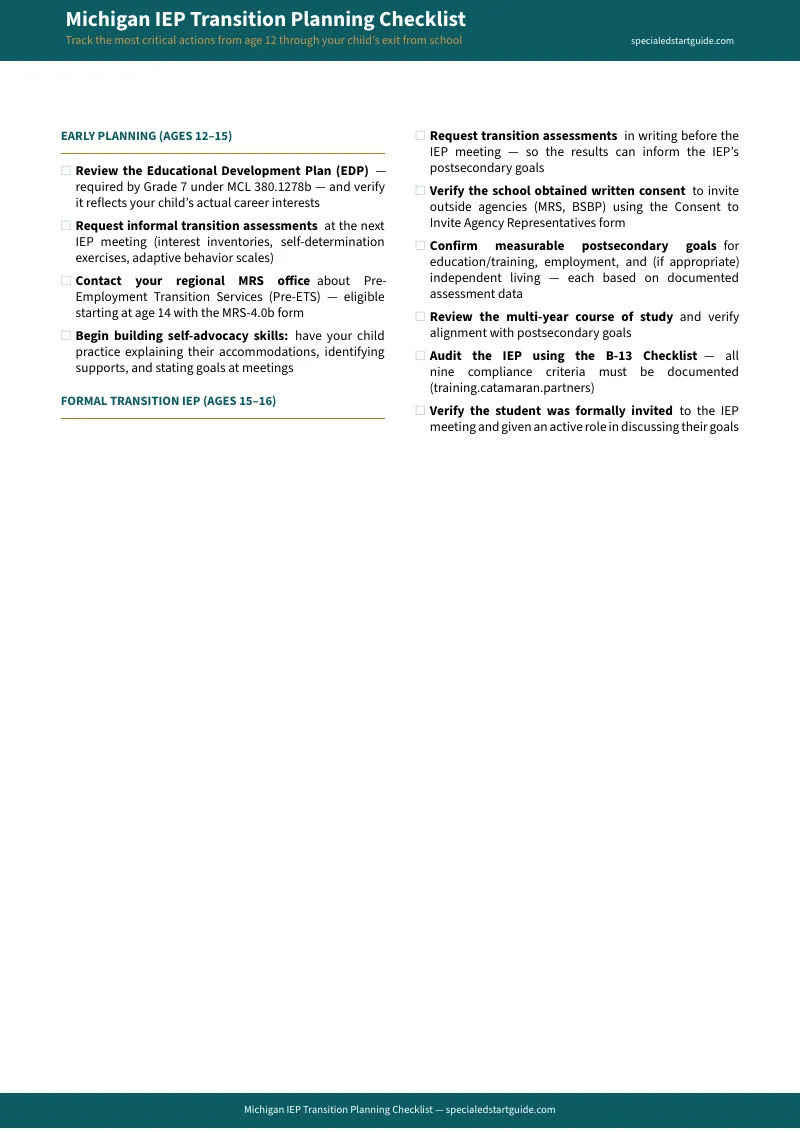
Not sure if you need the full guide? Start with the free Michigan Transition Planning Checklist — a milestone-by-milestone action list from age 14 through age 25. It covers the key steps at each stage so you can see the shape of the process. The full guide expands every item into detailed chapters, worksheets, and agency-specific instructions.
Get the full Michigan IEP Transition to Adulthood Guide and stop piecing together the transition plan from a dozen different sources. One workspace, every handoff, every deadline — organized around your child's timeline.