
Michigan Parents Don't Lose IEPC Meetings Because They're Wrong. They Lose Because Nobody Handed Them the MARSE Rulebook.
You walked into the IEPC thinking it was a planning meeting. It was a ritual. A pre-written document slid across the table. A string of staff reading sections aloud. A row of nods. A pen held out toward you. Somewhere between "placement" and "service minutes," you realized the decisions were made before you sat down — and now they want your signature to make it official.
You called Michigan Alliance for Families. They're lovely. They told you to listen actively, build partnership, keep collaborating. You read the Disability Rights Michigan manual — all 182 pages of it — and you still don't know what email to send tomorrow morning. The ISD claims the LEA made the decision. The LEA says the ISD controls the placement. And if it's a charter, the principal is quietly telling you the school "can't accommodate" your child's IEP — which is illegal, but nobody told you that either.
That gap between what the law says and what you can actually do with it tonight? That's where the district wins every time.
The Michigan MARSE Enforcement Playbook
The Michigan IEP & 504 Advocacy Playbook is a MARSE enforcement system — not another summary of your rights. Every template cites the specific Michigan Administrative Rule that triggers a legal obligation. Every script names the exact MARSE timeline the district is supposed to be hitting. Every strategy is engineered around Michigan's stacked LEA/ISD architecture, Michigan's participant-recording rule under MCL 750.539c (subject to school policy and private-place rules), and a Michigan-specific plan for using four dispute-resolution options: FIEP, SEMS mediation, an MDE state complaint, and MOAHR due process.
Michigan Alliance for Families teaches you how to hold hands with the district. This Playbook teaches you how to hold their feet to the MARSE timeline.
What's Inside the Playbook
The MARSE-Cited Dispute Letter Arsenal
Every letter quotes the Michigan rule that starts the clock. A written evaluation request starts the process; after the public agency receives signed parental consent, the 30-school-day offer-of-FAPE timeline begins under R 340.1721b. Request an Independent Educational Evaluation citing MARSE R 340.1723c — the agency must respond in writing within 7 calendar days by stating whether it intends to provide the IEE at public expense or initiate a hearing. A Prior Written Notice demand under 34 CFR 300.503 asks the district to document its proposal or refusal, the data it used, and the options it considered. "Federal law requires..." is a polite suggestion. "Under MARSE R 340.1721b, after it receives signed consent, the agency has 30 school days to issue an offer of FAPE or determine ineligibility; the parent and agency may agree in writing to an extension measured in school days" is a legal hook.
The IEPC Disruption Kit
Michigan calls the IEP team the Individualized Educational Planning Committee — the IEPC — and in most Michigan districts, the meeting is a rubber-stamp ceremony. The Playbook gives you the 3-school-day pre-meeting email requesting the draft IEP, recent MET reports, progress-monitoring data, the proposed PLAAFP, and evaluation reports, plus in-meeting phrases to request PWN when a requested service is refused. It also covers the MET-composition rule that lets you challenge an evaluation when team membership does not match the suspected disability. If the IEPC chair tries to run past you, you now have exactly what to say — on the record — to make them stop.
The Facilitated IEP (FIEP) Escalation Path
Most Michigan parents have never heard of the Facilitated IEP — a free, trained, neutral facilitator through Special Education Mediation Services who can help an IEPC stay focused when the team disagrees. Both parties must agree to use facilitation. The Playbook shows you when and how to request a FIEP, what to prepare, and how the FIEP fits into a wider dispute escalation ladder that ends at MOAHR due process. This is Michigan's most underused dispute tool — and a useful step before filing anything formal.
The MDE State Complaint Blueprint
The MDE publishes a complaint form, but it does not tell you how to write a complaint the MDE will actually investigate. The Playbook gives you the anatomy of a successful Michigan state complaint: tying a factual narrative to a specific MARSE rule, explaining the alleged violation, and requesting corrective action the MDE is empowered to order (compensatory services, district-wide policy change, mandatory staff training). The MDE must issue a final written decision within 60 calendar days after a complaint is filed. The OSE may extend that deadline for exceptional circumstances or when both parties submit a written extension request to use SEMS mediation. This is how you convert a pattern of district misconduct into enforceable state-level consequences.
The ISD vs. LEA Placement Battle Playbook
Michigan is unique: its stacked LEA/ISD structure can make placement responsibility confusing. An ISD may operate a center-based program, but the IEP team determines the student's programs and services. The resident district must conduct the initial IEP meeting and may authorize an operating district to conduct later meetings. If the LEA says "the ISD decided," the Playbook shows you how to ask the team to state the placement decision and each agency's role in writing. It also gives you FOIA language to surface placement policies and hold both agencies accountable for their part.
The Participant-Recording Strategy
In Fisher v. Perron (2022), the Sixth Circuit held that a conversation participant does not violate Michigan's eavesdropping statute, MCL 750.539c, by recording without the other participants' consent. That is not blanket permission to record any IEPC: school districts may regulate recording at IEP meetings, and MCL 750.539d separately restricts recording in a private place without the consent of people entitled to privacy there. The Playbook explains the case, the practical setup, when to disclose, how to check district policy and request an exception, and the narrower rules for remote meetings that cross state lines. State-funded mentors will never tell you this. District lawyers warn schools about it constantly.
The Charter School (PSA) Accountability Module
Michigan has ~300 charter schools (formally, Public School Academies). Under MARSE and IDEA they have identical special education obligations to traditional LEAs. Yet PSAs in Detroit, Grand Rapids, and Lansing routinely tell families they "can't accommodate" an IEP or suggest the child "might be happier somewhere else." That is unlawful counseling-out. The Playbook gives you the exact script that cites the PSA's federal FAPE obligation, the specific MDE complaint pathway that covers charter non-compliance, and the OCR option when the pattern is disability discrimination.
Manifestation Determination Review (MDR) Defense
For a student with an IEP, a disciplinary removal that changes placement requires an MDR within 10 school days under 34 CFR 300.530(e). A change of placement includes a removal of more than 10 consecutive school days or a pattern of removals totaling more than 10 school days that meets the criteria in 34 CFR 300.536. Districts routinely rush this meeting, ignore relevant evaluations, or pressure parents to waive rights. The Playbook gives you the pre-MDR preparation checklist, the questions that apply IDEA's two-part manifestation test, and the procedural moves that protect your child from disciplinary exile for symptoms of their own disability. Also covered: Michigan's restraint and seclusion reporting law (Public Act 394 of 2016) and how to use it.
MI-Access, Personal Curriculum & the Diploma Decision
Michigan's alternate assessment, MI-Access, is presented as a "better fit" for many special education students. What the IEPC doesn't always spell out is that MI-Access Functional Independence and Supported Independence participation can prevent your child from earning a regular Michigan high school diploma. The Playbook explains the three MI-Access tiers, when the Personal Curriculum is the right path to a diploma with modifications, and how to challenge an inappropriate MI-Access designation while Michigan special education eligibility is available through age 25.
MOAHR Due Process Strategy
When a dispute calls for a formal hearing, due process at the Michigan Office of Administrative Hearings and Rules is the formal hearing option. The Playbook explains the deadline to hold a resolution meeting within 15 calendar days after the due process complaint is filed with the MDE and received by the district, the burden of proof under Schaffer v. Weast (it rests on the party seeking relief), the documentary evidence a MOAHR ALJ will expect, and when due process is the wrong forum entirely. This is the chapter that saves you from filing a $40,000 case you were never ready to win.
Who This Playbook Is For
- Michigan parents whose district has missed the 30-school-day evaluation-to-FAPE deadline after receiving signed consent (unless the parent and public agency agree in writing to an extension measured in school days), the 7-calendar-day written-notice deadline on an IEE request, or the 15-school-day deadline to initiate the proposed IEP after the parent receives written notice of the initial FAPE offer or the public agency receives written parental consent to initial services (unless the parent files a due process complaint or the parties agree in the IEP to a later initiation date) — and you need to know exactly how to escalate
- Parents in DPSCD, Wayne, Oakland, Macomb, Washtenaw, Kent, Genesee, Ingham, or UP districts who've been told "the ISD decided" and you want to know what the ISD is actually legally required to do
- Parents in suburban Oakland, Washtenaw, or Livingston County fighting an ISD-pushed center-based placement when your child belongs in the neighborhood building with a 1:1 para
- Parents at Michigan Public School Academies (charters) being quietly counseled out because the school "can't support" an IEP it's federally required to implement
- Parents whose child is facing suspension, expulsion, or restraint/seclusion episodes and needs Manifestation Determination protections before the next incident
- Parents weighing whether to request a Facilitated IEP, file an MDE state complaint, go to SEMS mediation, or escalate to MOAHR due process — and who need the strategic map, not another legal treatise
- Parents preparing for a contentious IEPC next week who want the pre-meeting letter, the in-meeting script, and the post-meeting PWN demand ready before they walk in
Why Not Just Use the Free Resources?
Michigan has strong free resources. Michigan Alliance for Families (MAF) is empathetic and accurate. Disability Rights Michigan publishes one of the most comprehensive free legal treatises of any state. The MDE has Family Matters fact sheets. Here's why Michigan parents still lose after reading all of them:
- MAF emphasizes collaboration and early problem-solving. MAF is Michigan's federally funded Parent Training and Information Center; its role includes helping parents understand their rights and supporting parent participation. That's genuinely useful when the district is acting in good faith. The Playbook adds ready-to-send letters and scripts for parents who need to document a specific request and decide what to do next.
- The DRM manual is 182 pages of law school reading. It cites ALJ decisions, walks through MARSE rules, and surveys the dispute resolution landscape beautifully. It is also entirely unsuitable for a parent who has an IEPC scheduled for 8:30 AM Thursday. The Playbook is deliberately the opposite: short chapters, named templates, exact language, one action per page.
- Wrightslaw and national guides don't know Michigan. Wrightslaw is excellent on federal IDEA. It does not cover MARSE, the ISD system, Michigan's 7-calendar-day written-notice rule for IEE requests, MI-Access, Personal Curriculum, MOAHR, SEMS, or Michigan's participant-recording rule. When you cite a vague federal rule and the district's compliance officer knows MARSE gives them a more forgiving version, you've already lost the exchange.
- MDE Family Matters fact sheets explain the rules without the playbook. They describe the 60-calendar-day state complaint deadline (which can be extended for exceptional circumstances or a written agreement to request SEMS mediation) without telling you how to format the narrative so the MDE actually investigates. They describe procedural safeguards without telling you which safeguard to invoke on Monday morning. They dictate the game without giving you the moves.
Free resources teach you the rules. This Playbook teaches you how to enforce them — in Michigan, against Michigan districts, under Michigan law.
— Less Than Five Minutes with a Michigan Advocate
A Michigan special education attorney charges $250–$450 per hour. A private non-attorney advocate charges $100–$175 per hour, with an intake consultation running $150–$300 before they've even opened your file. A full MOAHR due process hearing with counsel costs a Michigan family an estimated $40,000–$50,000. And before any good advocate will take your case, they'll need the documented paper trail this Playbook helps you build in the first place — which means every hour you invest here directly offsets the billable hours you won't pay later.
Your download includes the complete Michigan Playbook guide plus standalone printable PDFs — every template, script, and reference card, ready to print and use this week.
- Complete Advocacy Playbook — 13 chapters covering the Michigan legal framework, procedural safeguards, IEPC disruption, evaluation and IEE demands, ISD placement battles, the full dispute forum ladder (FIEP / SEMS mediation / MDE complaint / MOAHR due process), charter/PSA accountability, discipline and Manifestation Determination, transition planning and MI-Access, documentation standards, regional realities across Michigan, and a Michigan resources directory
- MARSE Dispute Letter Templates — fill-in-the-blank enforcement letters citing the Michigan rule for every common trigger: evaluation request (R 340.1721b), records request under FERPA plus Michigan FOIA, Prior Written Notice demand (34 CFR 300.503), IEE request (R 340.1723c), and assessment-timeline-violation escalation
- IEPC Meeting Scripts — word-for-word language for the top district pushbacks every Michigan parent encounters, each anchored to a MARSE rule or MI-specific authority
- FIEP Request Package — the exact email to send to Special Education Mediation Services, the preparation worksheet, and the post-FIEP follow-up plan
- MDE State Complaint Template — the format the MDE actually investigates, with violation framing, MARSE citations, and corrective-action requests built in
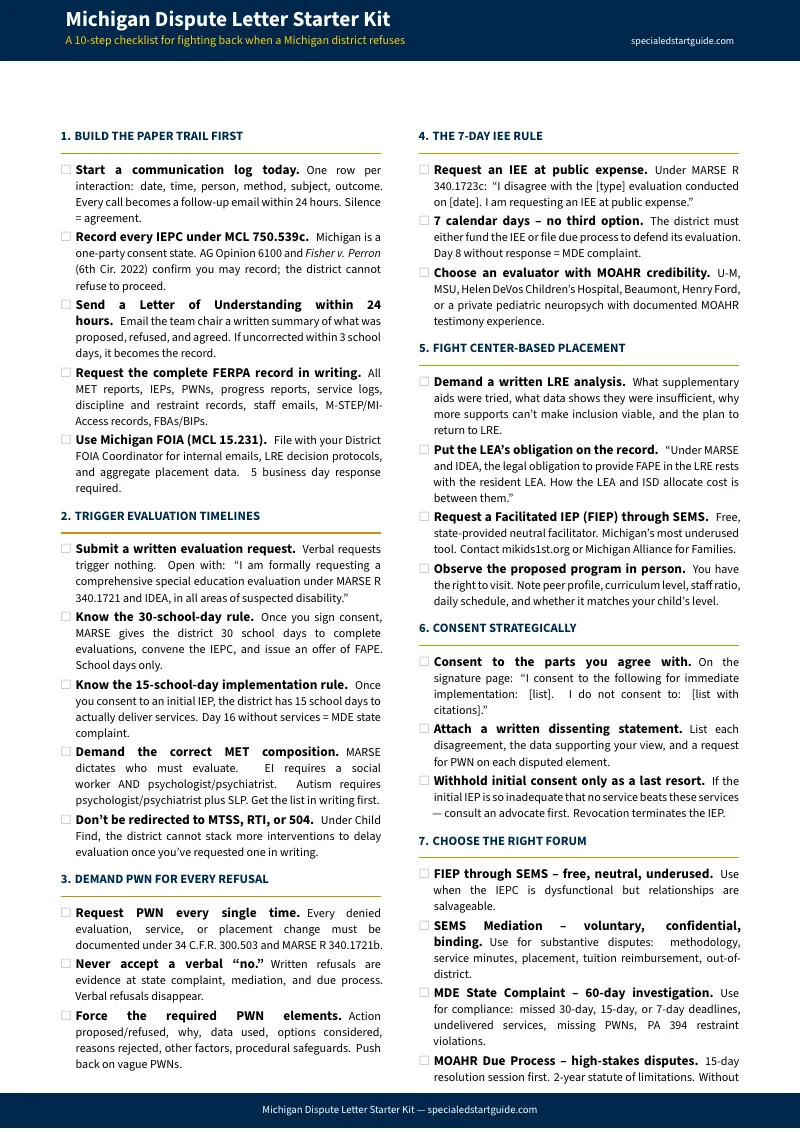
- Free Michigan Dispute Letter Starter Kit — a 10-step checklist with MARSE-cited request language, a key-timelines table, and steps for placement, discipline, charter, and transition issues
Instant PDF download. Fill in the first template tonight. Send it before the district's next MARSE deadline expires.
Full refund, no time limit. If the Playbook doesn't change how you handle your next IEPC or dispute with a Michigan district, email us for a full refund. No questions asked.
Not ready for the full Playbook? Download the free Michigan Dispute Letter Starter Kit — a 10-step checklist with MARSE-cited request language and a key-timelines table. It is enough to start building your paper trail tonight, and it's free.
The district is counting on you not knowing MARSE. After tonight, they'll have to deal with a parent who does.
Frequently Asked Questions
What if the rules change after I buy?
We update the guide when the rules change. Email us any time, even years later, and we'll send you the current edition free.