
The 18th Birthday Problem Nobody Warns You About
One morning your child is a student with an IEP, a care team, and parents who can call the doctor, sign the forms, and manage the bank account. The next morning — legally — they are a stranger whose medical records you cannot access, whose finances you cannot protect, and whose school meetings you may be told you have no right to attend.
Most families hear about this shift from a doctor, a school administrator, or a bank teller who says the same thing: "You need guardianship."
That advice is incomplete — and in Maryland, it is often flat wrong.
The Autonomy-First Decision System
Maryland enacted a comprehensive Supported Decision-Making Agreement statute in 2022. Circuit Courts now require evidence that less restrictive alternatives were explored before granting any guardianship petition. Filing without that evidence doesn't just waste money — a judge can deny the petition outright.
This guide builds your decision from the ground up, in the exact order Maryland law expects:
- Supported Decision-Making Agreements — the full Title 18 requirements, witness rules, and the statutory disclosures that make banks and hospitals honor the document. Includes what the 2025 Pughsley appellate ruling changed.
- Power of Attorney & Advance Directives — how to delegate financial and medical authority without court involvement, and the specific capacity threshold your child needs to meet to sign these documents.
- Maryland's IEP Exception — the one fact that most school administrators get wrong. Under Education Article § 8-412.1, your educational rights do not transfer at 18. This section gives you the exact statutory citation to hand to any administrator who says otherwise.
- Circuit Court Guardianship — when it is genuinely necessary, what the filing requires, the two clinical exams within 21 days, county-by-county filing fees ($165–$185), and the October 2026 assessment form overhaul that changes how capacity is documented.
- Limited & Emergency Guardianship — how to petition for authority over only the specific areas where your child needs help, preserving autonomy everywhere else.
- SSI, ABLE & Representative Payee — the age-18 redetermination process, 2026 benefit rates ($994/month individual SSI), the expanded ABLE onset age (now 46), the permanent ABLE-to-Work provision, and why the Social Security Administration does not recognize your guardianship order for managing benefits.
- Month-by-Month Transition Timeline — from the first DDA intake at age 14 through the GTYI waiver deadline at age 21, with every filing window, ID application, and DORS referral mapped to the calendar.
Who This Is For
- Parents whose child's 18th birthday is 6–12 months away and who need a clear comparison of every option before deciding whether court involvement is necessary.
- Families told "you need guardianship" by a school, hospital, or bank — who want to verify whether that advice is accurate under current Maryland law.
- Parents of adults already under guardianship who want to explore whether a less restrictive alternative is now legally viable.
- Transition coordinators and advocates working with Maryland families who need a single reference covering the full statutory landscape.
Why Free Resources Fall Short
Maryland families have access to excellent free resources — Disability Rights Maryland publishes sample forms, Parents' Place of Maryland runs workshops, and the Maryland Judiciary posts court-approved guardianship documents online. None of those resources are wrong. But none of them connect.
The free toolkit from Disability Rights Maryland tells you what an SDMA is. It does not tell you what to do if a bank refuses to honor one, which statutory provisions protect you, or how to structure the document so it covers the specific domains your child needs help with.
Parents' Place of Maryland explains supported decision-making concepts. It does not walk through how those concepts interact with the SSI age-18 redetermination, ABLE contribution limits, or DDA waiver timelines — because those are separate systems administered by separate agencies.
This guide stitches the full picture together: every alternative, every court procedure, every federal benefit interaction, and the specific Maryland statutory citations that give each document its legal force. You read one resource and understand the complete decision.
What the Free Checklist Covers
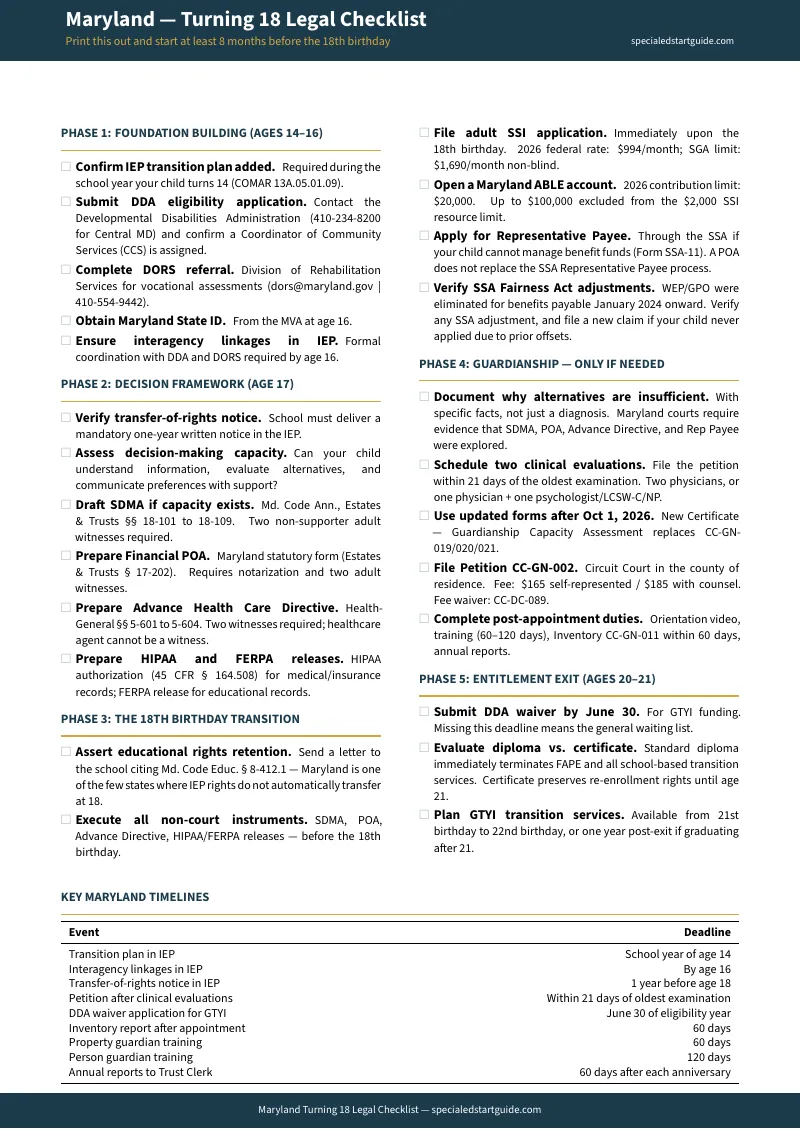
The free one-page turning-18 checklist gives you the key milestones and action items from age 14 through 21 — enough to see what is coming and start a conversation with your child's IEP team. The full guide goes deeper: statutory analysis, form-by-form execution instructions, benefit calculations, and the county-level cost details that turn a checklist into a plan — plus six print-and-use planning tools: the Guardianship Alternatives Decision Worksheet, SDMA Preparation Checklist, Transition Timeline Planner, Court Filing Document Tracker, Agency Communication Log, and Benefits and Asset Tracker.
Get the full Maryland Guardianship & Alternatives Guide →
Satisfaction Guarantee
If the guide does not give you a clearer picture of your options than what you had before downloading it, email us and we will refund your purchase — no questions, no forms, no waiting period.