Your child's IEP team just introduced transition planning. The school bus will stop coming — and no one gave you the calendar for what happens next.
Maine requires transition planning by age 14 — two full years before federal law mandates it. The state set the clock earlier because the system your child is about to enter is fragmented across five agencies, two fiscal calendars, and dozens of intake forms that don't share information with each other.
The Division of Vocational Rehabilitation handles Pre-ETS and employment services. The Office of Aging and Disability Services manages Medicaid waivers. The Social Security Administration runs redeterminations on its own schedule. Your school district operates September to June. The state agencies run July to June. And you're supposed to keep all of it synchronized while raising a teenager.
Free guides from the Maine DOE and Disability Rights Maine explain the statutes. They don't manage the calendar. They don't tell you that the timing of your DVR referral determines whether employment support is seamless or interrupted. They don't explain why accepting a standard diploma this spring terminates every school-based service your child receives — immediately, not at the end of the year.
The Transition Calendar System — Every Agency, Every Filing, Every Deadline from 14 to 22
The Maine IEP Transition to Adulthood Guide converts eight years of overlapping state and federal deadlines into a single chronological planning system. It doesn't replace the free resource booklets — it organizes them. Where the state tells you what the rules are, this guide shows you when to act, which agency handles it, and what happens if you miss the window.
What's Inside
- The complete MUSER timeline — ages 14 through 22 — every regulatory milestone organized chronologically with the lead agency, the statutory source, and specific action items so you know exactly what to file and when
- DVR and Pre-ETS navigation — how your child accesses Pre-Employment Transition Services as "potentially eligible" starting at age 14, the five core Pre-ETS services, and the formal referral timeline for individualized vocational support before graduation
- OADS waiver pathways decoded — Section 21 comprehensive services, Section 29 support services, the three-tier priority waitlist system, and the new Lifespan Waiver launching May 2027 with its single enrollment process and SIS-A-based participant groupings
- Transfer of rights preparation — the mandatory written notice your school must deliver a year before your child turns 18, and a decision framework for Supported Decision-Making agreements, Powers of Attorney, and guardianship under Maine's revised Probate Code
- The diploma-vs-certificate decision — the single choice that determines whether your child keeps school-based transition services through age 22 or loses them at graduation
- SSI and benefits coordination — the Age-18 Redetermination under the adult disability standard, 2026 Federal Benefit Rate and SGA thresholds, the 60-day appeal window, and Disabled Adult Child benefit eligibility for families with a retired, disabled, or deceased parent
- ABLE ME account setup — how to open an account through the Maine State Treasurer, the 2026 contribution limits, the ABLE-to-Work provision, and the $100,000 SSI exclusion threshold
- All five MUSER dispute resolution pathways — from facilitated IEP meetings through mediation, state complaints, and due process hearings, with filing timelines and strategic guidance for each
- College transition guidance — why IEPs are not accepted at Maine colleges, the clinical testing standards colleges require (WAIS-IV/WIAT-III), and how to time the final triennial evaluation so you don't pay thousands for private testing after graduation
- Ten fillable worksheets — Transition Planning Calendar, IEP Transition Meeting Checklist, Agency Communication Log, Evaluation Request Template, Supported Decision-Making Planning Worksheet, Benefits Eligibility Tracker, Multi-Agency Release Form Matrix, Diploma Decision Worksheet, Waiver Application Tracker, and SDM vs. Guardianship Comparison
Who This Guide Is For
This guide is for Maine parents navigating the IEP transition to adulthood — whether your child just turned 14 and the school introduced transition goals for the first time, or they're approaching 22 and you're scrambling to ensure adult services are in place before FAPE ends.
- You've been told your child should "start transition planning" but nobody gave you a calendar showing which agency needs what, and when
- Someone mentioned DVR and Pre-ETS but you can't tell whether your child qualifies or how to get started without triggering a full vocational intake
- You've heard about Section 21 and Section 29 waivers but nobody explained the priority levels, the waitlist dynamics, or how the Lifespan Waiver changes everything
- Your child is approaching 18 and you need to decide between SDM, Power of Attorney, and guardianship — and Maine's Probate Code requires the court to evaluate least-restrictive alternatives first
- The school sent a notice about transfer of rights and you didn't realize this was your countdown clock to establish legal protections
- You're coordinating IEP meetings, DVR referrals, OADS applications, and SSA paperwork on overlapping timelines that nobody aligned for you
Why the Free State Guides Aren't Enough
The Maine DOE publishes transition assessment toolkits. Disability Rights Maine provides legal explainers on educational rights and dispute resolution. The Maine Parent Federation offers parent training and peer support. These are all excellent — and none of them solve the coordination problem.
State agencies publish reference materials about their own programs. They don't publish a unified calendar that synchronizes school IEP meetings with DVR enrollment windows, OADS waiver application cycles, SSA redetermination timelines, and college accommodation deadlines. They explain their rules; they don't manage the handoffs between systems. That gap — between knowing the rules and executing the calendar — is where families lose months, miss windows, and face denials that could have been prevented with better timing.
This guide bridges that gap with a chronological planning system that tracks every agency, every deadline, and every piece of documentation from the day transition planning starts through the day school services end.
Your Guarantee
If this guide doesn't help you navigate the transition process, you get a full refund, with no time limit — no conditions.
Get Started Today
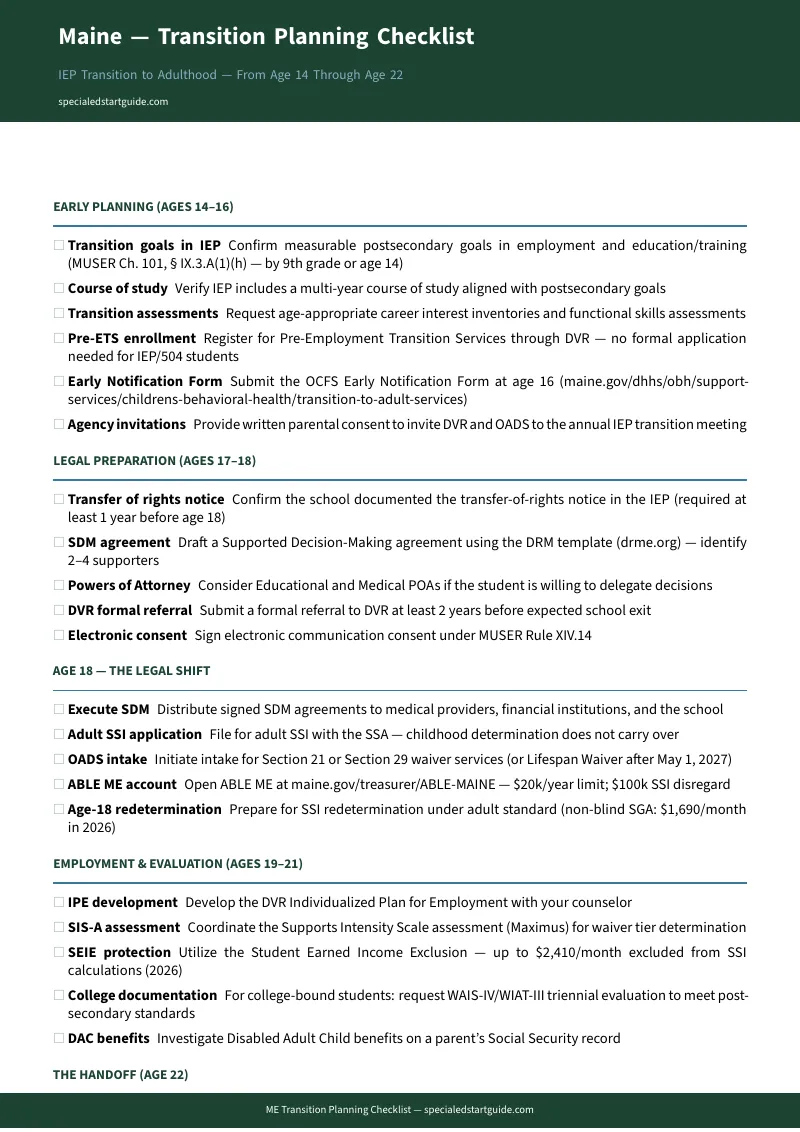
Download the Maine Transition Planning Checklist free — a printable summary of every critical filing deadline organized by age. Or get the full Maine IEP Transition to Adulthood Guide for — the complete 14-chapter planning system with ten fillable worksheets, dispute resolution guidance, and the unified timeline that keeps every agency, every filing, and every deadline in one place.
Frequently Asked Questions
What if the rules change after I buy?
We update the guide when the rules change. Email us any time, even years later, and we'll send you the current edition free.