
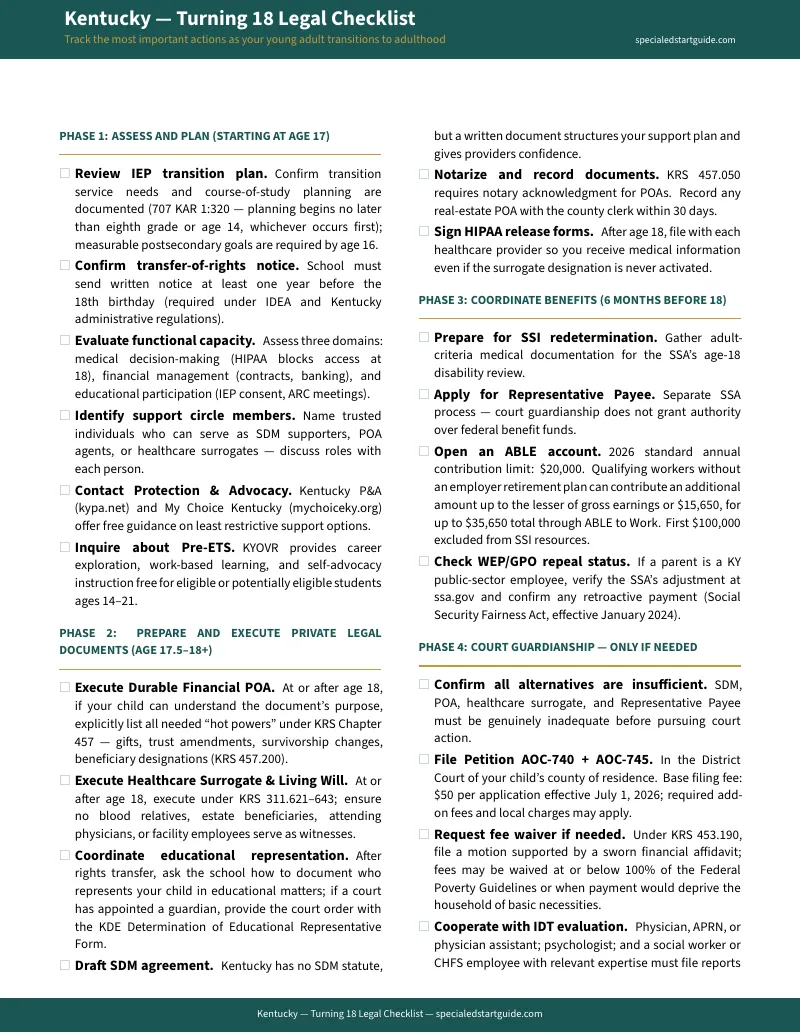
Your child is turning 18. Kentucky is about to treat them like any other adult.
On that birthday, every doctor, school administrator, bank, and government agency is legally required to treat your son or daughter as their own decision-maker. Your authority to sign consent forms, access medical records, manage benefits, or attend IEP meetings on their behalf ends — completely and without exception. No grace period. No automatic extension for disability.
For most parents, the instinct is to jump straight to guardianship. But Kentucky law is clear: guardianship must be used only as a last resort, "designed to encourage the maximum self-reliance and independence" of the individual. Full guardianship strips the right to vote, marry, drive, and make basic life decisions — and locks your family into permanent court oversight with mandatory jury trials, biennial financial accountings, and annual personal status reports.
The question isn't whether you need legal authority. It's which level of authority actually matches your child's needs — and how much of their civil rights you preserve while getting it.
The Less-Restrictive-First Framework
This guide is built around what we call the Less-Restrictive-First Framework — a structured method for evaluating your child's capacity domain by domain, mapping each area of need to the right legal instrument under Kentucky law, and executing the correct combination before the 18th birthday arrives.
Instead of one-size-fits-all advice, the framework walks you through five levels of legal authority — from informal supported decision-making through full court-supervised guardianship under KRS Chapter 387. A printable capacity worksheet helps you assess exactly where your child needs support (medical, financial, educational, residential) and which tools address each area. Many families discover they need two or three lighter instruments, not one heavy one.
What's Inside
- Capacity Decision Worksheet — a printable domain-by-domain assessment that helps you determine whether your child can sign contract-based instruments like powers of attorney, or whether the guardianship path is necessary
- Durable Power of Attorney Guide (KRS Chapter 457) — Kentucky POAs are durable by default, but certain "hot powers" require explicit statutory language to be legally valid. The guide identifies every hot power and shows you the exact wording required — because a POA without the right magic language can be rejected by the bank, hospital, or agency you need to deal with most
- Health-Care Surrogate Designation & Living Will (KRS 311.621–643) — step-by-step instructions for executing a valid healthcare surrogate designation, including Kentucky's specific witness restrictions (who cannot serve as a witness) and the living will directive for end-of-life decisions
- Educational Representative Guide (707 KAR 1:320) — how to use the district-level "Determination of Educational Representative" form so you can continue attending IEP meetings and making educational decisions after the automatic transfer of rights at age 18 — without court involvement
- Supported Decision-Making Guide — Kentucky has no formal SDM statute, but common-law SDM is recognized and practiced. The guide shows you how to structure an informal agreement, build a support network, and present it to third parties who may initially expect a court order
- Court Filing Roadmap + Petition Checklist — for families who do need limited or full guardianship: step-by-step petition preparation (AOC-740), fiduciary application (AOC-745), service-of-process timelines, what to expect from the six-person jury trial, and a fillable checklist for every required document
- Cost Calculator — a printable side-by-side comparison of first-year costs for voluntary instruments vs. District Court guardianship, including county-specific filing fees, surety bonds, court-appointed attorney costs, and interdisciplinary evaluation team fees
- Federal Benefits Integration — SSI age-18 redetermination preparation, representative payee vs. guardian comparison, ABLE account setup with 2026 contribution limits ($20,000 standard, onset age expanded to under 46), Disabled Adult Child benefit qualification, and how the Social Security Fairness Act changes planning for families with Kentucky public-sector pensions
- 12-Month Transition Timeline — a month-by-month countdown covering every deadline, from the school district's transfer-of-rights notification at age 17 through post-appointment fiduciary obligations
- Modification & Restoration Guide — instructions for using Petition AOC-795 to modify guardianship scope, restore rights, or replace a fiduciary as your child's capacity evolves over time
Who This Is For
- Parents whose child's 18th birthday is 6–12 months away and who need a clear plan before the legal shift hits
- Families who want to preserve their child's rights by exploring powers of attorney, health-care surrogates, and educational representatives before defaulting to guardianship
- Parents under pressure from schools or doctors who are being told "you need guardianship" and want to understand whether lighter alternatives would work in Kentucky
- Kentucky public-sector employees (teachers, police, firefighters) coordinating state pensions with Disabled Adult Child benefits after the WEP/GPO repeal
- Appointed guardians and conservators who need to file annual reports, biennial accountings, and the 60-day asset inventory
Why Free Online Resources Fall Short
The Kentucky Administrative Office of the Courts provides the raw petition forms (AOC-740, AOC-765, AOC-745) — but forms don't tell you whether you need to file a petition in the first place. Kentucky Protection & Advocacy publishes dense legal manuals, but they lack an actionable consumer decision matrix or practical checklists for coordinating SSI redetermination with private estate plans. My Choice Kentucky advocates for supported decision-making, but stops short of explaining what to do when SDM isn't enough — how to file for limited guardianship, what happens at the jury trial, or how to navigate post-appointment reporting.
This guide connects the pieces these resources leave disconnected. It integrates the school transition IEP timeline with the legal decision-making framework with the federal benefits preparation — in a single, chronological roadmap that shows how these systems interact and where the deadlines collide.
Satisfaction Guarantee
If the guide doesn't help you identify the right legal pathway for your family, email us at any time for a full refund. No forms, no hoops.
Get Started
Download the free Kentucky Turning-18 Legal Checklist to see the key milestones at a glance. When you're ready for the complete framework — capacity worksheets, POA and health-care surrogate instructions, court filing roadmap, and benefits integration — get the full guide for less than the cost of 15 minutes with an attorney.
The 18th birthday doesn't wait. The legal tools to prepare for it are available now — .
Frequently Asked Questions
What if the rules change after I buy?
We update the guide when the rules change. Email us any time, even years later, and we'll send you the current edition free.