Your child's IEP just said "transition." Now what?
You sit in the IEP meeting and the team starts talking about postsecondary goals, transfer of rights, and diploma pathways. You nod along, but the question forming in your mind is the one nobody in that room is answering: what actually happens when school ends?
In Kansas, that question is more urgent than you know. The state mandates transition planning by age 14 — two years earlier than federal law requires. Between that first transition IEP and the day your child's school eligibility expires on June 30 of the year they turn 21, your family will navigate three separate systems that do not coordinate with each other: the school district, Kansas Rehabilitation Services, and the CDDO-managed Medicaid waiver network. Each system has its own eligibility rules, its own application process, and its own timeline. None of them will explain how they connect to the others.
And behind all of it sits the number that changes every family's planning: the comprehensive I/DD waiver waitlist averages eight to ten years.
The Transition Coordination System
The Kansas IEP Transition to Adulthood Guide is built around the actual structure of Kansas's transition landscape — not generic IDEA summaries, not compliance checklists written for administrators, not a textbook designed for teachers who already know the system.
It maps every handoff point between the school IEP, KRS vocational services, and the CDDO waiver pathway so you can see the full picture before you are standing in the gap between them. Most free transition resources tell you what the law requires. This guide shows you what to do about it — which questions to bring to each meeting, which records to compile before each referral, and which decisions carry permanent consequences for your child's adult services.
What's Inside
- Age-by-age transition timeline from 14 through 21 — every milestone mapped to what the school must do and what you should do alongside it, because the district's compliance calendar does not account for the waiver waitlist, the VR referral window, or the guardianship decision at 18
- Transition IEP construction — how Kansas's measurable postsecondary goals work under K.S.A. 72-3429, why goals must describe actions after school exit rather than school activities, and how to push back on template language that meets compliance minimums but produces no actionable plan
- Diploma vs. certificate decision framework — the consequences of accepting a standard diploma (immediate FAPE termination) versus a certificate of completion (continued eligibility for 18–21 programming), mapped against your child's transition needs so you can have this conversation with data, not fear
- Transfer of rights at 18 — what shifts legally on your child's birthday, the written notification the school must provide by age 17, and a comparison of Supported Decision-Making, Power of Attorney, and guardianship so you choose the level of support that fits rather than defaulting to the most restrictive option
- KRS Pre-ETS and VR referral walkthrough — how to access free Pre-Employment Transition Services starting at age 14, the 18-month timeline for formal VR referrals before school exit, and what the Individualized Plan for Employment requires before your child's services end
- HCBS I/DD waiver and CDDO navigation — why early CDDO eligibility determination matters when the waitlist runs a decade, how Targeted Case Management bridges the gap while you wait, and what the Medicaid Functional Eligibility Instrument actually measures
- Community Support Waiver decision worksheet — the CSW's $20,000 annual spending cap, the permanent waitlist forfeiture trade-off, how enrollment priority works, and a structured framework for evaluating whether the CSW fits your child's current and projected needs
- College transition chapter — how disability accommodations shift from IEP entitlements to ADA-based reasonable accommodations, why a college will not read your child's IEP, and what documentation the disability services office actually requires
- Financial protections — SSI application at 18, Special Needs Trusts, Kansas ABLE Savings accounts (including the 2026 state Empowerment Grant), and how these interact with Medicaid and waiver eligibility
- Dispute resolution roadmap — mediation, due process complaints, and state complaints through KSDE, with guidance on when each tool is appropriate and where to find advocacy support through Families Together and the Disability Rights Center of Kansas
- Seven printable worksheets — Transition Planning Timeline, IEP Meeting Preparation Worksheet, Agency Communication Log, Diploma Decision Worksheet, Guardianship Alternatives Comparison Worksheet, Post-School Service Tracker, and Community Support Waiver Decision Worksheet
Who This Is For
This guide is built for Kansas families at three specific transition points:
- The first transition IEP (age 14) — you just learned the IEP has to include postsecondary goals and you need a system to track years of planning across multiple agencies that will not track it for you
- The transfer of rights notification (ages 16–17) — you are deciding between Supported Decision-Making and guardianship, navigating the SSI application, and trying to connect your child to VR services before the school-exit window closes
- The service cliff (ages 18–21) — your child is in or approaching the end of an 18–21 program, you are coordinating the handoff to CDDO services and community employment, and you need to know which waiver pathway protects their long-term funding
Why Not Just Use the Free State Resources?
KSDE, Families Together, KRS, and the CDDOs all publish transition materials — and you should read them. The problem is not that the information does not exist. The problem is that it exists in dozens of places, written for different audiences, using different terminology, with no single document that maps the sequence.
KSDE's compliance documents are written for district staff. Families Together's guides cover individual topics in depth but do not connect them into a chronological workflow. KRS explains its own intake process without telling you how it relates to the school timeline or the waiver waitlist. You end up with a stack of PDFs and no clear picture of what to do next — or, worse, when.
This guide puts the sequence in one place: organized by your child's age, connected across all three systems, with worksheets that help you prepare for each meeting before you walk in the door.
What This Guide Does Not Do
This guide does not provide legal advice, fill out official forms, or guarantee eligibility for any program. It cannot shorten the I/DD waiver waitlist or secure a VR placement. What it can do is help you organize your records, understand the right questions to ask at each meeting, and prepare for agency intake processes so you can advocate clearly and effectively for your child. For legal disputes, the guide explains how to access Families Together (Kansas's federally designated Parent Training and Information Center) and the Disability Rights Center of Kansas.
The Free Checklist
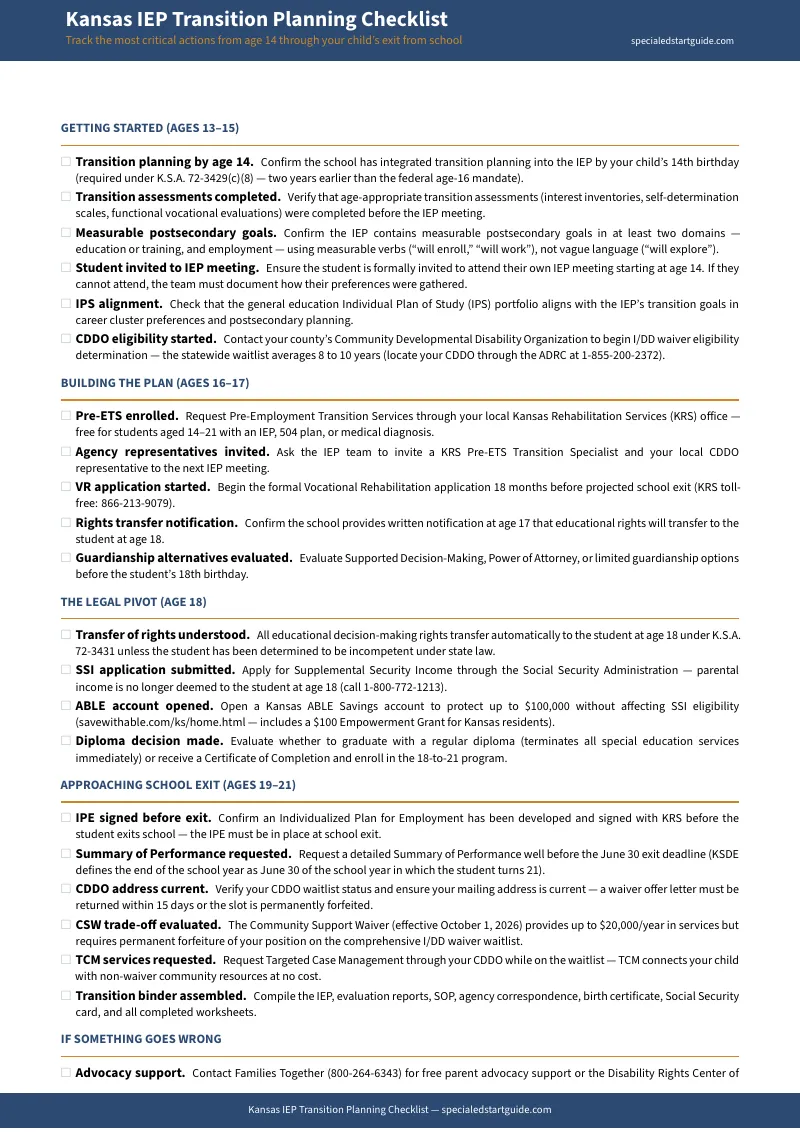
Not sure if you need the full guide? Start with the free Kansas Transition Planning Checklist — a two-page, age-by-age action list covering the key steps from 14 through 21. It shows you what to do and when. The full guide expands every item on that checklist into detailed chapters, decision worksheets, and agency-specific instructions.
Get the full Kansas IEP Transition to Adulthood Guide and stop piecing together the transition plan from scattered state resources. One workspace, every handoff, every deadline — organized around your child's timeline.