Your Child's IEP Team Handles School. Nobody Handles What Comes After.
Iowa starts transition planning at age 14 — two years earlier than the federal minimum. That sounds like a head start until you realize what happens next: the IEP team writes postsecondary goals, checks a compliance box, and moves on. Meanwhile, the adult service system your child is heading toward runs on entirely different rules. School services are an entitlement — your district must provide them. Adult services are eligibility-based, budget-capped, and rationed through waitlists that currently run approximately four years on the Intellectual Disability waiver alone.
No single agency coordinates the handoff. IVRS handles vocational rehabilitation but not waivers. Iowa HHS manages Medicaid waiver services but not employment. The Social Security Administration handles SSI but not school records. Each one tells you "that's not our area." And they're right — it isn't. The coordination falls entirely on you.
The Iowa Transition Coordination Sequence — that's what this guide is. It takes every school-side decision and every adult-side preparation and puts them in one chronological master sequence, connected by the worksheets that make each step completable rather than just understandable.
What's Inside
- The Complete Age-by-Age Timeline — every milestone from the first transition IEP at age 14 through the final school exit, with the specific actions, deadlines, and responsible agencies at each stage. Not a summary — the full operational sequence your IEP team is supposed to follow but rarely explains.
- The Graduation Pathway Decision Framework — a structured analysis of the regular diploma (with Iowa's 4-3-3-3 core requirements), the Certificate of Completion, and individualized graduation pathways. Includes a worked example showing exactly how the diploma timing decision plays out and why accepting a diploma too early permanently terminates FAPE eligibility.
- The Transfer-of-Rights Planning Workbook — Iowa law requires the school to notify student and parents of the transfer of rights by age 17, with the actual transfer occurring at age 18. The guide covers all three alternatives to full court-ordered guardianship: Educational Power of Attorney (with Iowa notarization requirements), Supported Decision-Making, and conservatorship — so you can choose and execute the right option before the 18th birthday.
- The IVRS and Pre-ETS Enrollment Guide — Pre-Employment Transition Services are available to Iowa students with disabilities ages 14 to 21 without a formal IVRS application — students can participate under "potentially eligible" status with a signed Pre-ETS Agreement. The guide covers all five Pre-ETS core areas, the timeline for moving from Pre-ETS to a formal IVRS referral and Individualized Plan for Employment (IPE), and the work-based learning programs: 4+ Services, Project SEARCH, and the Transition Alliance Program (TAP).
- The Medicaid Waiver and HOME Project Guide — Iowa is consolidating six diagnosis-based HCBS waivers into two age-based waivers under the HOME Project (Children and Youth Waiver for ages 0–20, Adults with Disabilities Waiver for ages 21+). The guide walks you through the Waiver Priority Needs Assessment (WPNA), the transition from SIS to CareStar/interRAI assessments, and the phase timeline — so you know exactly when your child's current waiver changes and what to document to maintain coverage.
- The Financial Planning Summary — a one-page worksheet for SSI Age 18 Redetermination documentation prep, IAble account structuring (including the ABLE to Work exception and Iowa's state tax deduction), and Iowa Code Chapter 634A Special Needs Trusts. Because one savings account opened without understanding the $2,000 SSI asset limit can cost your child their entire benefits eligibility.
- The Multi-Agency Handoff Checklist — a printable tracker for coordinating the transfer of records and services from the school district to IVRS, SSA, Iowa HHS, healthcare providers, and adult placement. Includes the specific documentation each agency requires and the order of operations to prevent gaps in coverage.
- The Dispute Resolution Reference — Iowa's three dispute pathways (mediation, state complaint, due process hearing), the two-year statute of limitations for due process complaints, compensatory education, and how to build a documentation file that supports each pathway.
Who This Is For
This is for Iowa parents navigating the IEP transition to adulthood — whether your child is approaching 14 and the school just mentioned "transition" for the first time, or your child is 19 and you're trying to figure out what replaces school services when FAPE ends.
- You need to decide between the regular diploma and a Certificate of Completion — and nobody has explained what each pathway means for your child's access to 4+ Services, college eligibility, and long-term benefits
- Your child is approaching 17 and you received the transfer-of-rights notice — and you don't know whether Educational Power of Attorney, Supported Decision-Making, or guardianship is right for your family
- Someone mentioned Pre-ETS or IVRS but you don't know how to access it, whether your child needs a formal application, or whether the school is supposed to make the referral
- You've heard about Medicaid waivers but the ID waiver waitlist is years long and nobody told you the HOME Project is changing the entire waiver structure during 2026–2027
- You're worried about SSI at 18, asset limits, and IAble accounts and you can't find a clear explanation of how they interact
- You've visited Transition Iowa, the ASK Resource Center, the Iowa DOE, and IVRS — and each gave you useful information about their piece, but nobody gave you the complete sequence connecting everything in chronological order
Why the Free Resources Aren't Enough
Transition Iowa, the ASK Resource Center, IVRS, and the Iowa Department of Education all produce genuinely valuable materials. The problem isn't quality — it's fragmentation. The ASK Resource Center publishes transition planning checklists organized by grade level, but they stop at the adult-services handoff. The Iowa DOE's secondary transition guidance is compliance-driven — written to satisfy Indicator B13 performance targets, not to tell families what to do next Monday. IVRS covers employment services but says nothing about guardianship alternatives or waiver timing. Iowa HHS explains waiver programs but doesn't connect them to the school exit timeline.
What doesn't exist in the public system is the single document that connects all of these into one chronological sequence — from the age-14 IEP where transition planning begins through the day school services end and adult services need to be operational. That's the gap this guide fills.
An independent special education advocate in Iowa charges $80 to $150 per hour. A special education attorney charges $250 to $500 per hour. An Iowa disability law firm charges $5,000 or more to start a guardianship proceeding. This guide costs a fraction of a single professional consultation — and it gives you the organized sequence that lets you handle most of the coordination yourself, and hand professionals an organized case when you do need them.
Satisfaction Guarantee
Money-back guarantee, no time limit. If the guide doesn't change how you prepare for your child's transition, you get a full refund. No conditions, no hoops.
Get Started
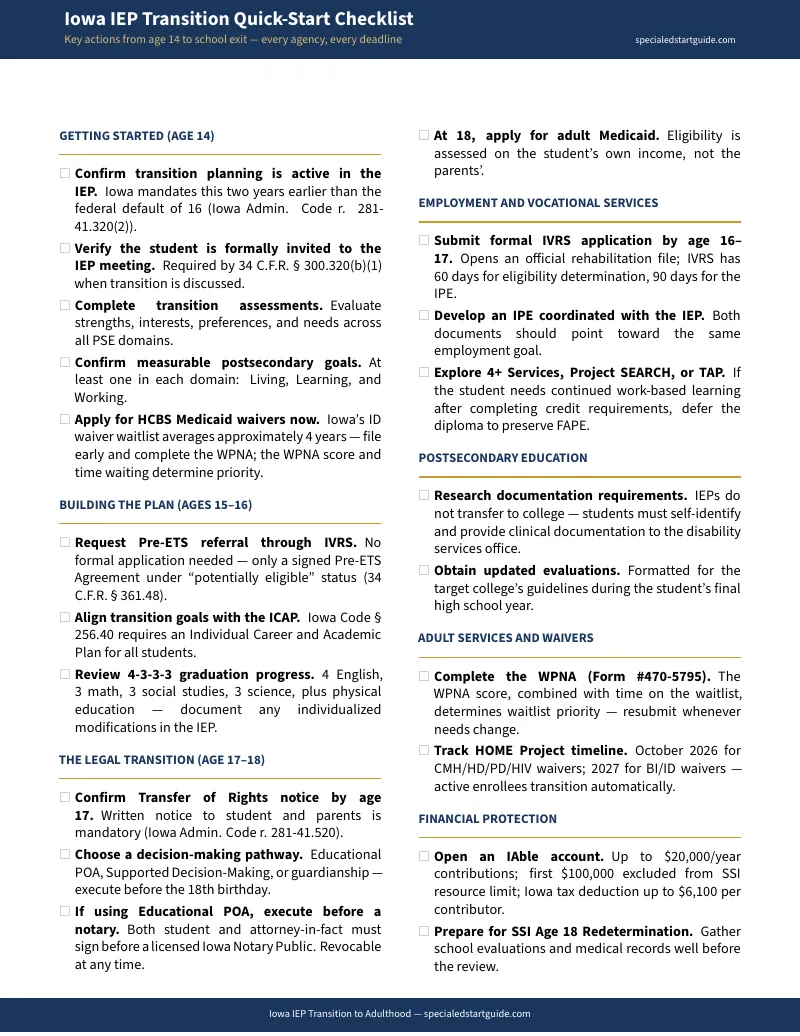
Download the free Iowa Transition Planning Checklist — the two-page timeline organized by age milestone with the critical actions, deadlines, and responsible agencies at each stage. Or get the complete Iowa IEP Transition to Adulthood Guide — the 49-page, 12-chapter guide plus nine printable worksheets (timeline tracker, IEP meeting prep, agency log, diploma decision, transfer-of-rights workbook, WPNA prep, college documentation, financial planning summary, and multi-agency handoff) covering Iowa's age-14 mandate, graduation pathways, transfer of rights, IVRS enrollment, Medicaid waivers and the HOME Project, financial protection, dispute resolution, and the multi-agency handoff — everything you need to coordinate the transition that no single public agency will coordinate for you.
Frequently Asked Questions
What if the rules change after I buy?
We update the guide when the rules change. Email us any time, even years later, and we'll send you the current edition free.