Your child turns 18. Illinois law presumes they're a fully independent adult. What's your plan?
On that birthday, every legal right you've held since birth transfers to your child — medical decisions, financial control, educational authority, all of it. The school district sent the ISBE Form 34-57i notice. The pediatrician's office warned about HIPAA. You started researching guardianship and found attorney fees of $4,500 or more, county courts that each run their own way, and enough legal jargon to fill a semester.
But most Illinois families don't need court-ordered guardianship. Illinois enacted one of the strongest Supported Decision-Making statutes in the country in 2022. The question isn't "do we need a guardian?" — it's "which combination of legal tools matches our child's actual needs?"
That's the question no one walks you through — until now.
The Dignity-First Transition Blueprint
This guide is built around a single framework: start with the least-restrictive option, evaluate your child's capacity domain by domain, and only move toward court intervention when the evidence shows it's genuinely necessary. Every chapter follows the Illinois Probate Act's own requirement that courts consider the least-restrictive alternative before appointing a guardian.
Instead of handing you a stack of forms and wishing you luck, the guide walks you through a structured decision process — worksheets, scripts, timelines, and county-specific instructions — so you know exactly what to file, where to file it, and what to say when an institution pushes back.
What You Get
Decision worksheets that replace guesswork with structure. You'll assess your child's capacity across five domains — medical, financial, educational, residential, and social — and map each domain to the right legal tool. No more defaulting to plenary guardianship because someone told you it was the only option.
The complete Illinois SDMA walkthrough. The 2022 Supported Decision-Making Agreement Act (755 ILCS 9) lets your child keep their legal rights while designating supporters who help them understand options and communicate decisions. The guide covers who can serve as a supporter, the execution requirements (two witnesses, no notary), how to unlock record access under the statutory release provisions, and — critically — what to do when a hospital compliance department refuses to recognize the agreement.
A Power of Attorney toolkit that addresses the capacity question head-on. The Healthcare POA under 755 ILCS 45/4-10 and the Property POA under 755 ILCS 45/3-3 are powerful tools, but they require your child to meet a cognitive threshold. The guide explains that threshold in plain language, helps you determine whether your child can meet it, and shows you what to do if they can't — instead of wasting time on documents that would be legally void.
The ISBE educational delegation form, decoded. ISBE Form 34-57K lets your child delegate educational decisions back to you without a court order — but schools don't always explain it clearly, and the form needs to be coordinated with your other legal instruments. The guide also covers the PUNS database registration window that many families miss.
County-by-county probate court navigation. Illinois has over 100 circuit courts, and filing fees, procedures, and attitudes toward pro se filing vary significantly. The guide maps the process for Cook County ($50 person-only filing, mandatory background screening, $23 plus mileage for sheriff service), DuPage ($300), Kane ($314), Lake, and Will — with the e-filing portal instructions that make courts accept your paperwork the first time.
Institutional resistance scripts. The biggest real-world hurdle isn't the legal paperwork — it's the compliance department at the hospital, the registrar at the college, or the banker who tells you they "don't accept that document." The guide includes citation-backed scripts for healthcare systems (invoking 755 ILCS 9/30), post-secondary FERPA access, and financial institutions (invoking the Illinois POA Act), so your child's legal instruments actually work in practice.
The court process, step by step. If guardianship is genuinely necessary, the guide walks you through every stage: securing the physician's report (within the 3-month admissibility window), preparing the petition, service of summons, the Guardian ad Litem investigation, Cook County background screening, the hearing itself, and receiving Letters of Office. No surprises at the courthouse.
Ongoing compliance mapped out. Guardianship doesn't end at the hearing. Annual status reports, financial accountings, surety bonds, and the mandatory GAC online training (required in counties under 3 million population — Cook County is exempt from the statutory mandate) add up. The guide includes a worked first-year cost summary so you know what you're committing to before you file.
Benefits protection that prevents the $2,000 trap. SSI, Medicaid, ABLE accounts, and Supplemental Needs Trusts each have their own rules — and one wrong move can disqualify your child from the benefits they depend on. The guide covers the SSI representative payee application (Form SSA-11-BK), the 2026 ABLE contribution limits, expanded eligibility rules, and how to structure assets so your child's savings don't trigger benefit loss.
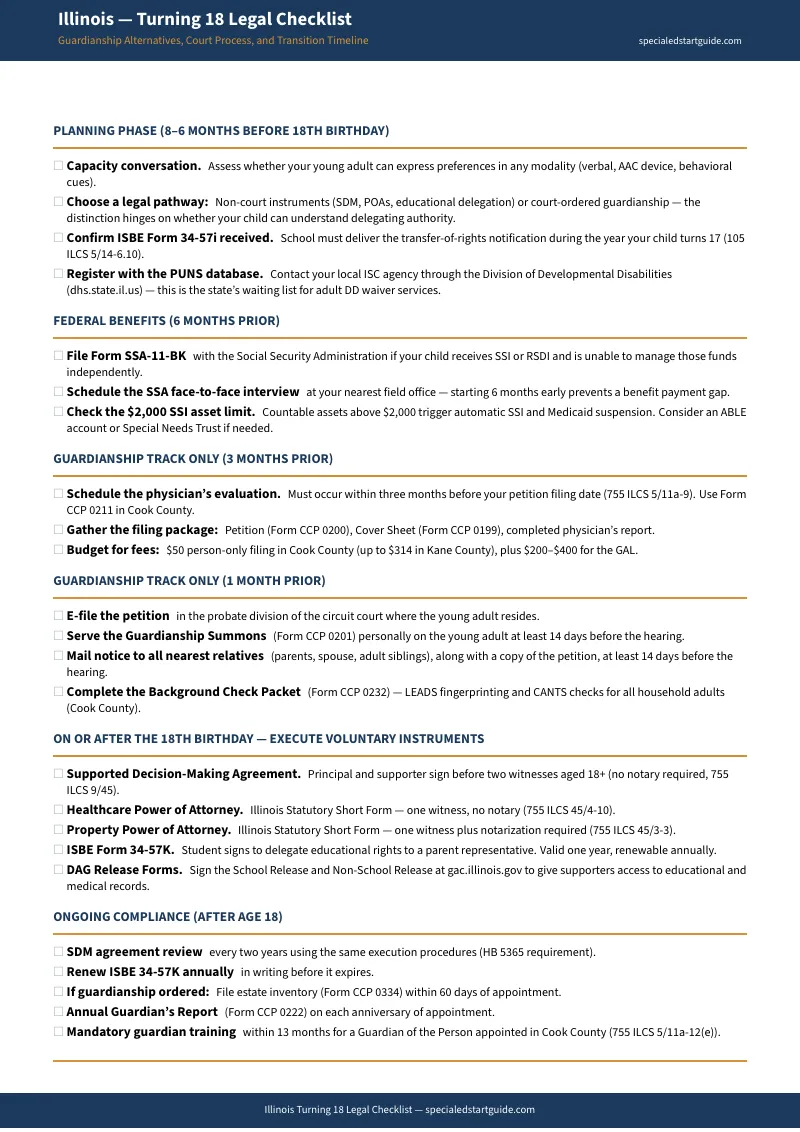
The eight-month timeline. A chronological planning sequence from eight months before the birthday (screening and planning) through the birthday itself (executing voluntary instruments) and beyond (ongoing compliance). Every deadline, every application window, every filing — in order.
Who This Is For
- Parents who received the ISBE transfer-of-rights notification and need to determine whether their child needs guardianship — or whether an SDMA paired with powers of attorney preserves their autonomy while still protecting them
- Families whose child can make many decisions independently but needs structured support with medical, financial, or educational choices
- Parents who've been told "just get guardianship" and want to understand the alternatives before committing to a probate court process
- Anyone who's priced guardianship attorneys at $4,500 to $15,000 and wants to determine whether court is even necessary — and if it is, walk in fully prepared to save billable hours
- Families navigating SSI redetermination at 18, representative payee designation, and ABLE account setup alongside the guardianship decision
Why This Isn't Covered by Free Resources
The Illinois Guardianship and Advocacy Commission provides statutory forms and fact sheets. Illinois Legal Aid Online offers guided document assembly. Both are excellent starting points — but they solve a different problem.
GAC's SDMA template doesn't explain how to coordinate the agreement with your child's IEP team or what to say when a bank compliance department refuses to honor it. ILAO's guardianship forms don't cover the SSI redetermination timeline or help you determine whether you even need to file. Neither source maps the county-by-county filing differences, the GAL deposit requirements, or the mandatory guardian training rules that vary by county population.
This guide connects every tool into one planning sequence: the capacity assessment that determines your starting point, the legal instruments that match your child's profile, the court process if it's necessary, and the benefits protection that runs in parallel. That's the integration gap — and it's the reason families end up with forty bookmarked tabs and no plan.
Satisfaction Guarantee
If the guide doesn't help you build a clearer plan for your child's 18th birthday transition, email us and we'll refund your purchase — no conditions, no time limit.
Get Started
Download the free Illinois Turning-18 Legal Checklist to see the 25-item chronological sequence for your child's transition. When you're ready for the worksheets, scripts, court process walkthrough, and county-specific instructions that turn that checklist into a plan, the full guide is waiting.