The School District Filed the Transition Plan. Your Child's Future Depends on What Happens Next.
The IEP team checked the transition boxes. They wrote a postsecondary goal that says "The student will obtain employment after graduation." They referenced an interest inventory your teenager filled out during homeroom. They marked Indicator 13 compliant. And then they moved on to the next student.
What they did not do: contact GVRA to start a Pre-Employment Transition Services referral. Explain that a standard diploma terminates every special education entitlement the moment it is awarded. Tell you that the DBHDD waiver planning list is not a chronological queue and that a student can wait six years past age 22 if nobody documented the urgency correctly. Or mention that every legal decision-making right transfers to your child on their 18th birthday — and that you have roughly twelve months to petition probate court if guardianship is necessary.
Georgia's school system measures transition compliance by whether the paperwork exists, not whether the plan actually connects your child to funded adult services. Indicator 13 is a checkbox audit. A perfect compliance score and a usable transition plan are two completely different things.
The Transition Sequence Blueprint is the chronological bridge between what the school files and what your child actually needs — a year-by-year administrative playbook that maps every Georgia-specific agency, deadline, and application procedure from ninth grade entry through the age-22 exit.
What's Inside the Blueprint
The Chronological Transition Sequence
Georgia requires transition planning to begin at entry to ninth grade or by age 16, whichever comes first (Ga. Comp. R. & Regs. R. 160-4-7-.06). For a student entering ninth grade at 14, that means the clock starts two years before most families realize it. The Blueprint maps every milestone from that first transition IEP through the final Prior Written Notice when services end — with the exact Georgia statute, agency form, and application portal at each step. No more piecing together fragments from Parent to Parent of Georgia fact sheets, GaDOE implementation manuals, and county school websites that haven't been updated since 2019.
The Georgia Graduation Decision Matrix
Georgia has four graduation pathways, and the one your child chooses determines whether special education services end at graduation or continue through age 22. Most families learn this too late. The Standard Regular High School Diploma terminates FAPE — it is a formal change of placement under 34 CFR §300.102(a)(3). The State-Defined Alternate Diploma, designed for students with significant cognitive disabilities assessed via GAA 2.0, is standard-aligned and counts toward graduation rates but does not terminate FAPE eligibility. The Blueprint builds a side-by-side comparison of all four pathways — standard diploma, special education diploma, certificate of attendance, and alternate diploma — mapped against their consequences for GVRA eligibility, college accommodations, Medicaid, and DBHDD waiver access.
The GVRA Pre-ETS Self-Referral Protocol
Students with disabilities can access free Pre-Employment Transition Services through GVRA starting at age 14 under "potentially eligible" status — no formal VR application required. Most families never hear about Pre-ETS until age 17 or 18, wasting three years of funded job exploration, work-based learning, and self-advocacy instruction. The Blueprint provides step-by-step self-referral instructions through the GVRA portal, explains the five federally mandated Pre-ETS services, and shows you how to embed Pre-ETS activities directly into the IEP Transition Service Plan so the school district is legally obligated to coordinate with GVRA staff.
The DBHDD Waiver Application Blueprint
If your child has an intellectual or developmental disability, the NOW and COMP waivers fund in-home and community-based support services after school ends. The planning list for these waivers is not first-come, first-served — it is prioritized by clinical urgency and caregiver capacity, assessed through a most-in-need questionnaire. A student can wait six or more years past age 22 if their needs are rated low, while a younger student in a caregiver crisis can receive funding immediately. The Blueprint explains exactly how the assessment works, how to respond to annual planning list contact letters without accidentally understating your child's support needs, and the operational differences between the NOW waiver and the higher-intensity COMP waiver — including Participant Direction, which lets you hire your own staff and control your own budget.
The Age-18 Legal Transition Toolkit
On your child's 18th birthday, every legal decision-making right transfers from you to them — automatically. The school must deliver a formal Transfer of Rights notice at age 17. If your child cannot manage their own medical, financial, or educational decisions, you have roughly twelve months to petition the Georgia probate court for guardianship or set up alternatives: supported decision-making agreements, healthcare proxies, or financial powers of attorney. The Blueprint walks through each option, explains the probate court timeline, and helps you decide which level of legal protection fits your family without defaulting to the most restrictive option.
The Adult Benefits Survival Guide
At age 18, SSA re-evaluates your child's disability under adult standards. Many families lose SSI benefits at this stage because they do not understand the adult disability determination process or fail to submit the right documentation. The Blueprint covers the age-18 SSI redetermination step by step, explains Georgia's Section 1634 automatic Medicaid enrollment for SSI recipients, details the Pickle Amendment and Disabled Adult Child protections that preserve Medicaid even if SSI changes, and provides the complete setup guide for Georgia STABLE accounts — including the ABLE Age Adjustment Act's expanded eligibility (onset age raised from 26 to 46 as of January 1, 2026) and the rule allowing up to $100,000 in savings without affecting SSI benefits.
Measurable Goal Guidance
A transition goal that reads "The student will get a job" satisfies Indicator 13 but generates zero actual services. The Blueprint shows you how to write measurable postsecondary goals across all three required domains — education/training, employment, and independent living — each directly tied to a specific Georgia agency service or community resource. When goals are measurable and agency-linked, they force the IEP team to coordinate with GVRA and DBHDD rather than writing aspirational language and marking the box.
Who This Guide Is For
- Parents whose child's IEP just added the word "transition" for the first time — and who need to know which steps to take now, not at graduation
- Parents of college-bound students on the standard diploma track who need to understand that IEP accommodations do not carry into college and that the shift from IDEA to ADA changes everything
- Parents of students with significant cognitive disabilities who are navigating the DBHDD waiver planning list and need to understand how clinical urgency scoring actually works
- Parents in rural Georgia — where public transportation is virtually non-existent and the nearest GVRA counselor may be in another county — who need strategies for remote agency coordination and virtual Pre-ETS access
- Parents approaching the age-17 transfer of rights deadline who have not yet explored guardianship, supported decision-making, or power of attorney options
- Parents whose child is 18 or older and still enrolled, approaching the age-22 exit — and who need the adult-services handoff sequence mapped before FAPE ends
- Parents who have been through multiple transition IEP meetings and suspect the plan is compliance theater — checking boxes without connecting their child to a single funded adult service
Why Not Just Use the Free Resources?
Georgia has legitimate free transition resources. Parent to Parent of Georgia publishes fact sheets. GaDOE posts implementation manuals. GVRA maintains a referral portal. Here's the problem:
- The information is scattered across dozens of agencies and hundreds of documents. Parent to Parent of Georgia alone has hundreds of individual PDFs, webinar recordings, and resource directories. GVRA has its own portal. DBHDD has its own intake process. SSA has its own redetermination procedure. An exhausted parent must spend dozens of hours piecing these fragments into a coherent timeline — and still miss critical connections between them.
- School checklists perpetuate dangerous myths. Multiple Georgia county district timelines state that DBHDD waiver funds "are typically not provided until the student turns 22" or imply that aging out automatically activates waiver services. Both are false. The planning list is clinically prioritized, not age-triggered. A family that waits until age 22 expecting automatic activation may discover a six-year wait with no funded services.
- Compliance-oriented documents do not teach execution. GaDOE's implementation manuals tell you the rules exist. They provide zero tactical instruction on how to self-refer for Pre-ETS, how to write measurable goals that force agency coordination, or how to respond to the DBHDD annual planning list letter without inadvertently lowering your child's urgency rating.
- National publishers miss every Georgia-specific nuance. Wrightslaw and other national resources provide excellent general IDEA guidance. They do not cover Georgia's ninth-grade transition trigger, the State-Defined Alternate Diploma's FAPE preservation, Georgia's STABLE account enrollment through the Ohio consortium, or the GVRA-specific referral process. A family following generic federal guidance will miss the state-level procedures that determine their actual outcome.
The free resources explain the rules. The Blueprint organizes the rules into a chronological action plan — with every Georgia-specific form, portal, and deadline in one place.
— Less Than One Hour of a Private Advocate
Private special education advocates in Georgia charge $75 to $200 per hour. Attorneys run $250 to $500 per hour. Even if you eventually need professional representation, the organized paper trail and agency coordination you build with this Blueprint saves thousands in billable hours — because you're handing your advocate a documented case, not a shoebox of unsigned IEP copies and half-remembered transition meetings.
Your download includes the complete transition guide plus 8 standalone printable planning tools:
- Complete Transition Guide — 14 chapters covering Georgia's transition system, the grade-by-grade timeline, diploma pathways, postsecondary goal writing, GVRA and Pre-ETS, DBHDD waivers and the planning list, the transfer of rights, SSI redetermination, Georgia STABLE accounts, supported employment, college accommodations, legal protections, the age-22 exit sequence, and a Georgia resources directory
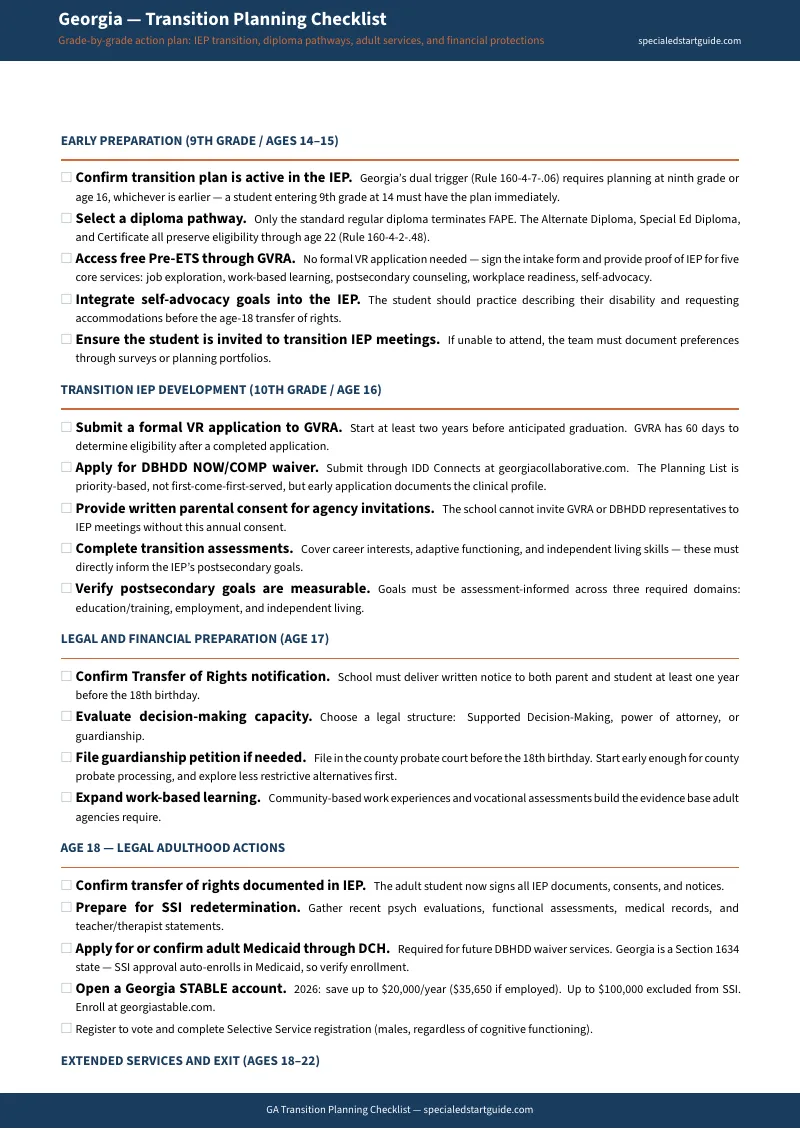
- Transition Planning Checklist — chronological checklist organized by age milestones from 14 to 22, covering every application, deadline, and agency contact in order
- Transition Timeline Tracker — year-by-year action plan with columns for responsible party, deadline, and completion status
- Agency Communication Log — running record of every contact with GVRA, DBHDD, SSA, and the school district
- Diploma Pathway Decision Worksheet — side-by-side comparison of Georgia's four credential options mapped against your child's goals
- DBHDD Planning List Status Tracker — log for tracking Regional Field Office contacts, needs assessments, and caregiver status changes
- IEP Meeting Preparation Checklist — pre-meeting planning tool covering documents, questions, goals, and agency representatives
- Financial Benefits Snapshot — single-page overview of SSI, Medicaid, STABLE account, and pending applications
- Summary of Performance Review Checklist — verification checklist for reviewing the school's draft SOP before exit
Instant PDF download. Start the self-referral to GVRA tonight. Walk into the next transition IEP meeting knowing every deadline, every agency, and every form — before the school district decides to check the box and move on.
Money-back guarantee, no time limit. If the Blueprint doesn't change how you navigate the transition process in Georgia, email us for a full refund. No questions asked.
Not ready for the full guide? Download the free Georgia Transition Planning Checklist — a printable chronological checklist with every age milestone, agency contact, and application deadline on one page. It's enough to see where you stand right now, and it's free.
Your child's transition to adulthood is not the district's responsibility to plan — it's their obligation to support. The difference is whether anyone shows up to the meeting knowing what to demand.