Florida Transition Planning Shouldn't Require a Law Degree
Your child's IEP team just mentioned "transition" — and now you're staring at a multi-year process involving graduation pathways, diploma deferral deadlines, three separate state agencies, a transfer of legal rights, and a waitlist that can run seven to fifteen years. The school handed you a stack of acronyms and wished you luck.
Here's the problem: the information you need exists. It's spread across Florida Department of Education bulletins, Project 10 publications, Disability Rights Florida factsheets, VR intake forms, and APD policy manuals. What doesn't exist — anywhere — is a single document that puts it all in order and tells you exactly what to do at each age, in plain language, with the deadlines and forms right next to the instructions.
The Milestone-to-Milestone System
The Florida IEP Transition to Adulthood Guide is built around one organizing principle: Florida's transition process runs on a strict statutory timeline, and every family decision connects to a specific age trigger. The guide follows that timeline from age 12 through age 22, turning scattered policy fragments into a chronological workflow you can actually follow.
Instead of reading about "transition planning" in the abstract, you get the exact action items, forms, and decision points at each milestone — along with the worksheets to track them.
What's in the Toolkit
- The age-12 statutory trigger explained — what your school must document under F.S. 1003.5716, how to verify self-determination instruction is listed as a direct service, and what to ask for in writing at the first transition IEP meeting
- Graduation pathway comparison — standard diploma vs. Access Points vs. employment-based courses, with a decision framework showing exactly how each pathway affects assessment requirements, postsecondary options, and access to deferral
- The diploma deferral playbook — the two-prong eligibility test, the May 15 deadline, qualifying enrollment categories, the Diploma Deferral Decision Worksheet, and a fill-in Diploma Deferral Request so you don't miss the window that keeps school services active through age 22
- District exit-age audit worksheet — a step-by-step tool for finding whether your county uses the 22nd-birthday cutoff, end-of-semester exit, or end-of-school-year exit, because Florida's 67 districts don't all follow the same rule
- Transfer of rights decision guide — Supported Decision-Making, Educational Power of Attorney, and Guardian Advocacy compared side by side, with a checklist for the documentation your family needs before the student's 18th birthday
- VR and Pre-ETS referral walkthrough — how to access Pre-Employment Transition Services through the "Potentially Eligible" pathway (no formal VR application required), plus the full traditional VR application process for comprehensive employment services
- APD and iBudget waitlist strategy — clinical eligibility criteria, the seven waitlist priority categories, realistic wait-time expectations, and instructions for documenting a change in circumstances that can move your family up the list
- SSI redetermination and ABLE United planning — the adult-standard evaluation at age 18, how to apply in the month before the student's birthday, and the 2026 ABLE contribution limits including the onset-age expansion to age 46
- IEP Meeting Preparation Sheet — what to request, what to bring, and what to document at each annual IEP meeting from seventh grade through the exit Summary of Performance
- Multi-Agency Referral Tracker and Agency Communication Log — a one-page coordination tool for tracking intake dates, assigned counselors, and pending paperwork across the school district, VR, APD, and SSA, plus a running contact log
Who This Is For
You'll get the most value from this guide if you're in one of these situations:
- Your child is between ages 12 and 15 and you want to set up the transition plan correctly from the start — before decisions get locked in
- Your family is approaching the senior-year deferral deadline and you need to understand the two-prong eligibility test and May 15 submission window
- Your young adult is in an 18–22 extended transition program and you need to coordinate the handoff to VR, APD, and SSI before school services end
- You just received the school's notice about transfer of rights at age 18 and you're trying to figure out what your options actually are
- You're managing applications to multiple agencies simultaneously and losing track of which forms went where
Why Not Just Use Free State Resources?
Florida's state agencies publish excellent guidance — thousands of pages of it. Project 10 alone hosts dozens of PDFs covering transition law, best practices, and program directories. The FDOE's transition page links to statutes, administrative rules, and teacher training materials.
None of those resources do what this guide does: organize the relevant pieces into a single chronological workflow with checklists attached. State documents are designed for compliance professionals. This guide is designed for the parent sitting at the kitchen table after a confusing IEP meeting, trying to figure out what to do first.
It also addresses the gap that every state resource quietly avoids: district-level variation. Florida law sets the framework, but your school board's local policies determine the details — including when services actually end. The guide's district exit-age audit worksheet puts that critical piece of information directly in your hands.
Satisfaction Guarantee
If the guide doesn't help you navigate your family's transition planning, email [email protected] and we'll make it right.
Get Started Today
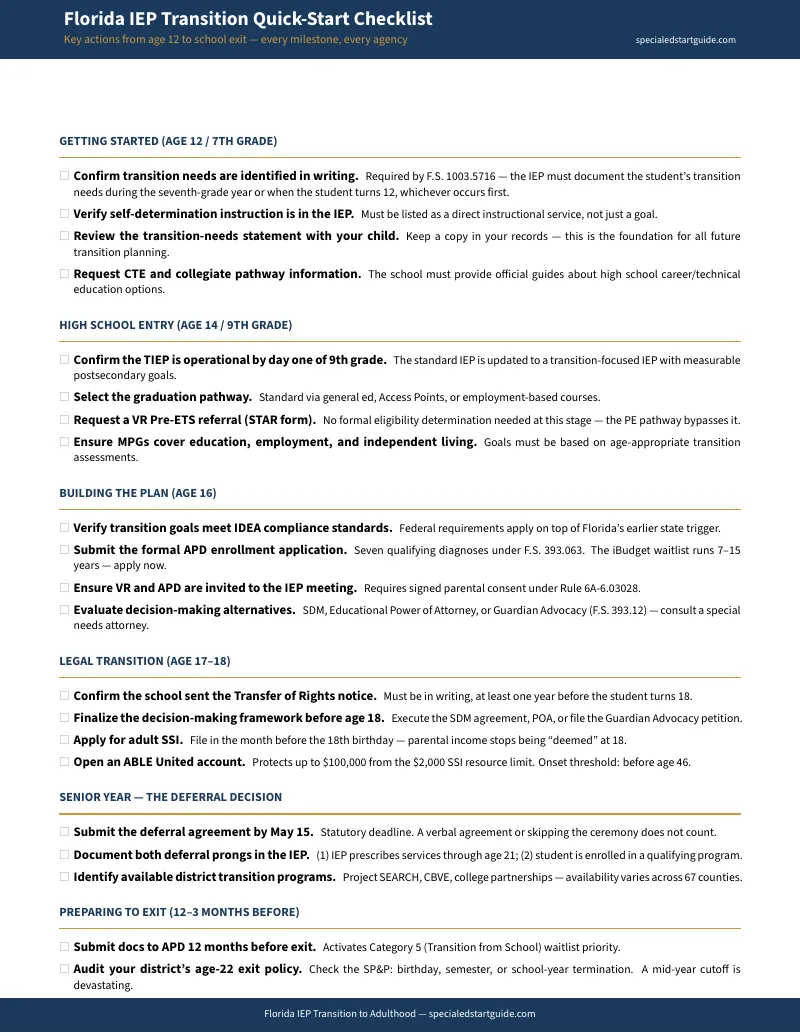
Download the free transition planning checklist to see the full timeline at a glance. When you're ready for the complete toolkit — with chapter-length explanations, worksheets, decision frameworks, and the district audit tools — the full guide is waiting for you.
Every week that passes without a clear plan is a week closer to a deadline you didn't know existed. The transition timeline doesn't pause while families figure it out.