Your Child's IEP Says "Transition." Now What?
The IEP team just added a transition section. They mentioned postsecondary goals, a course of study, maybe a referral to DVR. You nodded, signed, and walked out wondering what any of it actually means for your child's future.
You're not alone. Delaware starts transition planning at age 14 or eighth grade — two years earlier than federal law requires — which means families get hit with adult-world decisions while their child is still in middle school. And the system that's supposed to help you navigate this? It's scattered across the Department of Education, the Division of Vocational Rehabilitation, DDDS, DHSS, and a dozen legacy web pages that contradict each other.
The Delaware Transition Action System
This guide organizes every Delaware-specific deadline, agency referral, and decision point into one chronological action plan that runs from age 14 through age 22. Instead of hunting across five state agency websites for forms and timelines, you get the complete sequence — what to do, when to do it, and which agency handles each piece.
What's Inside
- Age-by-age action calendar (14 to 22) — every IEP milestone, agency referral window, and legal threshold mapped to your child's school year, so you never discover a deadline after it's passed
- Diploma vs. DAAS decision framework — the real differences between Delaware's standard 24-credit diploma and the Diploma of Alternate Achievement Standards, including how each pathway affects college admission, military eligibility, and employment screening
- DVR and Pre-ETS coordination guide — when to request the formal referral, how to register for summer Pre-Employment Experiences, and which community providers (ServiceSource, Rise Mid-Atlantic) deliver services in your area
- ESSE program walkthrough — step-by-step instructions for the Early Start to Supported Employment pilot that secures a paid job and job coach before your child exits the school system
- DDDS and Lifespan Waiver eligibility map — the 1915(c) waiver application process, the newly approved Enhanced Behavioral, Crisis Stabilization, and Remote Supports services, and how to coordinate waiver funding with school-based services
- Transfer of rights preparation — the mandatory age-17 notification, Delaware's Supported Decision-Making Act, guardianship alternatives, and the decision-making forms you need to have ready before your child turns 18
- Financial planning section — SSI, ABLE accounts, special needs trusts, and how the repeal of WEP and GPO under the Social Security Fairness Act affects your family's benefit calculations
- Postsecondary education pathways — how to access University of Delaware's CLSC and Spectrum Scholars programs, community college admission through DTCC, and the shift from IEP accommodations to ADA-based supports
- 8 fillable worksheets and trackers — diploma decision worksheet, agency communication log, DVR/DDDS application tracker, ABLE and benefits worksheet, IEP meeting prep checklist, SOP review checklist, supported decision-making worksheet, and transition timeline planner — each a standalone printable PDF
Who This Guide Is For
- Parents of middle schoolers whose IEP team just introduced transition planning and you're trying to understand what Delaware requires at age 14
- Families of high schoolers navigating the DVR referral, Pre-ETS registration, or the diploma vs. DAAS decision
- Parents of students aged 18–22 managing the transfer of rights, DDDS applications, and the countdown to the end of school-based services
- Anyone coordinating across multiple agencies who needs one document that shows how DVR, DDDS, DHSS, and the school district connect
Why State Websites Aren't Enough
Delaware's official resources are thorough, but they're built for agency compliance — not for a parent trying to plan at midnight after the kids are in bed. The DDOE transition pages use legacy URLs that move without redirects. DVR's Pre-ETS information doesn't mention when to start the school referral. DDDS waiver documentation doesn't explain how to coordinate with school-based IEP services. And none of them give you a single calendar showing how all the pieces fit together.
Private special education advocates charge $100–$175 per hour for the same coordination this guide provides. The Parent Information Center of Delaware offers workshops, but they're scheduled around their calendar, not yours.
This guide distills that scattered landscape into one self-paced resource you can use on your own schedule, at a fraction of the cost of a single advocate session.
Satisfaction Guarantee
If the guide doesn't help you navigate your child's transition planning, email us for a full refund. No forms, no justification required.
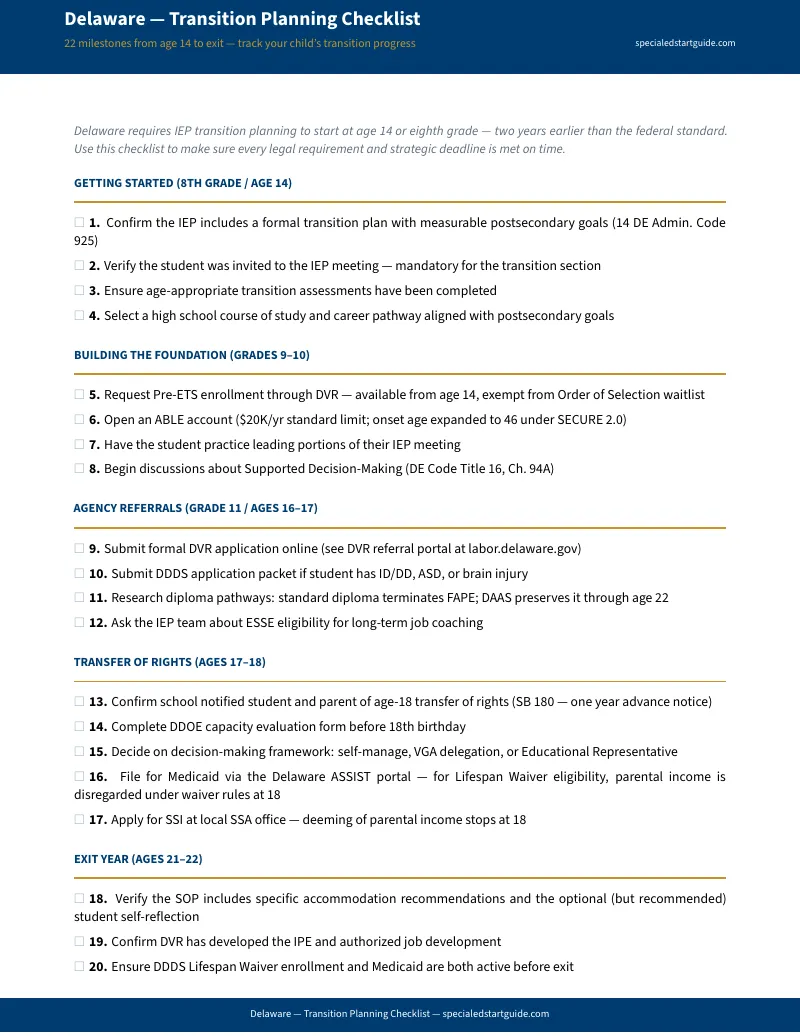
Get Started
Download the free checklist to see the transition planning timeline at a glance. When you're ready for the full action system — with worksheets, agency coordination tools, and the complete age-by-age calendar — get the full guide for .