
The District Knows ECEA Rules. Now You Will Too.
You walked into that IEP meeting prepared — or you thought you did. You read the PEAK Parent Center guide at 2 AM. You printed the procedural safeguards notice. You wrote down your concerns. And then the team smiled, used phrases you'd never heard before, and told you your child "doesn't qualify" or that certain services "aren't available through the BOCES."
You left the meeting with the same IEP your child walked in with. No additional minutes. No new assessments. No Prior Written Notice explaining why they refused your requests — because you didn't know to ask for one.
The problem isn't that you're uninformed. The problem is that Colorado's special education system is specifically designed to be navigated by professionals, not parents. An Administrative Unit structure where written operating agreements set out which special-education responsibilities the AU and member districts each handle. Itinerant providers who rotate across rural districts on weekly schedules and miss sessions when mountain passes close. A twice-exceptional framework under ECEA Rule 12.01(30) that the state publishes 100 pages of guidance on but provides zero fill-in-the-blank templates for. And IEP recording policies that many parents don't know to check.
The Colorado IEP & 504 Blueprint is the tactical enforcement toolkit that bridges the gap between knowing your rights and actually exercising them — with Colorado-specific tools and explanations of relevant ECEA rules and Colorado Revised Statutes.
What's Inside the Blueprint
The Copy-Paste Advocacy Letter Library
The letter library gives you Colorado-specific templates for common requests and explains the relevant ECEA rules and statutes. Request an initial evaluation; the AU must complete the evaluation within 60 calendar days after it receives your signed consent. Demand an Independent Educational Evaluation at public expense when you disagree with the district's assessment. Formally request Prior Written Notice when the team refuses any service or placement you've proposed. Ask about the district's recording policy and whether an exception is available when recording is needed to understand the IEP process; the guide cites C.R.S. § 18-9-304. These aren't generic samples — they're Colorado-specific tools that create a documented paper trail the moment you hit send.
The BOCES Navigation System
Colorado is one of the few states where special education often runs through regional cooperatives — Boards of Cooperative Educational Services — rather than individual districts. When a BOCES is the Administrative Unit, an operating agreement sets out which special-education responsibilities it and its member districts each hold. The Blueprint explains how this structure works and how to use it: tracking itinerant provider schedules, documenting missed sessions, calculating compensatory education claims, and escalating to out-of-district placement when the BOCES says "we don't have the staff." Under ECEA Rule 3.01, that excuse is legally invalid — and this chapter shows you exactly how to respond.
The 2e ALP + IEP Integration Framework
Colorado is one of the most progressive states for formally recognizing twice-exceptional students under ECEA Rule 12.01(30). But the practical gap between state policy and classroom reality is enormous. Parents are told their child is "too smart" to need an IEP, or that behavioral challenges disqualify them from gifted programming. The Blueprint provides a framework to coordinate your child's Advanced Learning Plan with their IEP or 504 accommodations — including how to write PLAAFP statements that document intellectual strengths alongside disability impacts, so the masking effect stops hiding your child's genuine needs.
The CMAS Accommodation Matrix
Colorado's standardized testing system offers universal tools, designated supports, and accommodations — but the CDE's official guidance is written for administrators, not parents. The Blueprint translates it into a plain-language checklist: if your child struggles with X, request accommodation Y. It covers paper-based testing for qualifying students whose documented disability prevents online test access, as specified in an IEP or 504 plan, and who regularly use paper during instruction and assessments; text-to-speech setup requirements; and the Unique Accommodation Request (UAR) process that must be submitted by December 15 — a deadline most parents learn about after it has passed.
The IEP Recording Policy Request
Colorado's eavesdropping statute (C.R.S. § 18-9-304) applies to people who are not visibly present during a conversation; it does not give parents an unconditional right to record an IEP meeting. IDEA allows a state or public agency to regulate recording at IEP meetings. The Blueprint includes a professional email template for asking about the district's recording policy and any exception needed to understand the IEP process. Teams behave differently when the conversation is on the record.
IEP Meeting Scripts and Checklists
What to say when the team tells you your child is "making progress" but the data shows otherwise. What to say when they offer a 504 instead of an IEP. What to say when the administrator claims they don't have staff for a specific service. Each script cites the ECEA rule or Colorado statute that proves them wrong — so you're not arguing opinions, you're citing law. The pre-meeting checklist covers IEP recording-policy review, team composition verification, and the specific documents to bring.
Goal-Tracking Worksheets
IEP goals are legally required to be measurable, and the IEP must explain how progress will be measured. Baselines, targets, and mastery criteria make that progress easier to track. But many goals are written so vaguely that progress is impossible to track. In SC2025-511 against Mesa County Valley School District 51, the CDE found that the district used class grades in place of goal-specific progress data and failed to report progress as the student's IEP required, resulting in a denial of FAPE. The worksheets give you a structured format to log data between meetings, compare school-reported progress against your own observations, and arrive at the annual review with documentation that either confirms the program is working or proves it isn't.
The Dispute Resolution Roadmap
When informal advocacy fails, you have three formal options in Colorado: filing a State Complaint with CDE's Exceptional Student Services Unit (60-day investigation), requesting mediation through the ESSU, or filing for due process (2-year deadline). The Blueprint explains when each option is appropriate, the timeline and costs involved, and how the paper trail you've been building with the advocacy templates becomes the evidence that wins your case.
Who This Blueprint Is For
- Parents in rural Colorado whose BOCES itinerant provider hasn't shown up in weeks — and who need to know how to document the gap and demand compensatory education
- Parents of twice-exceptional children who've been told their child is "too smart" for an IEP — and who need the framework to coordinate an ALP with IEP or 504 supports under ECEA Rule 12.01(30)
- Parents who've been told their child "doesn't qualify" for services despite a medical diagnosis — and who need the specific ECEA eligibility criteria to challenge that determination
- Parents in Denver, Jefferson County, Cherry Creek, or any large Front Range district where IEP services are chronically underdelivered and meetings are routinely postponed
- Military families at Fort Carson, Peterson Space Force Base, Buckley, or Schriever navigating IEP transfers between states and Colorado's AU system
- Parents preparing for their first IEP meeting who don't want to walk in blind against a team that does this every day
- Parents navigating the 504-to-IEP question — unsure whether their child's current plan is legally sufficient or whether they should push for a full evaluation
Why Not Just Use the Free Resources?
Colorado has strong free special education resources. PEAK Parent Center runs workshops. Disability Law Colorado publishes rights manuals. The CDE issues procedural safeguards notices. Here's why parents still struggle after consulting all of them:
- PEAK Parent Center provides overviews, not tools. PEAK's "Getting Started With Special Education" guide correctly states the 60-day evaluation timeline but introduces confusing 30-day windows without clarifying what they apply to. It lists the 14 ECEA disability categories without providing the specific eligibility criteria. Most critically, it omits the actual procedures for filing a state complaint, requesting mediation, or initiating due process. It's an informational brochure, not an advocacy toolkit.
- Disability Law Colorado writes for attorneys, not parents. DLC's manuals are legally precise — they correctly distinguish the 180-day OCR window from the 1-year state complaint deadline from the 2-year due process filing period. But the tone is clinical, dense, and intimidating. They focus on post-facto litigation rather than the interpersonal negotiation strategies you need at the IEP table tomorrow morning.
- CDE publications are written for administrators. The CDE's Twice-Exceptional Resource Handbook brilliantly defines the "masking effect" — but it was written for Special Education Directors and Gifted Coordinators, not parents. It explains what the district should do but provides zero guidance on what to do when the district refuses.
- Etsy and TPT planners organize paperwork — they don't enforce rights. A pastel IEP binder helps you keep documents in order. It won't tell you how to check the district's IEP recording policy, how to coordinate ALP/IEP supports for 2e students, or how to cite ECEA Rule 3.01 when the BOCES claims staffing shortages. Generic federal templates miss every Colorado nuance that actually determines your outcome.
The free resources explain what the law says. The Blueprint gives you the tools to make the district follow it.
— Less Than 3 Minutes of a Special Education Attorney
Special education attorneys in Colorado charge $250–$500 per hour. Retainers routinely start at $3,000–$5,000. Even if you eventually need professional help, the meticulous paper trail you build with this Blueprint saves thousands in billable hours — because you're handing your attorney an organized case, not a shoebox of unsigned IEP copies and half-remembered conversations.
Your download includes the complete Blueprint guide plus standalone printable PDFs — every template, worksheet, script, and reference card, ready to print and bring to your next meeting.
- Complete Blueprint Guide — 16 chapters covering evaluation, IEP development, 504 plans, 2e ALP integration, BOCES navigation, CMAS accommodations, progress monitoring, school discipline, transition planning, Part C transition, compensatory education, and dispute resolution
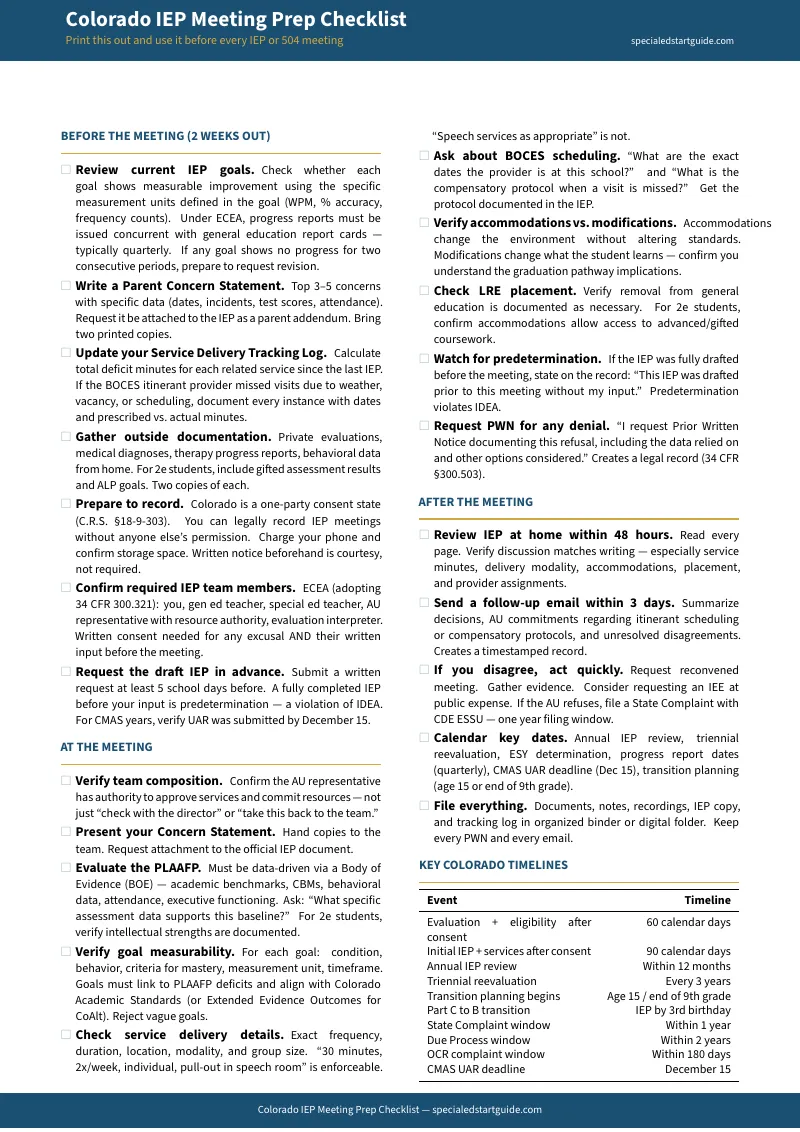
- IEP Meeting Prep Checklist — the before/during/after checklist with Colorado timelines and ECEA citations for every step
- Advocacy Letter Templates — copy-paste letters for evaluations, IEEs, Prior Written Notice requests, an IEP recording email template, and compensatory education claims, paired with relevant ECEA and Colorado statute references in the guide
- Goal-Tracking Worksheet — structured fillable worksheet for measurable progress monitoring between annual reviews
- CMAS Accommodation Checklist — classroom accommodations table plus the state testing accessibility matrix and UAR deadline guide
- Colorado Timeline Cheat Sheet — key legal deadlines in a printable timeline: 60-calendar-day evaluation, 90-day initial IEP, annual reviews, transition dates, CMAS UAR deadline, and dispute resolution windows
- IEP Meeting Scripts — word-for-word responses to common district pushback tactics, each citing the specific ECEA rule or Colorado statute
- IEP Recording Email Template — template email for notifying the district that you plan to record an IEP meeting
- Dispute Resolution Roadmap — your three formal options when advocacy fails, with a side-by-side comparison table
Instant PDF download. Print the templates tonight. Walk into tomorrow's meeting with the law on your side.
Full refund, no time limit. If the Blueprint doesn't change how you approach IEP meetings in Colorado, email us for a full refund. No questions asked.
Not ready for the full Blueprint? Download the free Colorado IEP Meeting Prep Checklist — a printable pre-meeting checklist with the Colorado timelines, team composition requirements, a section on recording IEP meetings, and red flags that require immediate action. It's enough to walk into your next meeting prepared, and it's free.
Your child's education is a legal right, not a favor. The district knows ECEA. After tonight, so will you.
Frequently Asked Questions
What if the rules change after I buy?
We update the guide when the rules change. Email us any time, even years later, and we'll send you the current edition free.