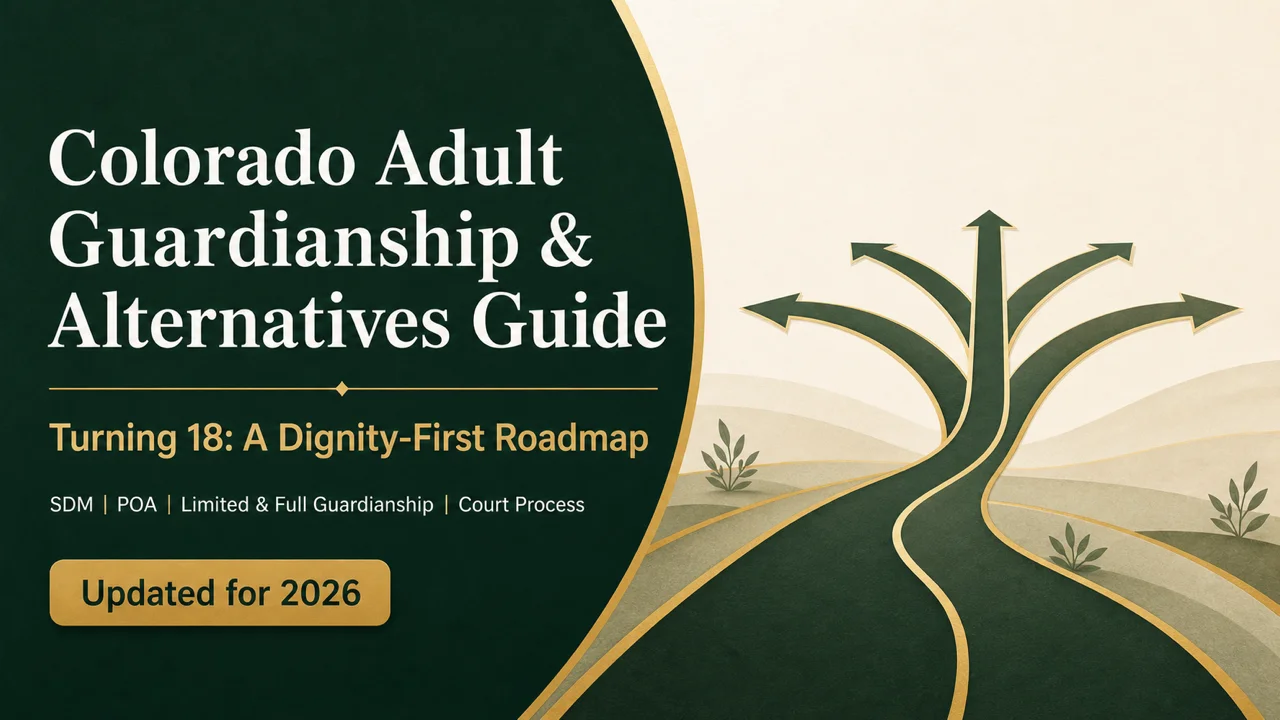
Your Child Turns 18 and You Lose Every Legal Right. Colorado Gives You a Better Path Than Guardianship Alone.
On the morning of your child's eighteenth birthday, you can no longer consent to their medical treatment, access their health records, manage their bank account, or sign a lease on their behalf. No diagnosis — intellectual disability, autism, traumatic brain injury, psychiatric condition — changes that legal reality. And most parents don't realize it until a doctor, a school administrator, or a bank teller tells them they no longer have authority.
The panic is real. And the default response — filing for full guardianship — is the most restrictive, most expensive, and most rights-removing option on the table. It costs $229 just to file, plus background checks, a court-appointed visitor, and potential attorney fees that can run into the thousands. If your child objects, you're looking at a contested hearing that can fracture your family.
Colorado built a better path. The state's 2021 Supported Decision-Making statute (C.R.S. § 15-14-801) was specifically designed to push families toward less restrictive options first — and to make those options legally enforceable with third parties like doctors, schools, and financial institutions.
The Authority Spectrum System
The Colorado Adult Guardianship & Alternatives Guide gives you what no free government PDF or fragmented nonprofit guide provides: a single, structured system for evaluating every decision-making tool Colorado offers, ranked from least restrictive to most, with step-by-step instructions for each one.
We call it the Authority Spectrum System — because the right answer for your family is almost never "all or nothing." It's a specific combination of tools matched to your child's actual support needs, and this guide walks you through finding that combination.
What's Inside
- Supported Decision-Making (SDM) Agreement Kit — Colorado's 2021 statute lets your child keep all their legal rights while designating trusted supporters. The guide covers every statutory requirement under C.R.S. § 15-14-805, including supporter selection, mandatory reporter warnings, witness requirements, and how to present the agreement to doctors and banks who've never seen one before. The safe-harbor provision (§ 15-14-806) protects them from liability — but only if you get the paperwork right.
- Medical and Financial Powers of Attorney — when your child has the capacity to voluntarily delegate specific authority. The guide explains Colorado's capacity standards for executing an MDPOA, how to combine it with HIPAA and FERPA releases, and the critical difference between a healthcare POA and a financial POA.
- Representative Payee, ABLE Accounts, and Special Needs Trusts — three targeted financial tools that handle SSI management, savings, and asset protection without court involvement. Each one solves a specific problem. The guide tells you which one you actually need and walks you through setup.
- Step-by-Step District Court Filing Map — for families who genuinely need guardianship or conservatorship. The guide covers every JDF form (841, 805, 806, 850), the $229 filing fee, the CBI background check process, what the court visitor will ask during their home visit, how to prepare for the hearing, and how to file Form JDF 205 for a fee waiver. Denver families file in Probate Court; the other 63 counties file in District Court — the guide explains both.
- Decision Worksheets — structured tools to assess where your child needs support (medical, financial, housing, daily living) and which legal instrument addresses each area. These aren't personality quizzes. They're the same analytical framework attorneys use to recommend an approach — translated into a format you can complete at the kitchen table.
- Post-Appointment Compliance Guide — if you become a guardian, your obligations don't end at the hearing. The guide covers the Initial Care Plan due within 60 days, the JDF 850 annual reporting process, limits on your authority, and the modification and termination procedures if your child's capacity changes over time.
- Pre-18 Timeline and Preparation Checklist — what to do at age 14, 15, 16, 17, and right before the birthday. The guide maps every milestone to the specific legal tool you should be evaluating at that stage.
The Colorado-Specific Edge
Generic guardianship guides miss what matters most in Colorado. This guide was built around the state's specific legal framework:
- ECEA age-21 exception: Unlike most states, Colorado parents keep their special education decision-making rights until the student turns 21 or exits public education with a regular diploma. That buys you time on the education side — and means the urgent gap is medical and financial authority, not the IEP.
- 2021 SDM statute: Colorado's supported decision-making law includes a safe-harbor provision (C.R.S. § 15-14-806) that explicitly protects third parties who rely on a valid agreement in good faith. Most states don't have this. It's the difference between a doctor accepting your paperwork and one who tells you "we need a court order."
- Limited guardianship preference: Colorado law presumes that only a limited guardianship is appropriate in all cases. The petitioner must explain why a limited arrangement won't work before the court will consider full guardianship. The guide shows you how to draft a petition that respects this presumption.
- Denver Probate Court: Denver is the only county with a specialized probate court for guardianship cases. The other 63 counties file in District Court. The guide provides county-specific filing instructions and local practice notes.
Who This Is For
- Parents whose child with a disability is approaching 18 and who haven't started the legal planning process
- Families who received the IEP transfer-of-rights notification at age 17 and were told to "look into guardianship"
- Parents who hit a wall when their child's doctor, pharmacy, or bank refused to share information after the 18th birthday
- Families who want to protect their child without stripping away their rights and autonomy
- Appointed guardians who need to understand their ongoing reporting obligations
Why Not Just Google It?
You can find scattered pieces of this information across Colorado Judicial Branch forms, Disability Law Colorado PDFs, The Arc training decks, and private law firm blogs. Here's what you'll run into:
- The state publishes standardized JDF forms — but with no strategic guidance on which path to pursue, no explanation of SDM alternatives, and legal terminology that increases anxiety rather than reducing it.
- Nonprofit advocates produce excellent philosophy on self-determination and dignity of risk — but fragment their practical guidance across dozens of separate PDFs, training presentations, and web pages that don't connect into a step-by-step process.
- Private probate attorneys provide customized legal advice — but charge $3,000 to $10,000, and many default to a court-first approach because that's what generates billable hours.
- National form-sellers offer templates — but miss Colorado-specific nuances like the ECEA age-21 rule, the SDM safe-harbor provision, and the Denver Probate Court distinction.
The Authority Spectrum System brings all of this into one structured guide — honoring the autonomy-first principles of disability advocacy while providing the clear, procedural roadmaps that match the state's actual filing requirements. For less than the cost of a single hour of paralegal time.
What You Won't Find Here
This is an educational decision-making tool, not legal representation. The guide clearly identifies "attorney-referral moments" — situations where professional legal counsel is necessary: contested filings, complex trusts, profound incapacity where the individual cannot express preferences, and interstate jurisdictional moves. If your situation falls into one of those categories, the guide tells you so directly and explains what to look for in an attorney.
The Free Checklist
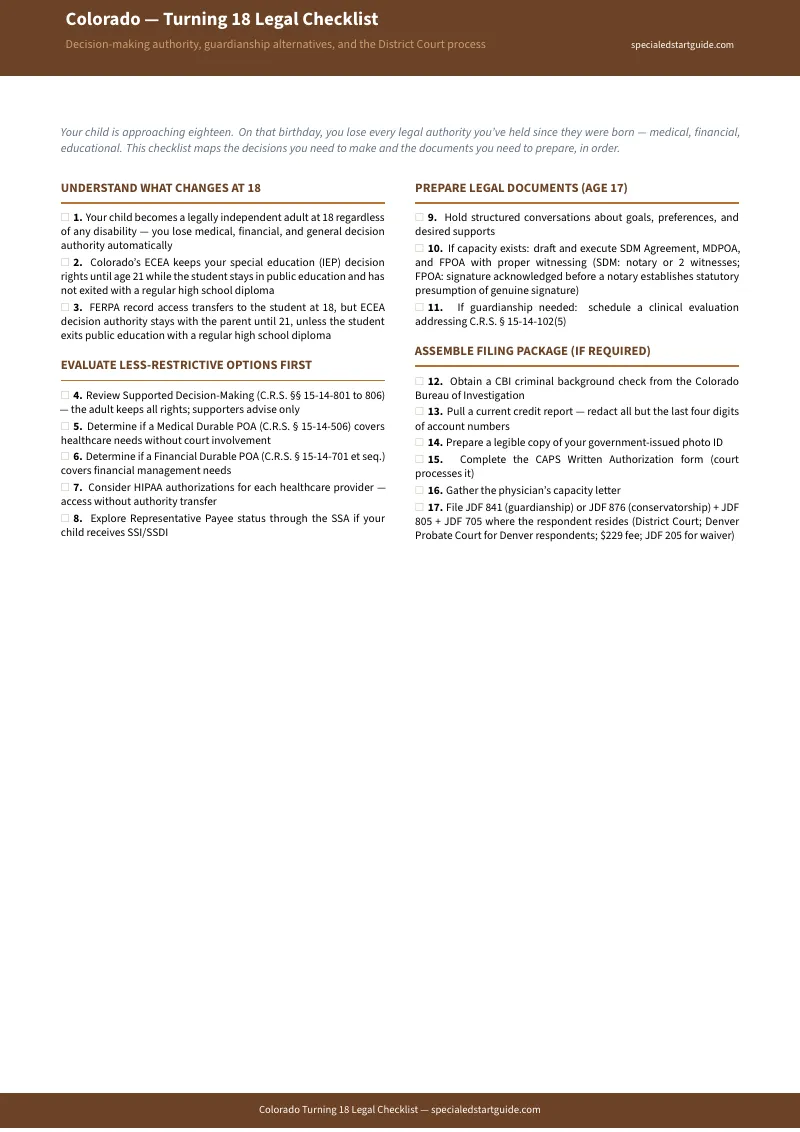
Not sure you need the full guide yet? Start with the Colorado Turning-18 Legal Checklist — a free download that covers the age-of-majority timeline, the FERPA vs. ECEA distinction, and the administrative documentation you'll need if you decide to pursue any formal legal tool. It gives you the what. The full guide gives you the how.