Three agencies. Zero coordination. One family stuck in the middle.
The school district owns your child's IEP. The Department of Rehabilitation handles vocational services. The Regional Center manages adult developmental supports. And when your teenager hits the transition years, all three expect the other two to take the lead — while you're left making phone calls, filing paperwork, and hoping nothing falls through the cracks.
That's the structural reality of California's transition system: no single agency is responsible for the handoff from K-12 special education to adult life. The LEA focuses on compliance. The DOR focuses on employment. The Regional Center focuses on long-term supports. And nobody is responsible for integrating the timelines, funding rules, and eligibility requirements into a coherent plan for your family.
The California IEP Transition to Adulthood Guide is a Three-Agency Coordination System — the first workbook that connects the school district, DOR, and Regional Center into a single chronological roadmap with fill-in worksheets, template letters, and the exact California statutes you need at every decision point.
What's Inside the Guide
- The AB 438 grade-by-grade timeline — California now requires transition planning consideration as early as 9th grade. The guide maps every milestone from age 14 through the final day of K-12 eligibility, with the specific forms, assessments, and agency referrals due at each stage.
- The California Exit Date Worksheet — Cal. Ed. Code § 56026(c)(4) uses a birthday-month formula that even district administrators miscalculate. The fill-in worksheet walks you through the exact statutory rules based on your child's birth month and school calendar type, so you can verify the correct exit date and push back if the district gets it wrong.
- Diploma Decision Worksheet — a side-by-side comparison of the standard high school diploma, the EC § 51225.31 alternate pathway diploma (AB 181), and the Certificate of Completion. Each row explains the impact on FAPE eligibility, graduation ceremony participation, employment documentation, and access to 18-22 transition programs — because accepting the wrong credential at the wrong time can terminate your child's services overnight.
- DOR referral and Order of Selection strategy — step-by-step instructions for submitting the DR 203 Student Services Plan Request, plus a contingency plan for the DOR's February 2026 Order of Selection waitlist. Includes template letters requesting Regional Center–funded job development services (launched January 2025) as a parallel track while your child waits for DOR placement.
- Supported Decision-Making Mapping Worksheet (AB 1663) — when your child turns 18, the school district transfers all educational rights to them. This plain-language worksheet helps you and your young adult map out exactly who assists with each category of life decisions — banking, healthcare, housing, employment — without the cost, complexity, or autonomy restrictions of a probate conservatorship.
- Payer-of-Last-Resort Action Sheet — the "payor of last resort" rule means the Regional Center will routinely deny funding for services it considers the school district's responsibility. The action sheet gives you meeting language and a demand letter citing WIC § 4659.1 so you can force a written response during the 18-22 window, when both agencies are most likely to point fingers.
- Self-Determination Program enrollment roadmap — a complete walkthrough of the SDP path: orientation, person-centered planning, individual budget calculation, and Financial Management Services (FMS) provider selection. Designed for families who want to bypass traditional vendored agencies and manage their young adult's service budget directly.
- College DSPS transition checklist — the shift from IDEA entitlements to ADA/Section 504 accommodations means your student must self-disclose, self-advocate, and navigate an entirely different intake process. The checklist covers California Community College DSPS, CSU disability offices, and UC accommodations with the specific documentation each system requires.
- Payor-of-last-resort escalation templates — when the Regional Center denies a service by claiming the school district or DOR should fund it, these pre-drafted demand letters (citing the 15-day response mandate under WIC § 4659.1), Clients' Rights Advocate email templates, and DDS grievance instructions give you a concrete enforcement path instead of another round of phone tag.
Who This Is For
This workbook is built for California families at any stage of the transition process:
- Early planners (ages 14-16) — your child's IEP team just mentioned "transition" and you need to understand the full multi-year timeline before the first transition-focused IEP meeting
- Transfer-of-rights families (age 17) — the school sent a notice about transferring educational rights at 18 and you need to decide between Supported Decision-Making, limited conservatorship, or educational power of attorney before the birthday deadline
- Adult Transition Program families (ages 18-21) — your young adult is in the district's 18-22 program and you need to coordinate Regional Center, DOR, and school services simultaneously without losing coverage in the handoff
- Age-22 exit families — your child is approaching the end of K-12 eligibility and you need to verify the exact exit date, confirm adult programs are funded and staffed, and prevent any gap in structured daily services
Why Not Just Use the Free Resources?
California has some of the best free transition resources in the country. Disability Rights California publishes the 600-page SERR manual. Your SELPA has a transition checklist. The DOR website lists its programs. The Regional Center sends orientation packets.
The problem isn't that the information doesn't exist. It's that it's scattered across six different agencies, written in legal language, and organized by each agency's internal structure — not by your family's timeline.
The result: you spend dozens of hours reading overlapping guides from agencies that don't coordinate with each other, trying to stitch together a coherent plan from documents that were never designed to work together. A professional special education advocate charges $75 to $250 per hour to do exactly that synthesis work. The guide delivers the same structural coordination for less than fifteen minutes of an advocate's time.
The Boundaries of This Guide
This is a planning and coordination workbook — not legal advice, and not a substitute for professional representation when disputes escalate. The guide includes a clear escalation framework that tells you when self-advocacy and template letters are sufficient, and when a situation has risen to the level where hiring a special education attorney or filing for a due process hearing is the responsible next step.
Every worksheet, template, and recommendation is grounded in current California statute (Education Code, Welfare & Institutions Code, Government Code) with direct section citations so you can verify every claim yourself.
What You Get
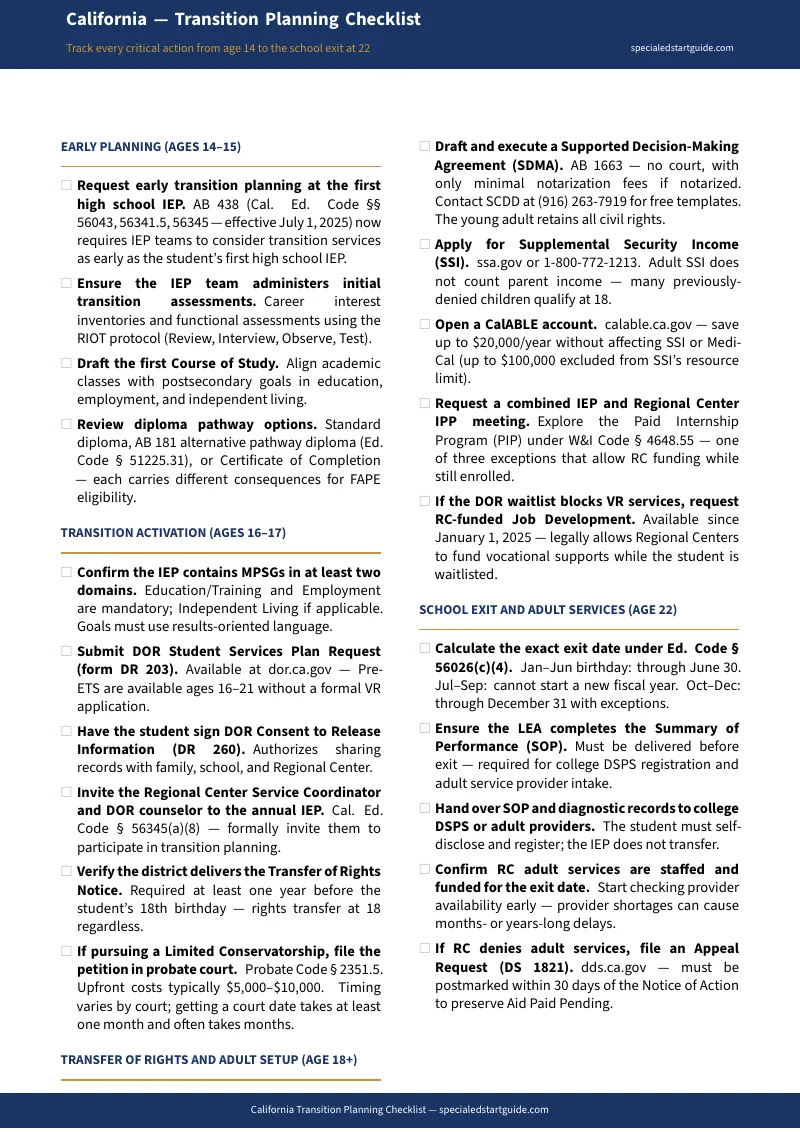
Your download includes 11 PDFs: the complete guide (49 pages, 13 chapters), a 2-page 20-item transition planning checklist, and nine fill-in printables — the California Exit Date Worksheet, Transition Timeline Planner, IEP Transition Goal Builder, Diploma Decision Worksheet, Supported Decision-Making Mapping Worksheet, Agency Communication Log, Provider Availability Tracker, Payer-of-Last-Resort Action Sheet, and Transition Skills Tracker. Save them, print them, and bring them to IEP meetings, Regional Center IPP meetings, and DOR intake appointments.
The guide reflects California law through the 2025-2026 academic year, including AB 438, AB 181/EC § 51225.31, AB 1663, the DOR's February 2026 Order of Selection, and the reinstated Medi-Cal asset limits.
Get the California IEP Transition Guide — every worksheet, template letter, and agency-specific timeline your family needs to coordinate the handoff from school to adult life, for .
Frequently Asked Questions
What if the rules change after I buy?
We update the guide when the rules change. Email us any time, even years later, and we'll send you the current edition free.