
Your child is turning 18 in Arkansas — and you're about to lose every legal right you assumed was permanent
The school sends home a Transfer of Rights letter. A pediatrician mentions HIPAA. A disability caseworker says "you should look into guardianship." And suddenly you're trying to figure out whether you need to file in circuit court before the birthday — while an advocacy website tells you guardianship is a last resort and you should try supported decision-making instead.
Here's what makes Arkansas uniquely confusing: the alternative everyone recommends doesn't legally exist here. National advocacy groups tell parents to sign a Supported Decision-Making Agreement. But Arkansas has no general SDM statute — House Bill 1005 failed in 2021. SDM is only recognized in narrow contexts under Lila's Law and the Uniform Health-Care Decisions Act. A generic SDM template from a national website carries no guaranteed legal weight with Arkansas banks, hospitals, or school districts.
So you're stuck between two bad options: pay thousands for a full guardianship that strips your child of the right to vote, marry, and sign contracts — or use a document that looks official but may be rejected the first time you actually need it.
The Least-Restrictive Authority Blueprint —
The Arkansas Adult Guardianship & Alternatives Guide is built around a simple principle that Arkansas circuit courts actually enforce: the law requires judges to impose the least restrictive alternative before granting guardianship. But nobody tells parents what those alternatives are, how to set them up under Arkansas statutes, or how to know which ones will hold up when a bank teller, ER nurse, or school administrator pushes back. This guide does.
It maps every instrument on a spectrum from least to most restrictive — informal supported decision-making, durable financial power of attorney, healthcare proxy, HIPAA and FERPA releases, Social Security Representative Payee, limited guardianship, and plenary guardianship — with the exact Arkansas statutory requirements, setup costs, and real-world enforceability for each one. You choose the combination that protects your child in the areas where they need support, without removing rights in the areas where they don't.
What's Inside
- Guardianship Alternatives Comparison Chart — a printable side-by-side of every instrument in the kit (informal SDM, durable financial POA, healthcare POA, HIPAA, FERPA, Representative Payee, conservatorship, limited guardianship, plenary guardianship) showing the governing statute, whether court filing is required, effect on civil rights, and estimated setup cost. Circle the combination you will actually use.
- Decision-Making Capacity Assessment Worksheet — Arkansas law does not treat disability as a binary determination of competence. A diagnosis of autism, Down syndrome, or intellectual disability does not automatically prevent your child from signing a power of attorney. This fillable worksheet walks through medical consent, financial management, daily living, and legal-document comprehension so you can document your child's understanding at the moment of signing — and flag when a professional evaluation under A.C.A. § 28-65-212 makes sense as a protective step.
- Power of Attorney Execution Guide — step-by-step instructions for setting up a durable financial power of attorney under the Arkansas Uniform Power of Attorney Act (A.C.A. § 28-68-101 et seq.) and a healthcare proxy under the Uniform Health-Care Decisions Act, including execution formalities, notarization requirements, and what to do if a financial institution refuses to honor the document.
- HIPAA & FERPA Authorization Setup — the forms your child needs to sign before their 18th birthday so you retain access to medical records, doctor conversations, patient portals, and educational records. Includes IEP meeting workarounds — how to stay at the table as a "knowledgeable individual" even after rights transfer at 18 under 6 CAR § 130-907.
- Representative Payee Process — how to apply through the Social Security Administration to manage your child's SSI or SSDI benefits without a court-ordered guardianship of the estate. The SSA does not recognize state court guardianship orders for federal benefit management — you need a separate administrative designation, and this section walks you through it.
- Complete Circuit Court Guardianship Process — every step from filing the petition in probate division to the hearing and final order. Covers petition contents, the professional evaluation required under A.C.A. § 28-65-212 (four Act 713 domains), 30-day notice, bond/letters/acceptance, and the Act 326 of 2023 change that shifted surety bonds from mandatory to discretionary. Includes a Pre-Filing Document Checklist you can print and fill before you file.
- Emergency Guardianship Procedures — when and how to petition for temporary emergency guardianship in crisis situations, including the order duration and the process for converting to a permanent appointment.
- Special Needs Trust & ABLE Account Planning — how an SNT and an Arkansas ABLE account work alongside guardianship or its alternatives to protect your child's SSI and Medicaid eligibility while building financial resources.
- Guardian Compliance Tracker — a fillable annual-cycle tracker for Form 32 (Annual Report of Guardian) and Form 31 (estate accounting), plus the 60-day Form 30 inventory, so you never miss a probate court deadline.
- County Court Fee Worksheet — the $165 statewide filing fee, professional evaluation costs, attorney retainer ranges, and surety bond premiums, with blanks to record what your own Circuit Clerk actually charges (counties add security, technology, and accounting fees).
- Agency Communication Log — a landscape log for every call, email, and office visit with banks, hospitals, schools, SSA, DHS, and clerks. You will need dates and names if a third party refuses a valid statutory POA (A.C.A. § 28-68-120).
- Attorney Consultation Prep — a one-meeting sheet listing documents to bring, questions to ask, and the domains you do and do not want the court to touch, so you arrive organized.
Who This Is For
- Parents whose child's 18th birthday is 8 to 12 months away — and who are getting the Transfer of Rights letter from the school district without a clear plan for what comes after educational rights shift to the student.
- Families whose pediatrician just mentioned HIPAA — who are realizing for the first time that they will be locked out of medical records, doctor conversations, and treatment decisions the moment their child turns 18 unless they have a legally recognized instrument in place.
- Parents told they "need guardianship" without being told what it costs — uncontested cases with attorney representation typically run $2,000 to $5,000 in Arkansas. This guide helps you evaluate whether a $0 power of attorney or a $0 Representative Payee application covers your needs before you commit to that expense.
- Families who want to preserve their child's civil rights — Arkansas circuit courts are statutorily required to apply the least restrictive alternative before granting guardianship. This guide gives you the framework to demonstrate to the court that you've considered and documented less restrictive options.
Why Free Resources Aren't Enough
Disability Rights Arkansas provides essential advocacy and a comprehensive guardianship resource booklet — but their materials are written at a policy and legal-theory level. They explain what the options are without walking families through how to set them up. Arkansas Transition Services offers excellent educational resources for IEP transition, but their scope stops at the school door — they don't cover probate court preparation, power of attorney execution, or financial planning. National document generators sell template packages, but none of them address Arkansas's missing SDM statute, the specific execution formalities of the state's Uniform Power of Attorney Act, or the county-level variations in court filing procedures.
These resources explain your options in the abstract. What they don't do is help you decide which option fits your child's specific situation, then execute it with documents that Arkansas institutions will actually accept.
The Cost of Waiting
Skip the HIPAA authorization before the 18th birthday, and the first time your child is hospitalized, you'll be standing in a waiting room while doctors refuse to share information with you. Use a generic national SDM template, and an Arkansas bank manager may refuse to let you manage your child's account. Default to full guardianship when a limited arrangement would have covered it, and your child loses the right to vote, marry, and sign contracts — rights that are extremely difficult to restore once removed through Arkansas probate court.
None of these mistakes are cheap or fast to fix. The guide exists so you can make this decision with complete information before the birthday, not under pressure after it.
Satisfaction Guarantee
If the guide doesn't help you make a clearer, more confident decision about your child's transition to adulthood under Arkansas law, reach out for a full refund. No questions, no hoops.
Start With the Free Checklist
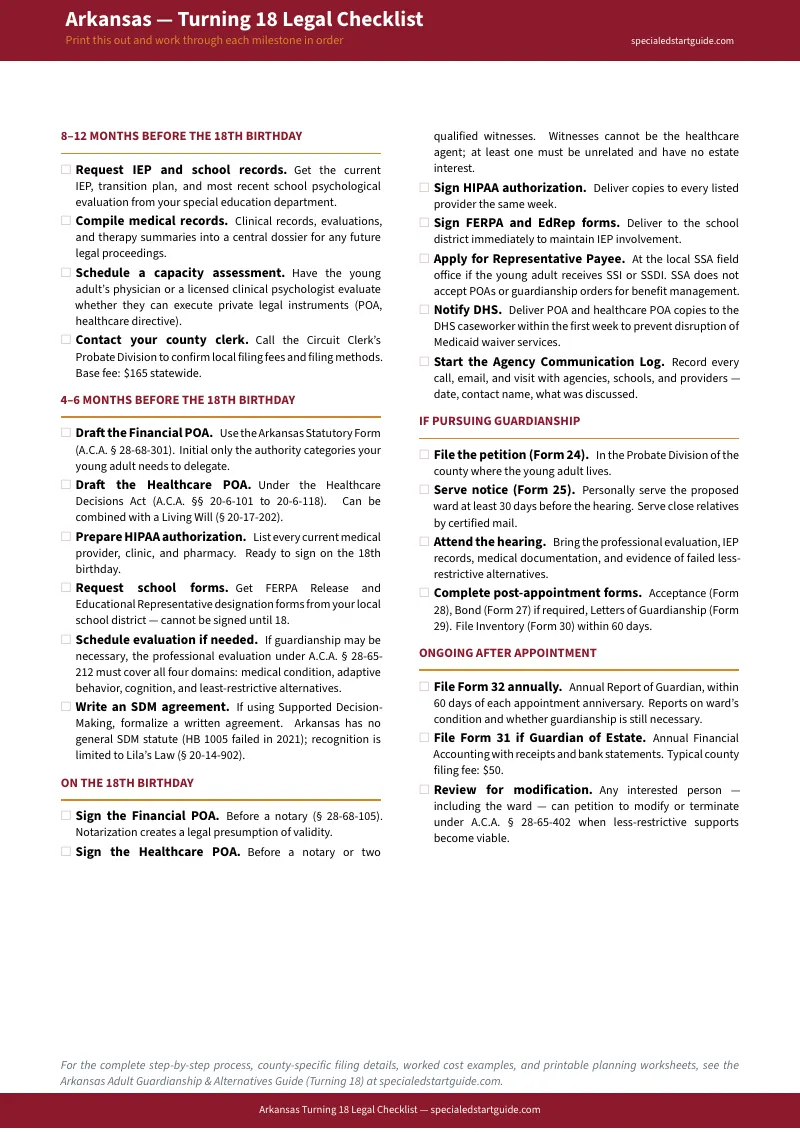
Download the Arkansas — Turning 18 Legal Checklist — a one-page overview of every milestone, deadline, and decision point between now and your child's 18th birthday. If the checklist confirms you need deeper guidance, the full guide is ready when you are.