The IEP Meeting Said "Transition." Now What?
Arizona starts transition planning earlier than many families expect. Under a rule change approved in October 2024, transition services must be in effect by the time a student finishes 9th grade or reaches age 16 — whichever comes first. That means the IEP meeting you just sat through introduced terms like measurable postsecondary goals, Indicator 13 compliance, and estimated graduation date, connected to deadlines you didn't know existed, for agencies you've never contacted.
You could piece it together yourself. The Arizona Department of Education publishes one set of transition rules. The Rehabilitation Services Administration runs its own Pre-ETS and VR programs through DES. The Division of Developmental Disabilities has a separate eligibility process with five qualifying diagnoses. AHCCCS administers the ALTCS Medicaid pathway with strict income and asset limits. The probate courts handle guardianship. The Social Security Administration handles SSI redetermination. Each agency has its own timeline, its own paperwork, its own intake procedures. None of them talk to each other. And none of them will tell you what to do first.
The AZ Transition Roadmap: One Sequence, Every Agency, Every Deadline
The Arizona IEP Transition to Adulthood Guide is a state-specific planner that puts every agency, deadline, and decision point into a single chronological sequence — from the 9th-grade IEP trigger through the age-22 services endpoint and into the adult system.
This is not a summary of federal law with "Arizona" pasted on top. It tracks the state's actual rules: the October 2024 SBE rule under A.A.C. R7-2-401(G)(4)(A) that lowered the transition trigger to 9th-grade completion. The Delegation of Educational Rights under A.R.S. § 15-773(B) that most families never learn about until after they've already paid a guardianship attorney. The Supported Decision-Making Agreement under A.R.S. §§ 14-5721 and 14-5722 that preserves the young adult's autonomy without court involvement. The five DDD qualifying diagnoses. The ALTCS $2,982 income limit, the $2,000 asset threshold, and the 40-point PAS scoring minimum. The two DDD managed care plans and what switching between them actually looks like.
What's Inside
- Grade-by-grade transition timeline — every milestone from 9th grade through age 22, mapped to specific IEP actions, agency contacts, and filing deadlines so nothing falls through the gap between "the school mentioned it" and "the deadline passed"
- Graduation pathway comparison — regular diploma vs. certificate of completion, with the FAPE consequences of each laid out plainly, including the one-year graduation notice requirement and protections against forced graduation
- Decision-making alternatives toolkit — the A.R.S. § 15-773(B) Delegation of Educational Rights, the A.R.S. § 14-5722 Supported Decision-Making Agreement, and full guardianship, organized by which situations each one covers and what each one requires
- Pre-ETS and VR coordination guide — how to access Pre-Employment Transition Services without a formal VR application, the five core workshop areas, the RSA transition team contact, and how to develop an Individualized Plan for Employment before school exit
- DDD eligibility and application walkthrough — the five qualifying diagnoses, the three-of-seven functional limitation threshold, and the difference between DDD-only support coordination and ALTCS-funded services
- ALTCS financial and medical qualification guide — the income and asset limits, parental deeming rules, Qualified Income Trusts, ABLE accounts, Special Needs Trusts, and the Pre-Admission Screening evaluation process
- Managed care plan comparison — Mercy Care vs. UnitedHealthcare Community Plan, enrollment windows, switching rules, and what the DDD Support Coordinator actually does
- Dispute resolution guide — Facilitated IEP, mediation, State Complaint, and Due Process pathways with when to use each one and where to get advocacy support
- 9 standalone printable worksheets — transition timeline planner, diploma decision worksheet, decision-making comparison, agency communication log, ALTCS readiness tracker, IEP meeting preparation worksheet, PAS preparation worksheet, health plan comparison, and IPE alignment worksheet — print them and bring them to every meeting
Who This Is For
Parents and guardians of Arizona students with IEPs who are approaching or navigating the transition to adulthood — whether your child just started high school and you want to understand what's coming, or they're 17 and the transfer-of-rights notice just arrived and you need to act this month.
Also for family advocates, educational consultants, and transition coordinators who need a consolidated reference for Arizona's specific rules, agency landscape, and managed care system.
Why Not Just Use the Free Resources?
Encircle Families, Disability Rights Arizona, and the Arizona Community of Practice on Transition all publish excellent materials — and this guide cites them throughout. But those resources are fragmented across separate PDFs, different websites, and different agencies, each covering one piece of the picture. Encircle Families offers peer mentoring and training events. Disability Rights Arizona publishes dense legal manuals. AZCoPT hosts a text-heavy directory of transition providers. RSA has its own forms. DDD runs its own intake. AHCCCS administers its own financial eligibility.
None of them sequence the full picture from a parent's perspective: what to do first, what can wait, what triggers what, and where the hidden deadlines sit. That sequencing — turning six agency silos into one workflow — is what this guide does.
Your Purchase Is Protected
If the guide doesn't help you navigate your child's transition planning, email us and we'll refund your purchase. The checklist is yours to keep either way.
Start With the Free Checklist — Or Get the Full Guide
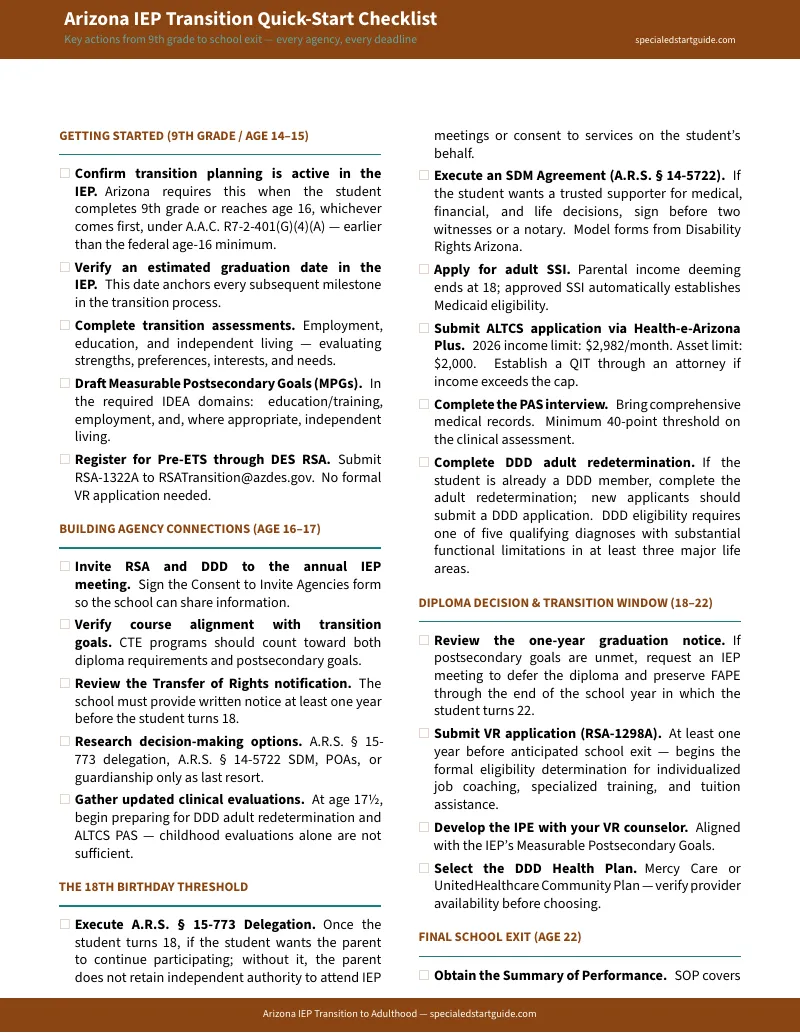
The free Arizona Transition Planning Checklist gives you a printable overview of every milestone from 9th grade to age 22. Download it to see where you stand. When you're ready for the full workflows, decision-making tools, and agency step-by-steps, the complete guide is available for .
Frequently Asked Questions
What if the rules change after I buy?
We update the guide when the rules change. Email us any time, even years later, and we'll send you the current edition free.