Your Child's IEP Services Have an Expiration Date. The Agencies That Replace Them Require Applications You Haven't Filed Yet.
The school district has been providing your child's speech therapy, occupational therapy, job coaching, and behavioral support for years. When your child exits school — at graduation or on their 22nd birthday — all of it stops. Not gradually. Immediately. And the agencies that are supposed to pick up where school leaves off — DVR, SDS, Social Security — don't appear at your door. They have eligibility criteria, intake processes, and waitlists that can run more than a decade.
You've heard the school mention "transition planning." You sat through the IEP meeting where the team added postsecondary goals. The transition coordinator talked about vocational rehabilitation referrals and self-advocacy skills. Then the meeting ended, the IEP document went into a binder, and nobody told you that the Developmental Disabilities Registry draws only 50 names per year — or that the average wait time runs 3.5 to 13 years. Nobody mentioned that if you wait until your child leaves school at 21 to apply, they could be 30 before waiver services arrive.
The Alaska IEP Transition to Adulthood Guide is the Agency Handoff System — the step-by-step planner that takes every agency, every deadline, and every application your family needs to complete and puts them into a single coordinated timeline, from the first career exploration at age 14 through the final handoff to adult community services when FAPE ends.
What's Inside the Guide
The Age-by-Age Transition Timeline
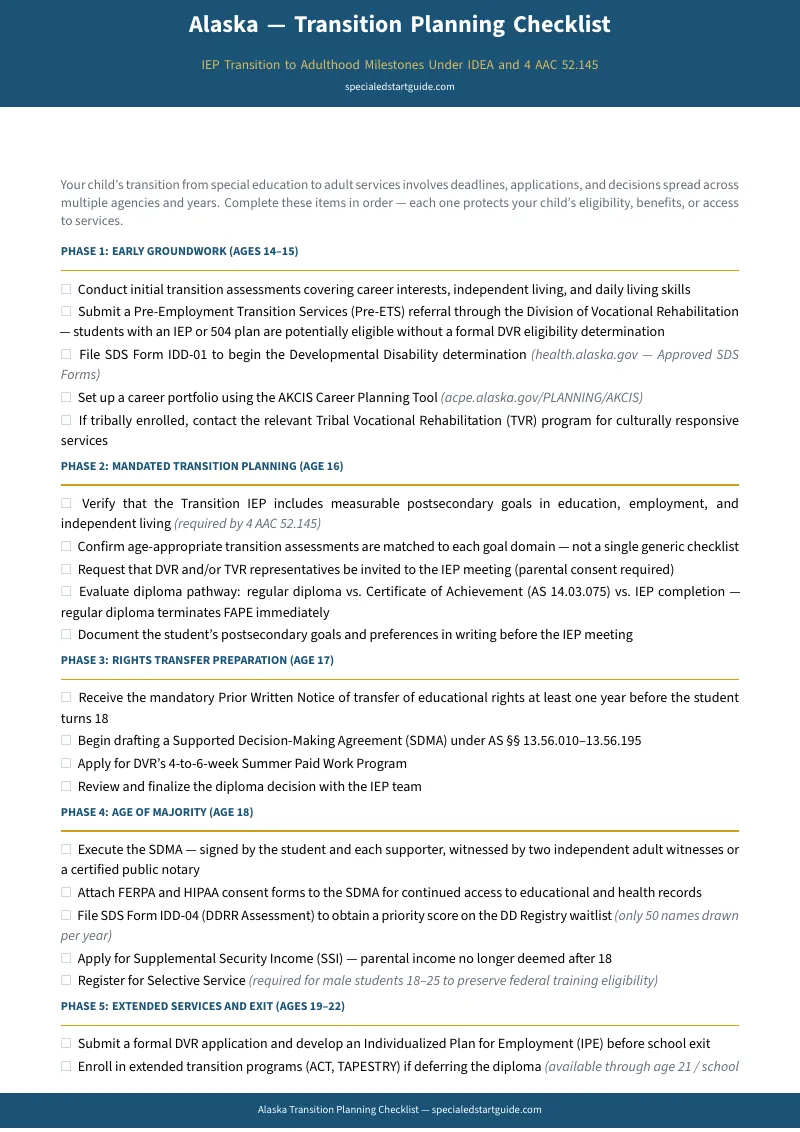
Every milestone from 14 through 22, mapped to the specific agency action your family should take at each stage. At 14: initiate Pre-ETS through DVR and file the DD Determination with SDS. At 16: formalize transition goals in the IEP and invite agency representatives. At 17: draft the Supported Decision-Making Agreement. At 18: manage the rights transfer, apply for adult SSI, coordinate the ABLE account. At 22: execute the handoff from school to adult waiver services. This is not a general checklist — it is a planning calendar calibrated to Alaska's specific agency timelines, statutory deadlines, and waitlist realities.
The DVR and Pre-ETS Referral System
Pre-Employment Transition Services are available starting at age 14 for any student with an IEP or 504 plan — and most families do not learn this until the student is already 17 or 18. The guide walks you through the Pre-ETS eligibility criteria (no formal DVR determination needed — your child is "potentially eligible"), the five core Pre-ETS service categories, how to request a referral through the school or self-refer, and when to transition from Pre-ETS to individualized DVR services with a formal Individualized Plan for Employment. For families in regions served by one of Alaska's 11 Tribal Vocational Rehabilitation programs, the guide maps which regional TVR program covers your community and how TVR coordinates with — or substitutes for — state DVR services.
The DD Registry Waitlist Strategy
This is the section that saves families years. Alaska's DDRR waitlist controls access to Medicaid Home and Community-Based Services waivers — the funding that pays for supported employment, day habilitation, respite, and residential supports after school ends. The guide covers how to file the Developmental Disability Determination application, what the clinical criteria require (severe chronic disability before age 22, substantial limitations in three or more major life activities), the difference between the comprehensive IDD Waiver and the budget-capped Individualized Supports Waiver, and how to keep Medicaid active while your child waits. Most critically, it explains why filing at 14 instead of 18 can mean the difference between receiving services at 25 and receiving services at 30.
The Diploma Pathway Decision Framework
This decision is irreversible and most families do not understand the stakes. A regular high school diploma terminates FAPE eligibility immediately — your child loses access to school-based transition services the day they accept it, regardless of age. An alternate diploma or certificate of completion allows your child to continue receiving FAPE through their 22nd birthday. The guide lays out all three pathways, the eligibility consequences of each, the impact on college applications and military service, and a structured decision worksheet so you can evaluate the tradeoffs before the school steers you toward a default track.
The Supported Decision-Making Toolkit
When your child turns 18, educational rights transfer from you to them — by law. Guardianship is one option, but it strips your child's legal autonomy entirely. Supported Decision-Making Agreements (SDMAs) are the less restrictive alternative: your child retains their legal rights while designating trusted supporters who can help with specific domains like healthcare, finances, education, or housing. The guide provides step-by-step instructions for drafting an Alaska-compliant SDMA under HB 336, explains how to identify and appoint supporters, and includes FERPA authorization templates so you can continue accessing educational records after the rights transfer.
The Rural Alaska and TVR Planning Chapter
Standard career assessment models assume urban infrastructure — public transit, large employers, office and retail environments. In rural Alaska, competitive integrated employment may be limited to a handful of positions at the school, the tribal office, or the village store. The guide explains how to translate traditional subsistence activities — hunting, fishing, trapping, gathering, carving, sewing — into measurable IEP transition goals that regional TVR programs recognize as viable work outcomes. It profiles all 11 TVR programs by region and tribal affiliation, covers telehealth coordination for families who cannot travel to Anchorage or Fairbanks for assessments, and addresses the specific planning adjustments families in off-road communities need to make.
The Financial Protection Suite
SSI adult eligibility changes at 18 — parental income and resources are no longer counted, which means some students who were ineligible as minors may qualify as adults. The guide covers the SSI application process, the Disabled Adult Child (DAC) benefit for children whose parents receive Social Security retirement or disability, ABLE account setup and contribution rules, and the Plan to Achieve Self-Support (PASS) that allows SSI recipients to set aside income for a work-related goal without losing benefits. Every financial tool is explained in terms of how it interacts with the Medicaid waiver and the DVR plan — because the wrong combination can cost your child benefits they cannot get back.
The Agency Communication Templates
Pre-written letters for every stage of the transition process: DVR referral requests, DD Determination applications, school-to-agency coordination meeting requests, dispute resolution complaints, and service delivery documentation letters. Each template cites the specific Alaska statute or federal regulation that creates the agency's obligation to respond. These are not generic form letters — they are Alaska enforcement tools designed to create a paper trail that protects your family's position at every handoff point.
Who This Guide Is For
- Parents whose child has an IEP and is approaching or currently in the transition years (ages 14–22) — whether you are starting early or catching up
- Parents who attended the first transition IEP meeting and left without a clear plan for what happens after school
- Families who need to file for DVR, the DD Registry, and SSI but do not know which applications to submit, in what order, or when
- Parents in rural Alaska who need transition planning that reflects subsistence lifestyles, TVR program availability, and the reality of coordinating services by telehealth
- Parents of students approaching 18 who need to understand the transfer of rights and make a decision about Supported Decision-Making versus guardianship
- Parents facing the diploma pathway decision who need to understand the irreversible consequences before the school schedules the conversation
- Alaska Native families who want IEP transition goals that incorporate cultural and community standards, not just the college-and-career framework designed for Anchorage
- Families whose child is approaching 22 and needs the full agency handoff plan in place before FAPE terminates on their birthday
Why Not Just Use the Free Resources?
Alaska has excellent free transition resources. Transition Alaska provides educator-focused curricula and webinars. Stone Soup Group publishes informational handbooks and offers peer navigation. DVR's website lists Pre-ETS services and eligibility criteria. Here is what those resources do not do:
- No single resource integrates all three agency timelines. DVR explains DVR. SDS explains SDS. The school explains the IEP. But the actual work of transition planning is coordinating all three systems simultaneously — knowing that the DVR referral should happen at the same meeting where the IEP team reviews transition goals, and that the DD Determination needs to be filed years before the student exits school. Free resources address their own domain. This guide maps the entire sequence.
- Transition Alaska's portal is built for educators, not parents. The lesson plans, assessment databases, and professional development materials are designed for transition coordinators and teachers — not for a parent trying to figure out which application to file next Tuesday.
- Stone Soup Group's handbook is informational, not operational. It explains what transition services are and what rights families have. It does not provide step-by-step filing instructions, agency communication templates, or the structured planning tools that turn information into action.
- National resources miss Alaska's specific rules. Wrightslaw and Understood.org cover federal IDEA requirements accurately, but they say nothing about Alaska's age-22 birthday exit rule (not the end of the school year), the DD Registry's 50-per-year draw rate, TVR program eligibility, or subsistence skill integration. Generic national guides applied in Alaska produce generic national plans that miss the state-specific filing deadlines that matter most.
The free resources tell you what Alaska's transition system looks like. This guide gives you the tools to move through it — on a timeline that works for your child, not the one the system defaults to.
— One Planner. Every Agency. Every Deadline.
Special education attorneys in Alaska charge $300 to $500 per hour. A missed DD Registry filing deadline does not cost money — it costs years on a waitlist your child cannot jump. The guide puts every application, every milestone, and every agency handoff into a single coordinated system so nothing falls through the gaps between school, DVR, SDS, and Social Security.
Your download includes the complete guide plus 9 standalone planning tools — 10 PDFs total:
- Complete Transition Guide — 12 chapters covering Alaska's transition system overview, the age-by-age timeline (14–22), diploma pathway decisions, transfer of rights and Supported Decision-Making, Pre-ETS and DVR referrals, rural Alaska and TVR planning, DD Registry and Medicaid waiver strategy, postsecondary education accommodations, financial tools (SSI, ABLE, DAC, PASS), dispute resolution, worksheets and planning tools, and key contacts and resources
- Alaska Transition Planning Checklist — a printable milestone tracker covering every filing deadline, agency referral, and decision point from age 14 through 22
- Age-by-Age Transition Timeline — a one-page visual timeline with checkboxes for every agency action from age 14 through 22
- Agency Communication Log — a landscape fill-in log to document every call, email, and meeting
- IEP Preparation Worksheet — organize postsecondary goals, assessments, and agency invitations before each IEP meeting
- DD Registry Application Tracker — track every form, date, and priority score in the DDRR process
- SDMA Preparation Checklist — step-by-step guide to drafting and executing a Supported Decision-Making Agreement
- Diploma Decision Worksheet — a comparison of the three exit credentials with guided decision questions
- Post-School Services Checklist — everything that must be in place before FAPE ends
- Agency Communication Templates — five pre-written letters citing Alaska statutes for DVR referrals, DD applications, agency coordination, dispute resolution, and service documentation
Instant PDF download. No video courses. No streaming platforms. Print the timeline tonight and start coordinating with your child's team this week.
Money-back guarantee, no time limit. If the guide doesn't change how you approach your child's transition to adulthood, email us for a full refund. No questions asked.
Not ready for the full guide? Download the free Alaska Transition Planning Checklist — a one-page reference with the key milestones, agency contacts, and filing deadlines from age 14 through 22. It's enough to see what's coming — and it's free.
The agencies your child will depend on after school are not going to find your family. You have to find them first — and the waitlist clock is already running.
Frequently Asked Questions
What if the rules change after I buy?
We update the guide when the rules change. Email us any time, even years later, and we'll send you the current edition free.