
Your teenager's IEP team just said "transition" — now what?
Alabama starts transition planning when your child enters ninth grade or turns 16, whichever comes first. That sounds manageable — until you realize the school team handles the IEP compliance, and everything else falls on you. The diploma pathway decision. The vocational rehabilitation referral. The 310 Board application. The transfer of rights at 19. Somewhere between "measurable postsecondary goals" and "contact your local ADRS counselor," you're supposed to figure out how three separate state agencies, a county-level waiver gatekeeper, and the Social Security Administration all fit together.
Most Alabama families discover the gaps the hard way: at 19, when parental decision-making authority vanishes and nobody drafted a Supported Decision-Making Agreement under the Colby Act. Or at 21, when the August 1 rule cuts off services and "the cliff" drops your child into a landscape of eligibility forms and waiting lists with no coordinated support in sight.
The Alabama IEP Transition to Adulthood Guide is a Coordinated Handoff System — a single-source planning tool that maps every regulatory trigger, agency referral, and legal decision point across your child's transition, in the order Alabama families actually face them.
What's Inside the Guide
This is not a motivational booklet or a glossary of acronyms. It is a structured, chapter-by-chapter system for navigating Alabama's transition pipeline — school district, ADRS, 310 Boards, ADMH, Medicaid, SSI — without the $80-to-$500-per-hour professional fees.
- The Alabama Transition Timeline (9th Grade–Age 21) — every regulatory trigger mapped to what your IEP team owes, what you need to request, and when each agency handoff should happen. Not generic federal timelines — Alabama-specific deadlines under Alabama Administrative Code 290-8-9.
- Three-Way Diploma Decision Framework — General Education, Essentials/Life Skills, and Alternate Achievement Standards, with the FAPE consequences of each choice explained plainly. Includes the continuation option for students who receive an Essentials or AAS diploma and remain eligible for services through age 21.
- Transfer of Rights Toolkit — Alabama's age of majority is 19, not 18. The guide covers the full hierarchy of alternatives to court-ordered guardianship: Supported Decision-Making Agreements under the Colby Act (effective August 1, 2023), the ALSDE educational representative appointment, and when guardianship is actually the right call.
- ADRS Pre-ETS and Vocational Rehabilitation Guide — how to access free Pre-Employment Transition Services starting in ninth grade through the Alabama Department of Rehabilitation Services, the five core service areas, and how to transition from Pre-ETS into a formal Individualized Plan for Employment with the 60-day eligibility and 90-day IPE timelines.
- 310 Board and Medicaid Waiver Navigator — step-by-step intake preparation for your county's 310 Board. Eligibility criteria including the two-evaluation rule at age 18, the ID Waiver, Living at Home Waiver, and Community Waiver Program, the Crisis Identification Status scoring, and honest guidance on what to do while waiting on a list of approximately 1,848 people.
- SSI and Financial Planning System — the income-deeming shift at 18, the Student Earned-Income Exclusion, ABLE accounts, and Special Needs Trust considerations — including Alabama's lack of a TEFRA/Katie Beckett pathway, which makes waiver-based Medicaid the only practical route for many middle-income families.
- The August 1 Rule, Explained — exactly how Alabama Administrative Code 290-8-9-.04(3)(b) works, the one-day birthday difference that can mean an entire additional school year, and how to plan around the cutoff.
- Standalone Printable Worksheets — a diploma pathway comparison, decision-making options comparison, ADRS referral tracker, 310 Board intake checklist, financial planning worksheet, transition timeline planner, agency communication log, IEP meeting preparation checklist, and exit portfolio checklist — nine separate PDFs you can print, fill in, and bring to meetings.
- Dispute Resolution Roadmap — IEP facilitation, mediation, state complaints, and due process hearings, with guidance on building the paper trail before you need it and free advocacy resources including ADAP and the Alabama Parent Education Center.
Who This Guide Is For
- Parents of 13- and 14-year-olds whose IEP team just introduced "transition" and who want to make informed diploma and assessment decisions from the start
- Parents approaching the 18th birthday who need to understand the transfer of rights timeline and start the Colby Act or educational representative process before their child turns 19
- Families navigating ages 16–17 — ADRS VR application, 310 Board intake, and the two-evaluation rule all converge in the same critical window
- Parents of students aged 19–21 who are negotiating exit plans with the school district and need to understand how the August 1 rule protects their child's final year of eligibility
Why Not Free Resources?
Alabama has strong free organizations — the Alabama Parent Education Center (APEC), the Alabama Disabilities Advocacy Program (ADAP), the EngageAL app. The problem is not quality. The problem is fragmentation.
APEC publishes individual training materials and fact sheets, each covering one slice of the transition. ADAP's special education manuals are detailed but written in dense, compliance-focused legal language — a rights reference, not a step-by-step planner. The EngageAL app helps students build a draft transition profile, but it does not give parents the coordination binder they need for waiver intake, agency tracking, or decision-making planning. And none of these sources give you a single document that coordinates the IEP, ADRS, 310 Board, SSI, and Medicaid timelines into one actionable sequence.
You could spend 40 hours pulling these sources together, cross-referencing timelines, and hoping nothing slipped through a gap between agencies. Or you could open one guide that already did that work — organized chronologically, written in plain language, and structured around the specific decisions Alabama families face at each stage.
Satisfaction Guarantee
If the guide does not help you navigate your child's transition planning, email [email protected] and we will refund your purchase — no questions, no hoops.
Get the Free Checklist — or the Complete System
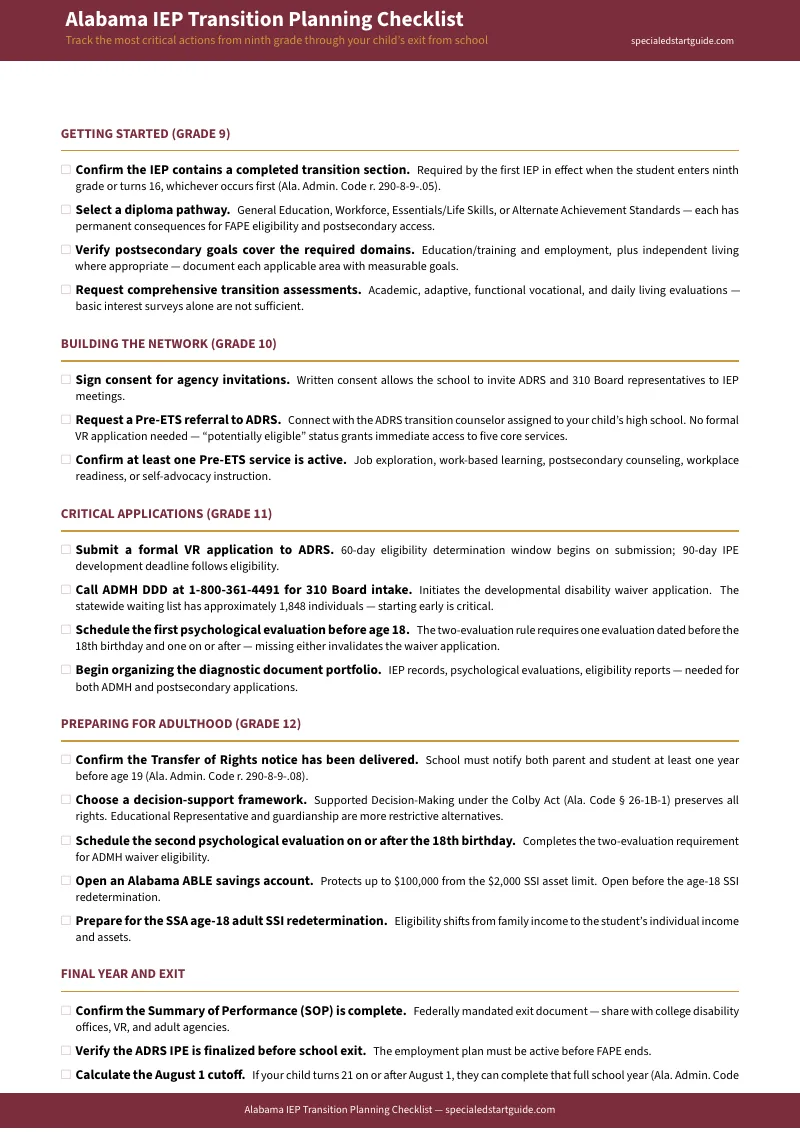
Download the Alabama — Transition Planning Checklist for free — a chronological overview of every critical milestone from ninth grade to age 21. It shows you what to do. The full guide shows you how, with step-by-step instructions, decision frameworks, printable worksheets, and agency navigation for every handoff.
Ready for the complete Coordinated Handoff System? Get the full Alabama IEP Transition to Adulthood Guide — for a fraction of what one hour with a special education advocate would cost — and walk into your child's next IEP meeting knowing exactly what to ask for, when to ask for it, and which agency call to make next.
Frequently Asked Questions
What if the rules change after I buy?
We update the guide when the rules change. Email us any time, even years later, and we'll send you the current edition free.