
99% of SEND Tribunal Cases Decided Were in the Appellant's Favour. Their Strategy Is to Exhaust You Before You Get There. This Playbook Makes Sure You Do.
You received the letter. Maybe it was a refusal to assess. Maybe it was an EHCP so vague that "access to support" and "opportunities for interaction" are the strongest commitments your child's plan contains. Maybe the school placed your child on a reduced timetable without your agreement or a proposed end date. Whatever the trigger, you are now standing at the threshold of the SEND Tribunal — and every instinct is telling you that you're not equipped to cross it.
Here's what the data says: In 2024/25, 99% of SEND appeals decided by the Tribunal were in favour of the appellant. They spent over £150 million defending decisions they knew were legally indefensible. They don't win Tribunals — they win when parents give up. Every refusal letter, every delayed response, every meeting where an officer tells you "we're working within our resources" is designed to drain your energy until you stop fighting. The 18% increase in registered appeals in 2024/25 tells you that thousands of families are refusing to stop. This playbook makes sure you're one of them.
You've read the IPSEA factsheets. You've called SENDIASS and been told the wait is three weeks — while your two-month appeal deadline runs. You've joined the Facebook groups and received fifty different opinions on whether to go to mediation. What you don't have is a single, linear, step-by-step system that takes you from the moment you decide to appeal through to the hearing itself.
The England SEND Tribunal Playbook is the tactical case-building system that transforms you from an overwhelmed parent into an organised, evidence-driven advocate — with every template, checklist, and script grounded in the Children and Families Act 2014, the SEND Code of Practice, and current Tribunal case law.
What's Inside the Playbook
The Tribunal Evidence Bundle System
The Local Authority prepares the final hearing bundle under the Tribunal's practice direction. You submit the evidence you rely on by the deadlines in the Tribunal's directions; for an appeal about plan contents, the parties prepare a working document showing proposed and agreed changes. Use SEND35A for an appeal against a refusal to assess, or SEND35 for other EHC plan appeals. This system gives you a chronological checklist for gathering and organising your evidence, a formatting guide for the working document, and a checklist item for the 1-page child profile that Tribunal judges actually read first. You gather your materials piece by piece over the weeks before your hearing, not in a panic the night before.
The Section F Audit Matrix
61% of registered SEND appeals in 2024/25 related to the contents of EHC plans — and the single most common problem is Section F provision that uses vague, unenforceable language. The audit matrix gives you a systematic tool to scan every line of Section F and flag vague phrases against the SEND Code of Practice's Section F guidance. The Code says provision must be detailed and specific and should normally be quantified. But this goes further than the EHCP Blueprint's weasel word checker: for every vague phrase you flag, the matrix shows you how to draft the replacement wording — detailed and specific, normally quantified, and clear about the level of expertise — so your proposed amendments are ready to submit as part of your Tribunal case.
The Clinical Report Translation Guide
Your Educational Psychologist wrote that your child "would benefit from a structured visual timetable." Your Speech and Language Therapist recommended "a communication-friendly environment." Both recommendations are clinically sound and legally useless. Local Authorities rely on the gap between clinical language and legal language to avoid funding specific provision. This guide shows you exactly how to take each clinical recommendation and draft proposed Section F wording — "15 minutes daily with a Level 3 Teaching Assistant using a personalised visual schedule" instead of "access to visual supports." When specified provision is included in a maintained EHC plan, the Local Authority must secure it unless the parent or young person has made suitable alternative arrangements. You take the clinician's expertise and turn it into a proposed amendment to the plan.
The Mediation Strategy Framework
Before most Tribunal appeals, you must obtain a mediation certificate. But mediation itself is where many parents lose — not because they attend, but because they accept a compromise that trades a permanent legal entitlement for a temporary concession. The framework tells you when mediation is worth attending (narrow disputes, strong evidence, time-critical placements), when to decline and proceed straight to Tribunal, and the five rules that prevent you from agreeing to something in a meeting that you'll regret for years. You'll know before you walk in whether you're negotiating or simply collecting your certificate.
The Enforcement Escalation Pathway
Winning at Tribunal is only half the battle. The Tribunal cannot enforce its own orders. If the LA ignores or delays implementation, you need to escalate — and most parents don't know the pathway. This section maps the full escalation route: formal complaint to the Director of Children's Services, escalation to the Local Government and Social Care Ombudsman (who can recommend a financial remedy the Tribunal cannot), and when to consider Judicial Review through the Administrative Court. It includes a template complaint letter citing the relevant legal provisions, plus guidance for the Ombudsman and Judicial Review steps.
The Disability Discrimination Claim Guide
If your child's school has failed to make reasonable adjustments or treated them unfavourably because of disability under the Equality Act 2010 — a reduced timetable used to manage a disabled pupil's behaviour, exclusion from trips, failure to provide sensory breaks documented in the EHCP — you may be able to bring a separate disability discrimination claim against the school's responsible body in the SEND Tribunal. This is a separate jurisdiction that most parents don't know exists. The guide explains the legal test, how to evidence a failure to make reasonable adjustments, and how a discrimination claim strengthens your overall case.
The Hearing Day Preparation Guide
The night before your hearing, you need to know exactly what happens when you walk into the room. This section covers the structure of a typical SEND Tribunal hearing, how to write and deliver an opening statement, how to prepare for cross-examination of your witnesses and the LA's, what the panel expects from you, and the practical details that reduce anxiety — where to sit, whether to bring water, how to address the judge. You'll walk in prepared, not petrified.
Template Letters and Appeal Wording
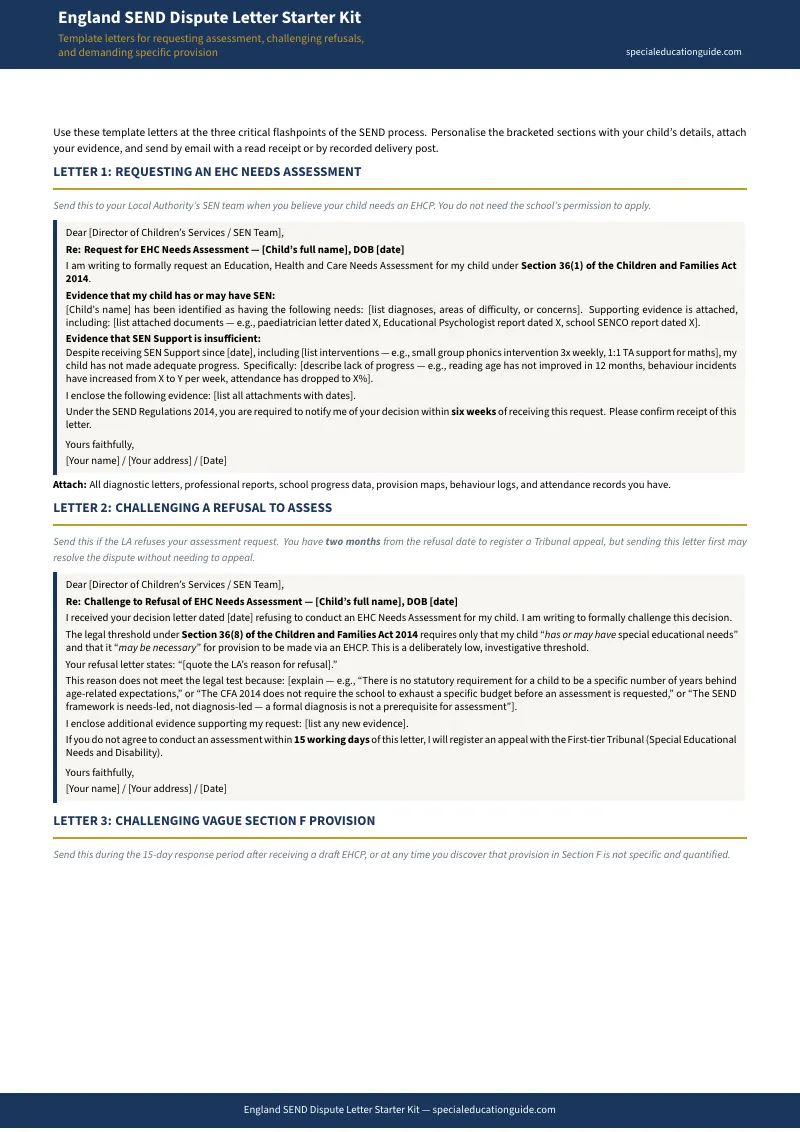
Pre-written letters for requesting an EHC Needs Assessment, challenging a refusal to assess, challenging vague Section F provision, and filing a formal complaint about missing provision. The guide also includes sample appeal wording for EHCP contents and placement disputes, plus the Ombudsman escalation route. You personalise the bracketed sections with your child's details and send.
Who This Playbook Is For
- Parents whose Local Authority refused an EHC Needs Assessment and who need the Tribunal to receive an appeal within two months of the decision letter or one month from the mediation certificate, whichever is later — with grounds that hold up at Tribunal
- Parents who've received a final EHCP with Section F provision so vague it's unenforceable — and want to appeal the contents with a professionally organised case
- Parents fighting a placement dispute where the LA names a mainstream school your child's own professionals say cannot meet their needs
- Parents whose LA has issued a notice to cease maintaining their child's EHCP and who need to appeal before the plan disappears
- Parents whose child has been unlawfully excluded, placed on a reduced timetable without parent agreement, or off-rolled — and want to explore a separate disability discrimination claim against the school
- Parents already registered for Tribunal who need to gather and submit evidence for the hearing bundle, prepare a working document, and get hearing-ready without hiring a solicitor
- Parents who've been through mediation and it failed — and now need a clear roadmap from the relevant appeal form to the hearing
- Parents whose LA has ignored a Tribunal order and need the enforcement pathway — complaint, Ombudsman, Judicial Review
Already Have the EHCP Blueprint?
The England EHCP & SEN Blueprint covers the upstream process: auditing SEN Support, requesting an assessment, reviewing a draft EHCP, writing SMART outcomes, and tracking provision delivery. It's designed for the earlier stages — getting an EHCP right in the first place.
This Playbook picks up where the Blueprint ends. It covers what happens when the LA refuses, when the EHCP is finalised with inadequate provision, when you need to escalate to the Tribunal, and what to do after you win. If you already own the Blueprint, the Playbook completes the toolkit. If you don't, the Playbook stands alone — every template and checklist works independently.
Why Not Just Use the Free Resources?
- IPSEA's free guidance is excellent. It includes model letters and online guidance about evidence, bundles, working documents, and Tribunal hearings. This Playbook brings a printable evidence tracker, Section F audit matrix, mediation framework, and hearing preparation tools together in one place.
- SENDIASS is funded by the Local Authority you're appealing against. SENDIASS advisers are IPSEA-trained and many are genuinely helpful. But they are structurally constrained — funded by the LA, overwhelmed by caseloads, and their support for Tribunal hearings and evidence preparation varies by local service. This Playbook makes you independent of their availability and their employer.
- SOS!SEN webinars cover appeal preparation as well as legal rules. A recorded webinar on "Appeals against contents" costs £10 and gives you 60 minutes of expert-led education. This Playbook adds a printable tracker and tools for organizing your evidence and planning each step across the full appeal process.
- Facebook groups give you fifty opinions and no workflow. "Just send a strongly worded email" is not a Tribunal strategy. "My LA backed down when I mentioned Judicial Review" worked for one parent in one LA in one case. This Playbook gives you a repeatable, evidence-based process that works regardless of which LA you're fighting.
The free resources explain the law. This Playbook turns it into a case file the Tribunal panel can rule on.
— Less Than 15 Minutes With a SEND Solicitor
Specialist SEND solicitors charge £200 to £295 per hour. Full Tribunal representation costs £5,000 to £10,000. Even a private SEND consultant charges £50 for a single strategy session. If you eventually need professional help, the organised case file you build with this Playbook saves hours of billable time — because you're handing your solicitor a structured evidence bundle, not a folder of unread correspondence and half-remembered meetings.
Your download includes 8 printable PDFs — the complete Playbook guide, the Letter Starter Kit, and 6 standalone tools you can print and use immediately:
- Complete Playbook Guide — 15 chapters covering the Tribunal landscape, mediation strategy, appeal registration, evidence bundles, Section F auditing, clinical report translation, placement disputes, refusal appeals, disability discrimination claims, enforcement and Judicial Review, EOTAS provision, phase transfers, looked-after children protections, hearing preparation, and support organisations with legal aid guidance
- SEND Dispute Letter Starter Kit — 3 template letters (EHCNA request, refusal challenge, Section F challenge) plus a red-flag audit table and statutory deadlines reference
- Evidence Bundle Checklist — printable tracker for gathering and organising the evidence you rely on for the hearing bundle
- Section F Audit Matrix — the four-question test, weasel word red-flag list, and fillable worksheet for drafting your challenges
- Clinical Report Translation Guide — reference card for converting EP, SALT, and OT recommendations into enforceable Section F provision
- Mediation Strategy Framework — when to negotiate vs. decline, the five session rules, and the mediation trap to avoid
- Enforcement Escalation Pathway — step-by-step from formal complaint to Ombudsman to Judicial Review, with template letter
- Hearing Day Preparation Guide — what to expect, pre-hearing checklist, and on-the-day tips
Instant PDF download. Print the letter templates tonight. Start building your case tomorrow.
Full refund, no time limit. If the Playbook doesn't change how you prepare for your Tribunal, email us for a full refund. No questions asked.
Not ready for the full Playbook? Download the free England SEND Dispute Letter Starter Kit — three template letters for requesting an EHCNA, challenging a refusal, and demanding specific Section F provision, plus a red-flag audit table and key deadlines. It's enough to send your first legally grounded letter tonight, and it's free.
Local Authorities bet on your exhaustion. In 2024/25, 99% of cases decided by the Tribunal were in the appellant's favour. After tonight, you will be ready to make your case.
Frequently Asked Questions
What if the rules change after I buy?
We update the guide when the rules change. Email us any time, even years later, and we'll send you the current edition free.