
The birthday is eight months away. The legal rights are already slipping.
You sat in the IEP meeting and heard the coordinator mention "transfer of rights." You went home and learned the truth: on your child's 18th birthday, every medical, financial, and educational decision-making right transfers to them — regardless of their disability. You searched for answers and found fragments everywhere. The Court of Chancery's guardianship petition forms. The Delaware Autism Network's supported decision-making guide. Disability Rights Delaware's intake questionnaire. A special-needs attorney's quote for the court-appointed ad litem alone. None of them talked to each other.
Here's what makes this transition in Delaware uniquely complex: unlike most states, Delaware enacted its Supported Decision-Making Act back in 2016, creating a court-free alternative that many families still haven't heard of. But the free resources that cover it don't explain how an SDM agreement coordinates with your child's IEP team under S.B. 180, or why a supporter under 16 Del. C. § 94A cannot actually make decisions or sign documents — a misconception that creates real problems with hospitals, banks, and school districts.
The Delaware Transition Navigator — One Structured System Where You Need Six
This guide replaces the six-tab research session with a single chronological framework. It walks you through every legal option on the spectrum — from informal family support through full Court of Chancery guardianship — and helps you determine which combination actually fits your child's capabilities, not which option the last professional you talked to happened to specialize in.
The difference between this and the free resources isn't that we know more than PIC of Delaware or Disability Rights Delaware. It's that we've organized what they teach — along with the Court of Chancery process, the financial transitions, and the DDDS coordination — into one decision framework you can work through at the kitchen table.
What's Inside
- Capability Evaluation Worksheets — because "does my child need guardianship?" is the wrong question. The right question is domain-specific: can they consent to medical treatment? Manage a bank account? Choose where to live? These worksheets help you evaluate capacity across five domains so the legal framework matches reality, not anxiety.
- Complete SDM Act Walkthrough — Delaware's Supported Decision-Making Act (16 Del. C. § 94A) from start to finish. Who qualifies as a supporter, the witness disqualification rules (supporters named in the agreement cannot serve as witnesses), no notarization requirement, the critical distinction between assisting with decisions and making them, and how to present the agreement alongside HIPAA and FERPA releases to providers who've never seen one before.
- Power of Attorney and Health-Care Directive Toolkit — Durable Financial Power of Attorney under 12 Del. C. § 49A, the Advance Health Care Directive under Delaware's Uniform Health-Care Decisions Act (effective September 30, 2025), the DMOST form for emergency medical scenarios, and HIPAA/FERPA authorization forms. Each one includes the capacity requirement — the young adult must understand what they're signing — and step-by-step execution instructions.
- S.B. 180 Educational Rights Framework — the transfer-of-rights process under 14 Del. C. § 3132, the three-question capacity assessment the IEP team conducts, the Voluntary Grant of Authority form for students who retain capacity, the Educational Representative appointment hierarchy for students who do not (biological parent → adult relative → Educational Surrogate Parent), and how to contest a capacity determination you disagree with.
- Court of Chancery Process Guide — Form CM1 (person and property) vs. CM1-A (person only), the $135 petition filing fee, the $100 administrative deposit, the $2/page docketing scanning fee, the court-appointed attorney ad litem (up to $750 for uncontested cases), the three-month physician examination requirement for Form CM3, the waiver-of-notice process (Form CM5) for uncontested cases, and the typical 7-to-10-week timeline from petition to initial order.
- DDDS Service Coordination — the Division of Developmental Disabilities Services application process, how legal authority documentation affects who signs service agreements, the Lifespan Waiver, and coordinating DDDS intake with the legal transition so you don't face service delays.
- SSI Transition Planning — when your child turns 18, SSA reviews their eligibility under the adult disability standard. This section covers the age-18 redetermination, Representative Payee designation (a free, court-free alternative to guardianship of the property for managing SSI benefits), documentation preparation, and ABLE account planning with the $100,000 SSI exemption.
- Ongoing Compliance Guide — the Annual Update and Medical Statement (Form CM21) for guardians of the person, surety bond requirements and periodic financial reporting (Form CM22) for guardians of the property, and the Guardianship Monitoring Program's ongoing oversight obligations.
- Guardianship Restoration Pathway — if your child's capabilities improve, you can petition for modification or termination. This section covers the court process, the role of ongoing monitoring, and the flexibility of SDM agreements (revocable or modifiable at any time without court involvement).
Who This Guide Is For
You're a Delaware parent or caregiver facing one of these situations:
- Your child turns 18 within the year and you're not sure whether they need guardianship, supported decision-making, or some combination of tools you haven't heard of yet
- You've been told "just get guardianship" but your child makes many decisions independently — you need a framework that protects without overriding their autonomy
- You're trying to coordinate the legal transition with DDDS service applications and the age-22 school exit — and the gaps between systems feel impossible to navigate alone
- You've priced special-needs attorneys at $2,000 to $5,000 and want to know whether court is even necessary before spending on a consultation — especially since the SDM agreement requires no attorney and no notary
- The school sent the S.B. 180 transfer-of-rights notice and you need to decide between the VGA form and a formal Educational Representative appointment before the next IEP meeting
- Your child is 14–17 and you want to start transition planning early, especially DDDS service coordination
Why Not Free Tools Alone?
Free resources in Delaware are excellent — and fragmented. The Delaware Autism Network provides an SDM guide for organizations but doesn't explain how families should coordinate the agreement with IEP teams. The Court of Chancery has petition forms and instructions but provides no context on whether you need them. PIC of Delaware's transition workshops are valuable but don't cover the Court of Chancery filing process or the financial transitions that directly affect your guardianship decision. Disability Rights Delaware's advocacy focuses on qualifying cases, not self-help planning.
This guide doesn't replace any of those resources — it connects them into one decision framework so you can evaluate your options systematically, gather every document the process requires, and walk into any professional consultation fully prepared.
Your Purchase Is Protected
Money-back guarantee, no time limit. If the guide doesn't give you a clear path forward for your child's 18th birthday transition, email us for a full refund. No forms, no hassle.
The Clock Is Already Running
Every month without a plan is a month closer to a birthday that changes everything. Delaware's Supported Decision-Making Act means a court order may not be what your family needs — but figuring that out takes structured evaluation, not a last-minute scramble.
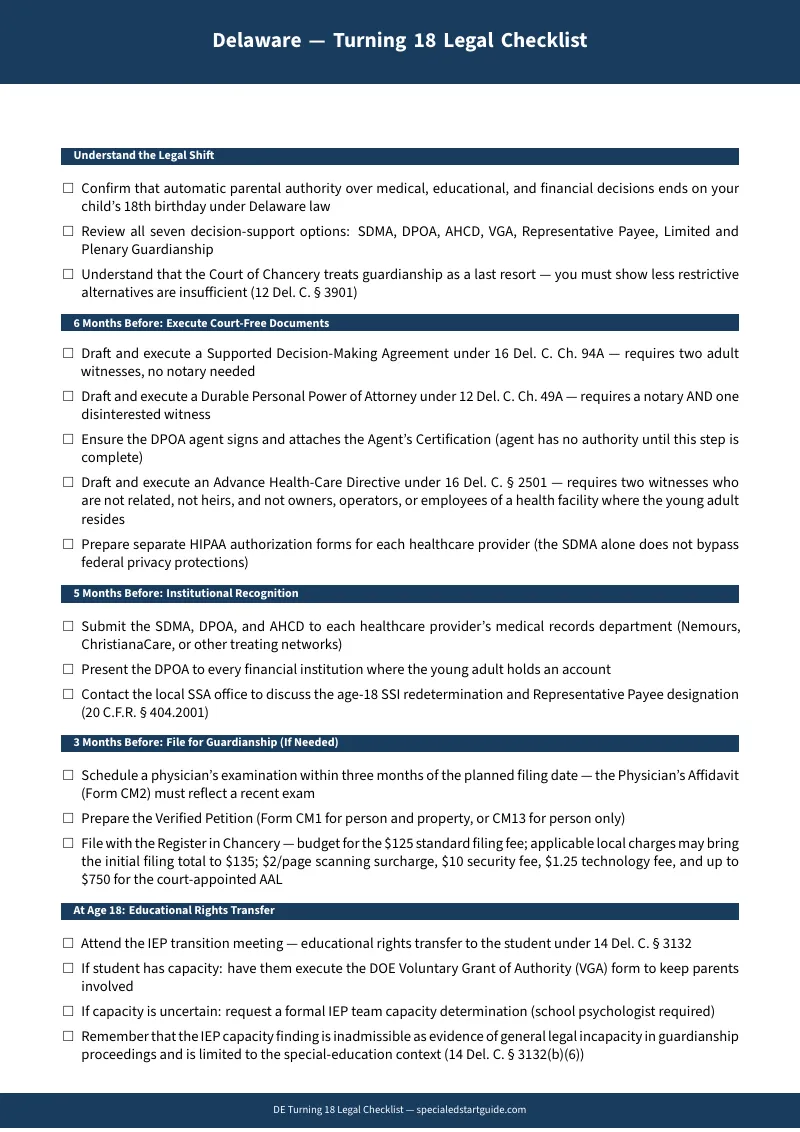
Download the free Delaware Turning-18 Legal Checklist to see the timeline, or get the full guide to start the capability evaluation tonight.
Get the Delaware Guardianship & Alternatives Guide — instant download, .