The Transition Authority Blueprint — Every Legal Path Connecticut Offers, One Guided Decision
Your child's eighteenth birthday is eight months away. The school transition coordinator just told you that "you'll need guardianship" to stay involved in PPT meetings. The pediatrician's office mentioned HIPAA. The bank asked whether you have "legal authorization" to deposit their savings-bond check.
And now you're up at midnight, trying to figure out whether your child needs a guardian, a conservator, a power of attorney, or something you've never heard of called "supported decision-making" — while every state website sends you to a different probate district, a different form, a different set of deadlines.
Here's what nobody tells you: Connecticut law requires that any formal intervention in an adult's decision-making be the least restrictive option that meets their needs. A probate judge cannot appoint a guardian if your family's needs can be met through less intrusive private arrangements. That's not a suggestion — it's statutory.
The Transition Authority Blueprint is the diagnostic planning system that helps you identify which of Connecticut's six legal paths actually fits your child's capacity, your family's circumstances, and your values — before you spend a single dollar on attorney fees. It replaces the scattered state websites, confusing court forms, and conflicting advice with one guided decision framework.
What's Inside
The IQ-Based Statutory Decision Tree
Connecticut draws a hard legal line between guardianship and conservatorship based on diagnosis. If your child has a documented intellectual disability with an IQ of 69 or below, you file with DDS. If they have autism, TBI, or psychiatric conditions with an IQ of 70 or above, you're in conservatorship territory — completely different forms, evaluations, and court expectations. The decision tree identifies your child's legal pathway in under ten minutes, so you don't waste months preparing the wrong petition.
The Decision Worksheet
A structured self-assessment that maps your child's actual capacities across eight life domains — medical decisions, financial management, residential choices, educational planning, social relationships, personal safety, vocational activity, and daily living. Each domain gets a rating, and the ratings point to which combination of legal tools matches the real support needs — not the worst-case scenario the school coordinator warned you about.
The Out-of-Court Planning Package
Step-by-step instructions for the four documents that can replace court intervention entirely — a durable financial power of attorney compliant with the Connecticut Uniform Power of Attorney Act, a health care representative designation with an integrated HIPAA release, a FERPA educational records consent form, and a formal supported decision-making agreement. Each comes with execution requirements (two witnesses plus notarization), capacity thresholds, and plain-language instructions.
The Probate Court Filing Companion
If court involvement is necessary, this section walks you through every step of filing Form PC-700 (guardianship) or the applicable conservatorship petition. Complete fee schedules — $250 for guardianship applications, $250 for conservatorships — with instructions for filing a fee waiver (Form PC-184A) if the family qualifies. Step-by-step preparation for the mandatory DDS Assessment Team evaluation, including what the three DDS evaluators look for and how to ensure your child's actual capabilities are accurately captured.
The SSI and Benefit Coordination Module
Parental income deeming stops the month after your child turns eighteen — opening the door to SSI and Medicaid HUSKY C eligibility based solely on their own limited assets. But the application process is dense, the $2,000 countable resource limit is easy to accidentally exceed, and the SSA has its own Representative Payee appointment process that doesn't recognize powers of attorney or court guardianships. The module walks through each step, including how to set up an ABLE CT account to shelter up to $100,000 without jeopardizing SSI eligibility.
The Integrated Transition Timeline
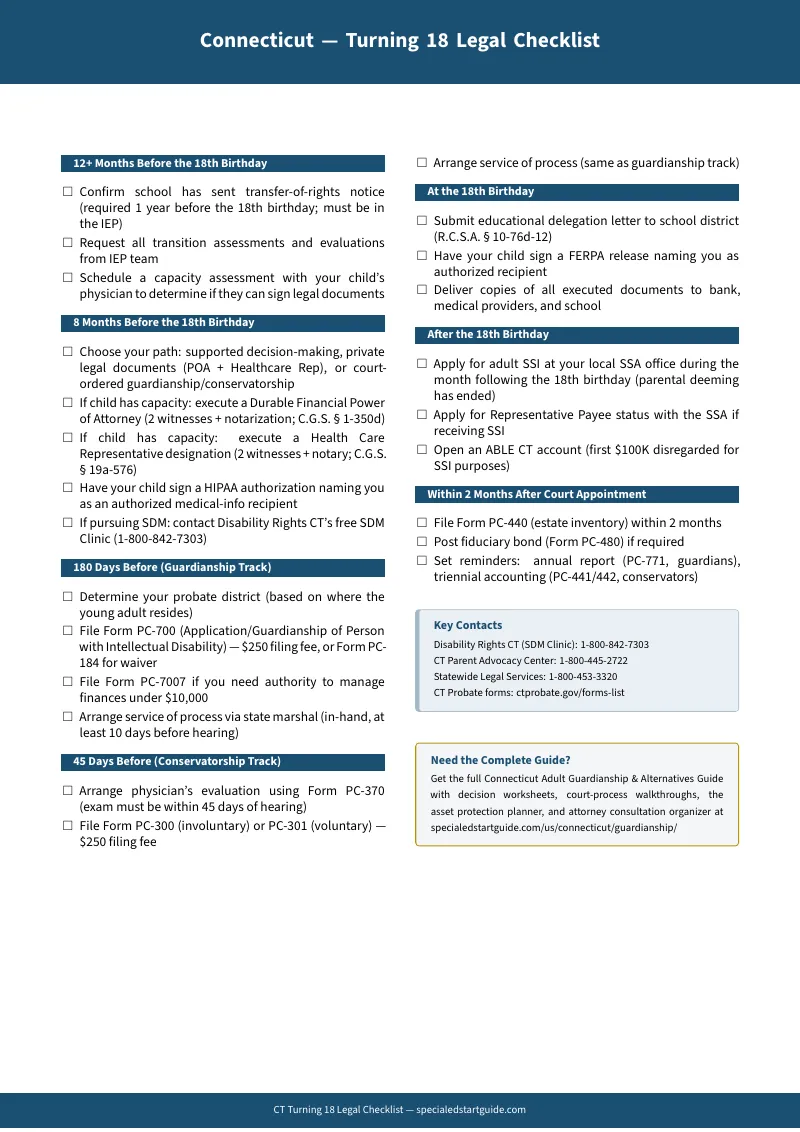
A chronological roadmap from age seventeen to eighteen-and-a-half that aligns school IEP transition requirements, probate court filing windows, and adult agency eligibility deadlines into one calendar. When to file the PC-700 (up to 180 days before the 18th birthday). When the DDS evaluation must be submitted (at least 45 days before the hearing). When to apply for adult SSI. When the transfer of educational rights takes effect. Every deadline in sequence, so nothing slips through.
The Attorney Consultation Organizer
A fillable workbook that compiles your child's medical evaluations, financial data, capacity observations, and legal questions into the package a special-needs attorney needs on day one — because when attorneys charge $300–$600 per hour, showing up organized saves real money.
Who This Guide Is For
- Parents of teens with intellectual disabilities (DDS-eligible) who need to understand the guardianship process, prepare for the DDS evaluation, and advocate for limited rather than plenary authority
- Parents of neurodivergent teens (autism, ADHD, learning disabilities with IQ of 70+) who need to secure decision-making authority without court intervention — because guardianship isn't even available to them under Connecticut law
- Families navigating the SSI/Medicaid transition who need to coordinate benefit applications, Representative Payee status, and ABLE CT accounts without accidentally disqualifying their child
- Any Connecticut family whose child receives special education services and whose 18th birthday is approaching — whether they need a simple power of attorney or a full probate filing
Why Not Just Google It?
You could. Connecticut's probate court website has the forms. The DDS portal lists the evaluation process. CPAC publishes transition brochures. Disability Rights Connecticut runs an SDM clinic.
But none of them shows you how the pieces connect. The probate site doesn't explain when guardianship is overkill. The DDS portal doesn't mention that a power of attorney might handle everything you need. The school transition team's "you'll need guardianship" advice is technically a common administrative misconception — your adult child can delegate educational decisions to you in writing, no court required.
The guide's value isn't the information. It's the decision architecture — the diagnostic worksheet, the timeline, the capacity mapping — that turns scattered facts into a clear, sequenced plan customized to your family.
Satisfaction Guarantee
If the guide doesn't help you identify the right legal path for your family, email us for a full refund. No time limit, no conditions.
Start With the Free Checklist
Download the Connecticut Turning-18 Legal Checklist — a 24-item milestone checklist organized by deadline, covering every action from the first IEP transition meeting to the SSI application window. It tells you what to do and when. The full guide tells you how, with the worksheets, templates, and filing instructions to do it right.