Your Child Is Gifted and Struggling — and the School Says Pick One
Your child scored in the 97th percentile on a cognitive test. They can explain black holes to their uncle and debate ethics with their grandmother. They also can't finish a five-paragraph essay, melt down after school every day, and have started refusing to go at all.
You brought the private evaluation to school. You showed them the ADHD diagnosis, the processing speed gap, the working memory score that sits 30 points below the rest. And they said: "Your child is too smart for an IEP."
That statement isn't a policy. It's not a regulation. It's a legal misunderstanding that you can challenge — and this playbook shows you exactly how.
The Dual-Recognition Framework: Serve Both Sides of Your Child
Free resources define what twice-exceptional means. This playbook provides the Dual-Recognition Framework — the legal citations, evaluation tools, and meeting scripts to get both disability services and gifted programming in the same plan.
Instead of arguing that your child needs help despite being smart, you argue what federal law actually says: high cognitive ability does not disqualify a child from disability services, and a disability does not disqualify them from gifted programming. The two are not opposites. They coexist, and the school is required to address both.
What's Inside
- The "Too Smart for an IEP" Legal Brief — the exact federal regulations, OSEP policy letters, and case citations that prohibit denying eligibility based on grades or cognitive ability, with plain-language explanations of what each one means for your next meeting
- Evaluation Decoder — how to read your child's WISC-V or psychoeducational report, when to request the General Ability Index (GAI) instead of the Full Scale IQ (FSIQ), what a 23-point (about 1.5 SD on the WISC-V) index gap actually means, and how masking hides the disability behind the giftedness
- Dual-Programming Playbook — step-by-step frameworks for getting disability accommodations and gifted access in the same IEP or 504, including accommodations in AP, IB, and honors classes where schools often refuse them
- Pushback Script Vault — word-for-word spoken and written responses to the six most common school deflections: "too smart for an IEP," "grades are fine so no educational impact," "no accommodations in AP/IB/honors," "gifted or resource room — pick one," "she's just unmotivated," and "we must finish RTI first"
- Strength-Based IEP Goals — goal frameworks that build on your child's abilities instead of reducing them to deficits, with executive functioning goals designed for high-ability students
- Prior Written Notice Response Template — a fill-in-the-blank letter for responding to evaluation refusals and eligibility denials, citing the specific regulations the school is required to address
- State Gifted Mandates Reference — which U.S. states require gifted identification and programming, and how to use that mandate to strengthen your dual-programming request
- International Frameworks — dedicated chapters for the UK SEND Code of Practice and EHCP process, Ontario's IPRC and Regulation 181/98, and Australia's Disability Standards for Education and NCCD
- Eight printable worksheets — Evaluation Request Letter Template, GAI Score Decoder Worksheet, IEP Meeting Agenda and Notes, Accommodation Tracker, Communication Log, Prior Written Notice Response Template, Pushback Script Vault, and Strength-Based IEP Goals
Who This Is For
This playbook is built for parents navigating a system that sees either the giftedness or the disability — but refuses to acknowledge both at the same time.
- Your child has a private evaluation showing high cognitive ability alongside deficits in working memory, processing speed, executive functioning, or written expression
- The school denied an IEP evaluation or eligibility because "grades are fine"
- Your child was removed from or denied entry to a gifted program because of behavior, incomplete work, or a disability diagnosis
- You've been told "we can do a 504 or gifted services, but not both"
- You manage daily post-school meltdowns, homework resistance, or emerging school refusal that the school doesn't see
- You've read Wrightslaw and the parenting books but need the specific evaluation tools and meeting scripts for a 2e profile
Why Free Resources Aren't Enough for 2e Advocacy
Wrightslaw is an excellent resource for understanding federal special education law — but it covers the full breadth of IDEA, not the specific dynamics of twice-exceptional identification. It doesn't walk you through GAI-vs-FSIQ score interpretation. It doesn't provide scripts for the "too smart for an IEP" conversation. It doesn't cover how to maintain gifted placement alongside disability services.
Understood.org explains what an IEP is and what a 504 plan is. It doesn't explain why a school psychologist might use the Full Scale IQ to mask a processing deficit that the General Ability Index would reveal, or how to request a different scoring method in writing.
Parent Facebook groups offer emotional validation — and they're valuable for that. But "my advocate said to request PWN" is not the same as having the pre-drafted letter in your hands with the regulatory citations filled in.
This playbook fills the gap between "understanding your child's rights" and "walking into a meeting with the tools to exercise them."
The Alternative Costs More — and Takes Longer
A private special education advocate charges $75–$250 per hour. An initial file review alone runs $400–$1,000. A special education attorney requires a $3,000–$10,000 retainer before they pick up the phone.
Many twice-exceptional disputes can be resolved at the initial school-team meeting when parents present organized legal citations, psychometric analysis, and prepared responses to common deflections. The playbook gives you the same framework advocates use — at a fraction of one billable hour — so you can attempt resolution yourself. If professional help is needed later, the case file you've built reduces the time they spend getting up to speed.
Satisfaction Guarantee
If the playbook doesn't give you what you need for your child's advocacy, email [email protected] for a full refund, no time limit. Every purchase is a one-time download — no subscription, no recurring charges.
Your Child Deserves Both
Your child isn't "too gifted for help" or "too disabled for challenge." They're both, and the law supports both. The only question is whether you walk into the next meeting with a general understanding of your rights — or with the specific citations, scripts, and tools to enforce them.
Get the Twice-Exceptional Advocacy Playbook
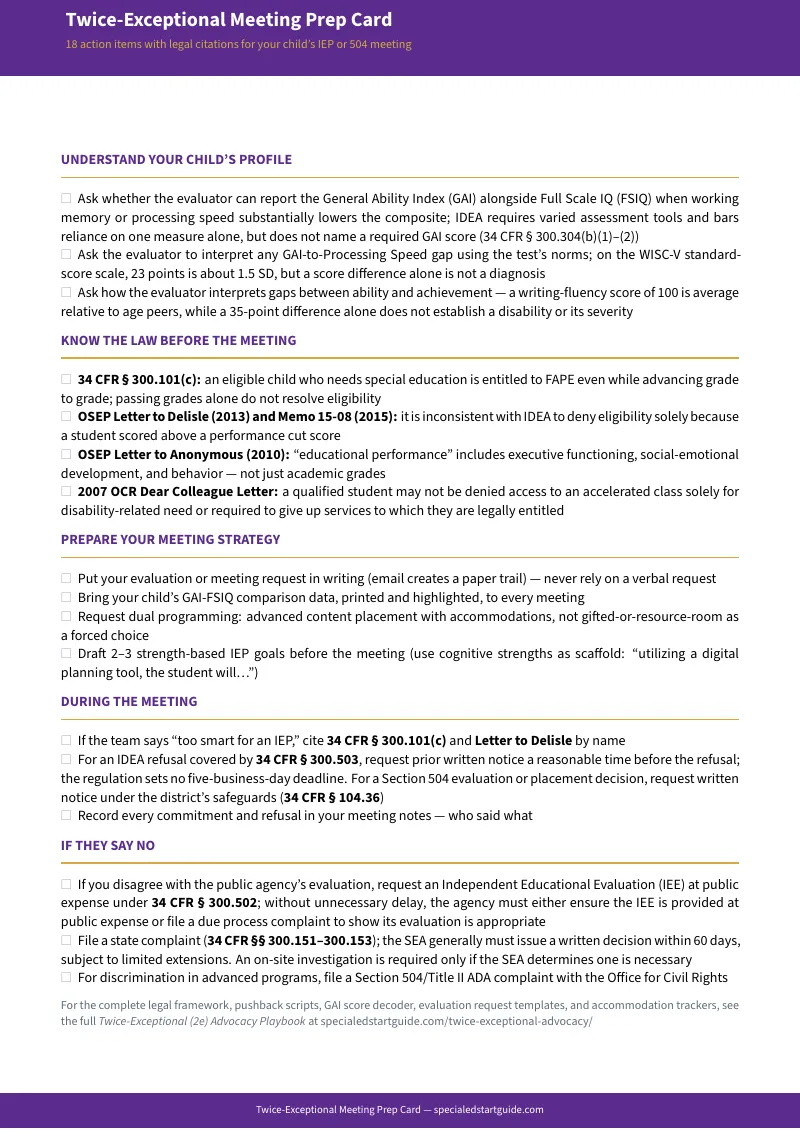
The free meeting prep card gives you the key legal citations and evaluation questions for one meeting. The full playbook prepares you for the entire advocacy process.