An IQ Score Is Not a Placement — It Is One Data Point in a Decision That Belongs to the Whole Team
Nearly half of all students with intellectual disabilities in the United States spend the majority of their school day in segregated classrooms. That number has nothing to do with what those students can learn. It has everything to do with school teams that hear a label and skip straight to the self-contained room — before asking what supports would make general education work.
You've been to the meeting where the school psychologist circled an IQ score, the special education coordinator pulled out the placement form, and everyone started talking about "life skills" and "alternate curriculum" before you could ask a question. You've downloaded the free checklists from the national organizations and found lists of rights you already know — but zero scripts for what to say when those rights are ignored at the table.
The Intellectual Disability IEP & Placement Playbook is the Placement Defense System that fills the gap between knowing your child has a right to inclusive education and being able to enforce it when the school says no. It gives you the exact cognitive and adaptive test decoders, placement evaluation matrices, pushback scripts, and IEP goal banks that professional advocates charge $75–$300 per hour to prepare — built specifically for the intellectual disability profile and mapped across four legal systems.
What You Get
- Cognitive and Adaptive Test Decoder — because an IQ score of 72 does not mean what the school tells you it means. How to read WISC-V, SB5, Leiter-3, Vineland-3, and ABAS-3 results, calculate the confidence interval the school omitted (a score of 72 with an SEM of 3.2 means the true score could be as low as 66), spot subtest scatter that invalidates a Full Scale composite, and challenge a verbal battery given to a child who communicates through AAC or sign language
- Placement Evaluation Matrix — because the school must prove that supplementary aids and services cannot support your child in general education before proposing a more restrictive setting, not the other way around. A structured decision framework that holds the team to the legal burden of proof: which specific supports were attempted, for how long, with what data, and why they were deemed insufficient
- Pushback Script Library — because the school has a script for every excuse, and you need one for every response. Six verbatim scripts you can say at the table: "the life skills room is the best fit," "he can't access the grade-level curriculum," "her IQ is 73 so she's too high for ID," "an alternate diploma is just a formality," "we don't have the resources for general education support," and "he needs to be with kids like him" — each paired with the legal standard and space to write the team's reply
- Alternate Assessment Decision Planner — because agreeing to alternate assessment in 3rd grade often permanently strips your child's access to a standard high school diploma, and most parents are never told that. Five questions to ask before consenting, with space to write the data the school must produce and the long-term consequences of each path
- IEP Goal Bank — because "will improve life skills" is not an IEP goal, and a child with an intellectual disability still deserves literacy, numeracy, and the skills that lead to employment. SMART-formatted goals blending academic content with functional skills across communication, social, adaptive, and transition domains — written for the intellectual disability learning profile, not copied from a generic template
- Developmental Delay to ID Transition Guide — because when your child turns 8 or 9 and the "Developmental Delay" category expires, the school may present the switch to Intellectual Disability as a fast track to segregation. How to navigate the mandatory re-evaluation, challenge whether low scores reflect true cognitive impairment or unaddressed instructional barriers, and ensure the new label opens resources without closing doors
- Diploma Pathway Protection — because by the time you realize the school has shifted your child to an alternate assessment track, the credits needed for a standard diploma may already be out of reach. Questions to ask at every transition meeting, the data to request before any assessment change, and documentation strategies that keep the standard pathway open through high school
- Cross-Jurisdiction Legal Framework — because a family in Ontario needs to know that "Least Restrictive Environment" translates to "placement in a regular class" under Regulation 181/98, and a family in Melbourne needs to know that "reasonable adjustments" under the Disability Standards for Education 2005 carries the same enforceable weight. Full coverage of the US (IDEA/Section 504), England (EHCP/Children and Families Act 2014), Canada (provincial IEP/IPRC systems), and Australia (NCCD/DSE 2005)
- Behavioral Supports and Discipline Protections — because a child who leaves the desk is communicating something the environment is not meeting, not "being defiant." Positive Behavior Support frameworks, discipline protections, manifestation determination procedures, and the evidence trail that prevents your child from being punished for disability-related behavior
- Worksheets and Planning Tools — the Evaluation Report Decoder Worksheet, Placement Evaluation Matrix, Alternate Assessment Decision Planner, IEP Goal Tracker, Meeting Preparation Checklist, Agency Communication Log, Accommodation Menu, Diploma Pathway Safeguard Checklist, Pushback Script Library, and IEP Goal Bank, so you walk into every meeting with printables you can fill in
Why Not the Free Resources?
You have probably already downloaded the free guides from TIES Center, The Arc, or your state's Parent Training and Information Center. Those resources do an important job: they explain what the law says. But they stop at the threshold of the meeting room.
Free resources tell you that placement must be individualized. The Placement Defense System gives you the verbatim script for when the special education director says "we've considered the regular class, and we believe the self-contained setting is appropriate" — including the specific data questions that force the team to document which supplementary aids and services were tried before proposing a more restrictive placement.
Free resources tell you that IEP goals should be measurable. This playbook gives you a goal bank designed for the intellectual disability profile — SMART-formatted goals that blend grade-level academic access with functional skill instruction, because your child deserves both literacy and life skills, not one traded for the other.
Free resources tell you that alternate assessment exists. This playbook explains the diploma trapdoor: how consenting to alternate assessment in 3rd grade can permanently remove the standard diploma pathway, and gives you the five vetting questions that make the school prove this is the right decision rather than the convenient one.
Who It's For
Parents of children with intellectual disabilities — from the initial eligibility meeting through high school transition — who are navigating any of these situations:
- Your child's team is proposing a self-contained classroom and you want to understand what supports should have been tried in general education first
- Your child is at the age 6–9 re-evaluation where Developmental Delay transitions to Intellectual Disability, and you want to protect placement and curriculum access through the category change
- The school is proposing alternate assessment or a certificate of completion, and no one has explained what that closes off permanently
- Your child has a genetic syndrome and the school assumes the diagnosis determines the ceiling
- Your child's IEP goals focus on compliance and self-care and nothing addresses reading, math, or the academic skills that build independence
- The evaluation report shows an IQ near the cutoff and the school is treating it as a hard line rather than a statistical estimate
- You're outside the US and every resource you've found is written for American IDEA law
The Placement Defense System vs. a Private Advocate
A special education advocate charges $75–$300 per hour, typically requiring a retainer of $950 for a basic IEP meeting package. Comprehensive case representation runs $2,500 or more. Special education attorneys require retainers starting at $2,500–$5,000 with hourly rates of $300–$500.
This playbook delivers the same structural preparation — the test decoders, the pushback scripts, the goal templates, the legal framing — for a fraction of a single advocate consultation hour. For 90% of IEP meetings, that preparation is enough. For the remaining 10%, you arrive at the advocate's office with an organized evidence file and documented concerns instead of a stack of frustration — which means fewer billable hours even when you do need professional help.
Satisfaction Guarantee
Full refund, no time limit. If you open the playbook and decide it's not what your family needs, email [email protected] and we'll process the refund. No form, no justification, no waiting period.
The Free Tier
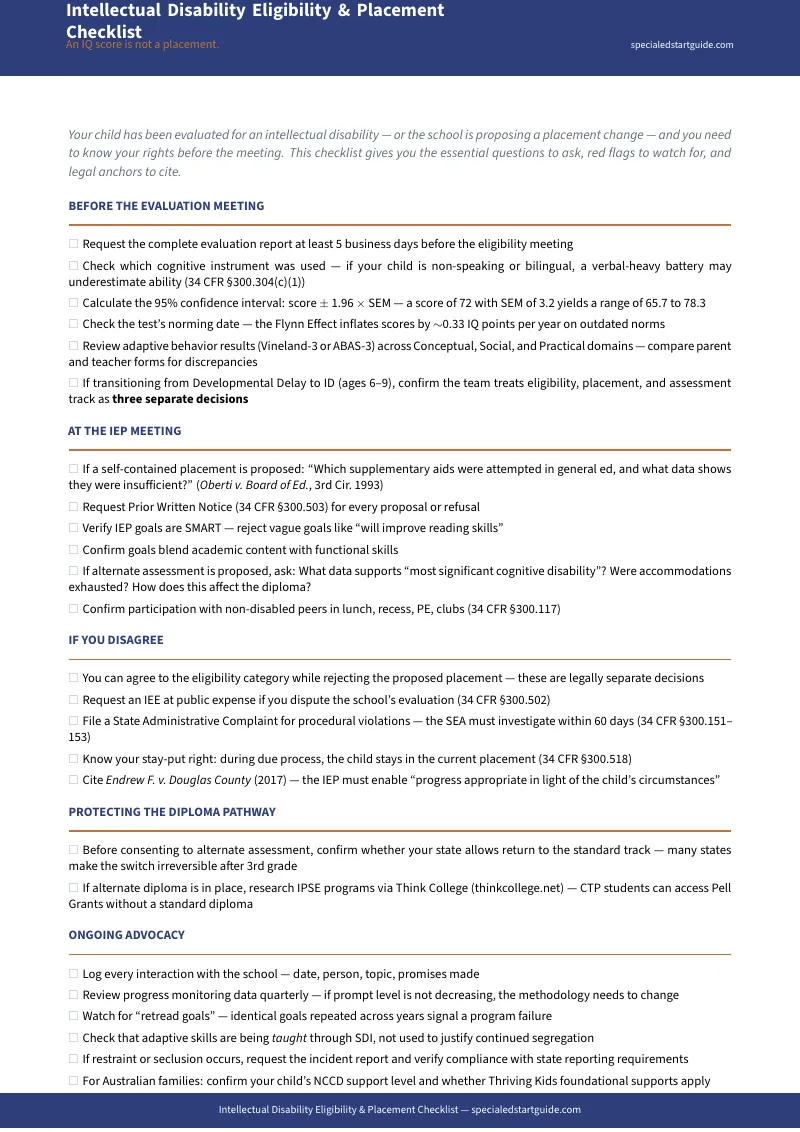
Not sure if you're ready for the full playbook? Start with the Intellectual Disability Eligibility & Placement Checklist — a printable checklist of eligibility evidence, placement questions, and diploma-pathway decisions to bring to your next IEP meeting. It's free, it's immediate, and it works on its own. The full playbook goes deeper — but the checklist is a powerful first step.