
They Handed You a Form Called "Notice of Transfer of Rights." Here's What Happens Next.
It arrives during an ARD meeting, usually when your child is 17. The special education coordinator explains that under Texas Education Code § 29.017, every legal right you've exercised since birth — medical consent, financial management, educational decisions, treatment authorization — transfers directly to your child on their 18th birthday. Unless a court says otherwise.
You went home and started searching. You found Disability Rights Texas, which publishes the statutory Supported Decision-Making Agreement form and plain-language guides — dense, thorough, and silent on whether an SDMA alone is enough for your child's specific situation. The Arc of Texas has advocacy toolkits — scattered across separate PDFs with no chronological sequence. Navigate Life Texas has empathetic articles — but you'd need to click through forty pages to piece together one plan. And every guardianship attorney you called quoted $3,000 to $10,000 before you even know whether court is necessary.
Here's the problem nobody tells you: guardianship isn't a yes-or-no decision. It's a spectrum. Texas was the first state in the nation to codify Supported Decision-Making Agreements as a formal alternative to guardianship. Between "do nothing" and "full guardianship," there are at least five legal frameworks — SDMAs, Powers of Attorney, HIPAA releases, Representative Payee designations, limited guardianship — and the right answer depends on your child's specific decision-making capabilities across medical, financial, educational, and residential domains.
The Texas Guardianship & Alternatives Guide is the Transition Authority Planner — the structured decision system that walks you through the full legal authority spectrum so you choose the right framework before the birthday arrives, not after a crisis forces your hand.
What's Inside the Guide
The Capability Evaluation Worksheets
Before you can choose the right legal framework, you need an objective assessment of your child's decision-making capabilities — not a gut feeling, not a doctor's one-paragraph letter. The worksheets guide you through four domains: medical consent (can they understand treatment options and communicate preferences?), financial management (can they handle a bank account, budget SSI income, avoid exploitation?), educational decisions (can they participate meaningfully in IEP and transition planning?), and residential choices (can they evaluate housing options and understand a lease?). Each domain maps directly to the legal tools available in Texas. The result isn't a diagnosis — it's a structured analysis that tells you whether an SDMA resolves the need, whether you should layer Powers of Attorney, or whether the evidence points toward court.
The Chapter 1357 SDMA Workbook
Texas's Supported Decision-Making Agreement is the least restrictive legal tool available — the individual retains full decision-making authority while a designated supporter helps gather information, access records, and communicate decisions. But an SDMA has strict execution requirements under Chapter 1357 of the Texas Estates Code: the form must substantially match the statutory template, the individual must sign voluntarily without coercion, and it must be witnessed by two people over age 14 or notarized. The workbook includes the current statutory form, step-by-step execution instructions, the supporter's fiduciary duties (good faith, loyalty, conflict avoidance), and plain-language scripts for presenting the agreement to doctors who've never seen one, banks that don't know what it authorizes, and school administrators who confuse it with guardianship.
The Power of Attorney and HIPAA Toolkit
For families whose child has the capacity to sign a contract but needs delegated authority in specific domains, the toolkit covers Durable Financial Powers of Attorney, Medical Powers of Attorney, Educational Powers of Attorney, and HIPAA disclosure forms. Each tool has different capacity thresholds and execution requirements — a Medical POA only activates when the individual lacks capacity, while a Durable Financial POA shares control immediately. The toolkit explains which combinations address which gaps, so you build exactly the legal scaffolding your child needs without going to court.
The County Court Navigation System
If guardianship is necessary, your first challenge is figuring out which court handles the petition — and Texas makes this harder than any other state. In Harris, Dallas, Tarrant, and Bexar counties, Statutory Probate Courts hold exclusive jurisdiction with specialized compliance divisions that actively audit guardian reports. In mid-sized counties, County Courts at Law share jurisdiction with the Constitutional County Court. In rural counties, the Constitutional County Court handles guardianship cases — and the judge is not legally required to be a licensed attorney. If the case becomes contested in a Constitutional County Court, it must be transferred to a District Court. The navigation system helps you identify your court, understand its procedures, and prepare accordingly.
The Court Process Preparation Workbook
A Texas guardianship application requires medical documentation with a strict expiration window: the Certificate of Medical Examination from a licensed physician is valid for only 120 days before filing. You also need to prepare for the court-appointed Attorney Ad Litem who will independently represent your child's interests, the court investigator who evaluates the proposed guardian, and the evidentiary hearing where you must prove by clear and convincing evidence that less-restrictive alternatives are not feasible. The workbook organizes every document, maps every deadline, and walks you through what to expect at each stage — including the cost breakdown: filing fees ($150–$350), citation and service fees ($80–$150), and Attorney Ad Litem fees ($500–$2,500+).
The SSI Age-18 Redetermination Organizer
On your child's 18th birthday, parental income deeming stops — which means some children who were financially ineligible during childhood qualify for SSI for the first time. But existing recipients face a complete reassessment using the strict adult disability standard, and approximately one-third lose their benefits. The organizer prepares you for the Disability Determination Services interview: which school records and medical documentation to compile, how the Substantial Gainful Activity threshold works, when Section 301 educational continuation applies, and what to do if benefits are denied (Form SSA-561 Request for Reconsideration, filed within 60 days).
The ABLE Account Financial Planner
Texas ABLE accounts let you save up to $100,000 without jeopardizing SSI eligibility — but the rules changed significantly for 2026. The standard annual contribution limit is now $20,000. The ABLE-to-Work provision (made permanent) lets employed account holders contribute an additional $15,650 from their own wages if they don't participate in an employer retirement plan. The age-of-onset limit expanded from before age 26 to before age 46. And if the balance exceeds $100,000, SSI cash benefits suspend — but Medicaid coverage stays active. The planner tracks resources against the $2,000 SSI limit, calculates contribution caps, and maps the interactions between ABLE balances, SSI payments, and Medicaid eligibility.
The Medicaid Waiver and Benefits Coordination Guide
The Texas HCS waiver interest list has over 100,000 individuals waiting. Getting on the list, maintaining your position, and understanding how guardianship status interacts with waiver eligibility requires careful coordination. The guide covers HCS registration, the distinction between a court-appointed guardian and an SSA Representative Payee (the SSA has its own system and does not recognize state court guardians for benefits management), Disabled Adult Child benefits, and the resource limits that determine ongoing eligibility.
Guardianship Restoration
Guardianship doesn't have to be permanent. Under Texas Estates Code Chapter 1202, the ward or any interested person can petition for restoration of capacity if the individual's abilities improve. The court appoints an Attorney Ad Litem, reviews updated medical evidence, and can modify or terminate the guardianship. The guide covers the petition process, the evidence standard, and how to prepare for the restoration hearing — because the goal was always the least restrictive arrangement that protects your child while preserving their autonomy.
Who This Guide Is For
This is for Texas parents facing the 18th birthday transition — whether you're eight months out and scrambling, or years ahead and planning strategically.
- You received the Notice of Transfer of Rights and realized you have months to figure out whether your child needs guardianship, supported decision-making, or something in between — and nobody gave you a framework for deciding
- Your child can make many decisions independently but struggles in specific domains, and "just get guardianship" feels like it would strip rights your child doesn't need to lose
- You live in a rural Texas county and have no idea which court handles guardianship petitions or what to expect when the judge may not be a licensed attorney
- Your child receives SSI and you need to prepare for the Age-18 Redetermination — one wrong step and a third of recipients lose benefits
- You've been told to open an ABLE account but the contribution rules, SSI exemptions, and Medicaid interactions make it feel like a trap you'll accidentally trigger
- You're on the HCS waiver interest list and need to understand how guardianship, Representative Payee status, and benefit eligibility interact
- You've priced guardianship attorneys at $3,000 to $10,000 and want to know whether court is even necessary before writing that retainer check
Why Not Just Use Free Resources?
The free resources are excellent — and they're fragmented, incomplete, and not sequenced for decision-making.
Disability Rights Texas publishes the statutory SDMA form and plain-language guides that explain what supported decision-making is. But an SDMA is one tool on a spectrum of five+. DRTx doesn't walk you through the capability evaluation that determines whether an SDMA is sufficient, or help you coordinate the SDMA with Powers of Attorney, HIPAA releases, and SSI Representative Payee designations.
Navigate Life Texas has empathetic, parent-written articles covering nearly every transition topic. But the information is spread across dozens of individual pages with no chronological sequence — you're assembling a puzzle without the picture on the box.
The Arc of Texas provides advocacy toolkits and a pooled trust program. But the materials are designed for broad awareness, not the county-by-county court navigation and domain-specific capability analysis that determine which legal framework your family actually needs.
County court websites list filing fees and office hours. They don't explain why a Harris County Statutory Probate Court operates fundamentally differently from a rural Constitutional County Court, or what that means for your family's guardianship experience.
This guide takes everything these organizations publish — the statutory forms, the legal frameworks, the transition timelines — and organizes it into a structured decision sequence that starts with "what can my child do independently?" and ends with "here's the legal framework that fits, here's how to execute it, and here's how to protect benefits in the process."
Satisfaction Guarantee
Money-back guarantee, no time limit. If the guide doesn't give you a clear path forward for your child's 18th birthday transition, you get a full refund. No questions, no forms, no waiting.
The Free Checklist Gets You Started. The Full Guide Gets You Through.
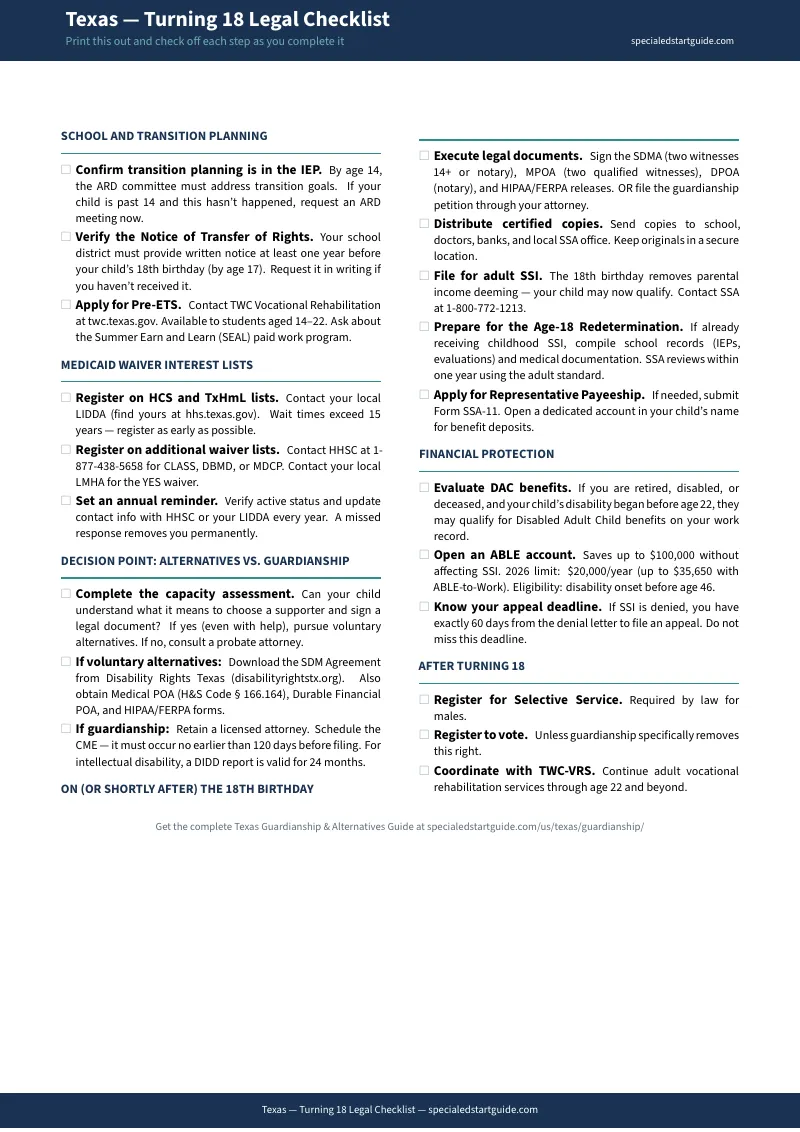
Download the free Texas Turning-18 Legal Checklist — 18 items covering the legal authority spectrum from supported decision-making through full guardianship, with key deadlines and the critical first steps every Texas family should take.
When you're ready for the capability evaluation worksheets, the complete SDMA workbook, the court process preparation, and the SSI/ABLE financial planning framework, the full guide picks up where the checklist stops.
Get the Texas Guardianship & Alternatives Guide — instant download, start the capability evaluation tonight.