Your Child Turns 18. Your Legal Authority Disappears. Do You Have a Plan?
On your child's 18th birthday, New York law presumes them fully competent — regardless of any disability diagnosis. The right to talk to their doctor, participate in their IEP, manage their bank account, and advocate with OPWDD or Social Security vanishes in a single day. No warning. No grace period. No exception.
Most parents learn this too late. They rush into a guardianship petition, spend thousands on attorneys, and permanently remove civil rights from the person they're trying to protect. Some of those families didn't need a guardianship at all — they needed a Supported Decision-Making Agreement, a Health Care Proxy, and a Power of Attorney. But nobody told them those options existed, and by the time they found out, the petition was already filed.
The Transition Authority Blueprint
The New York Adult Guardianship & Alternatives Guide is not a pamphlet about guardianship. It is a complete planning system for the turning-18 transition — built specifically for New York families whose child has an intellectual or developmental disability.
Instead of handing you a stack of court forms and wishing you luck, this guide starts where you actually are: uncertain about your child's capabilities, overwhelmed by agency timelines, and terrified of making the wrong legal call. It walks you through a structured capacity assessment, compares every legal mechanism New York offers from least restrictive to most, and gives you the preparation tools to execute whichever path fits — all without guessing, and all without paying an attorney to explain what your options are.
What's Inside
- Capacity Self-Assessment Worksheet — a printable two-page tool that rates personal care, medical, financial, educational, and vocational skills so you're working from evidence rather than anxiety when choosing a legal path
- The full Article 82 Supported Decision-Making walkthrough — New York's newest legal alternative, fully implemented under 14 NYCRR Part 634 as of November 2025, with the complete AIM Services facilitation process explained step by step
- Health Care Proxy and HIPAA release preparation — exactly how to maintain medical decision-making access after 18 without going to court, including what doctors look for when they evaluate capacity
- Durable Power of Attorney guidance — when a financial POA is enough, when it isn't, and how to execute one correctly under New York's General Obligations Law
- Article 17-A petition companion — a step-by-step walkthrough of the Surrogate's Court process, from obtaining the two required medical certifications to preparing for the hearing, aligned with the court's free DIY petition software
- Article 81 guardianship overview — how Supreme Court proceedings work, what the court evaluator looks for, and how tailored powers preserve your child's remaining rights
- OPWDD Front Door and CCO enrollment timeline — the eligibility documentation, the tenth-of-the-month enrollment cutoff, and how to connect with community habilitation, respite, and housing services without missing a single deadline
- SSI Age-18 Redetermination preparation — what changes when parental income deeming ends, the 2026 federal benefit rate of $994/month plus the New York State Supplement, and how ABLE accounts protect eligibility with a $20,000 annual contribution limit
- ACCES-VR connection guide — when to apply, what Pre-Employment Transition Services cover, and how to coordinate vocational rehabilitation with your child's school exit plan
- Age-by-age master timeline — every milestone from age 14 through 22 across school transition, OPWDD, ACCES-VR, SSA, and legal planning, unified into one chronological path so nothing slips through the cracks
- Five printable planning tools — Capacity Self-Assessment Worksheet, Decision Pathway Comparison Chart, Agency Communication Log, Transition Timeline Planner, and Court Filing Preparation Checklist, each a 1–2 page fillable PDF
Who This Is For
This guide is for parents in New York whose child with an intellectual or developmental disability is approaching their 18th birthday — typically 8 to 12 months out — and who need to understand their legal options before the transition clock runs out.
It is especially useful if you're in one of these situations:
- You're not sure whether your child needs a guardianship, or whether alternatives like SDMAs and Health Care Proxies would provide enough coverage
- You want to file an Article 17-A petition yourself and need a plain-language companion to the court's forms and procedures
- You're coordinating between multiple state agencies — school, OPWDD, ACCES-VR, SSA — and losing track of deadlines and requirements
- Family members disagree about your child's capacity, and you need an objective framework to assess their functional abilities before making a legal decision
Why Free Resources Aren't Enough
The information exists. Court websites publish the forms. OPWDD posts the eligibility criteria. Nonprofit webinars cover the basics. The problem is not access — it is fragmentation.
Free resources cover one agency at a time. INCLUDEnyc explains the transition timeline, but not how to file a guardianship petition. The Unified Court System provides the forms, but not how to evaluate whether you need them. OPWDD's Front Door website describes the process, but not how to time it against the CCO enrollment cutoff or coordinate it with your child's school exit. No single free resource connects all of these systems into one planning sequence — which is exactly where families fall through the gaps.
A special needs attorney connects all the pieces, but at per hour in retainer fees, most families are paying for an explanation of their options before they've even decided which path to take. This guide gives you that explanation for a fraction of the cost, and if you do end up needing an attorney, arriving with organized records and a clear understanding of your options can save you thousands in billable hours.
The Free Checklist vs. the Full Guide
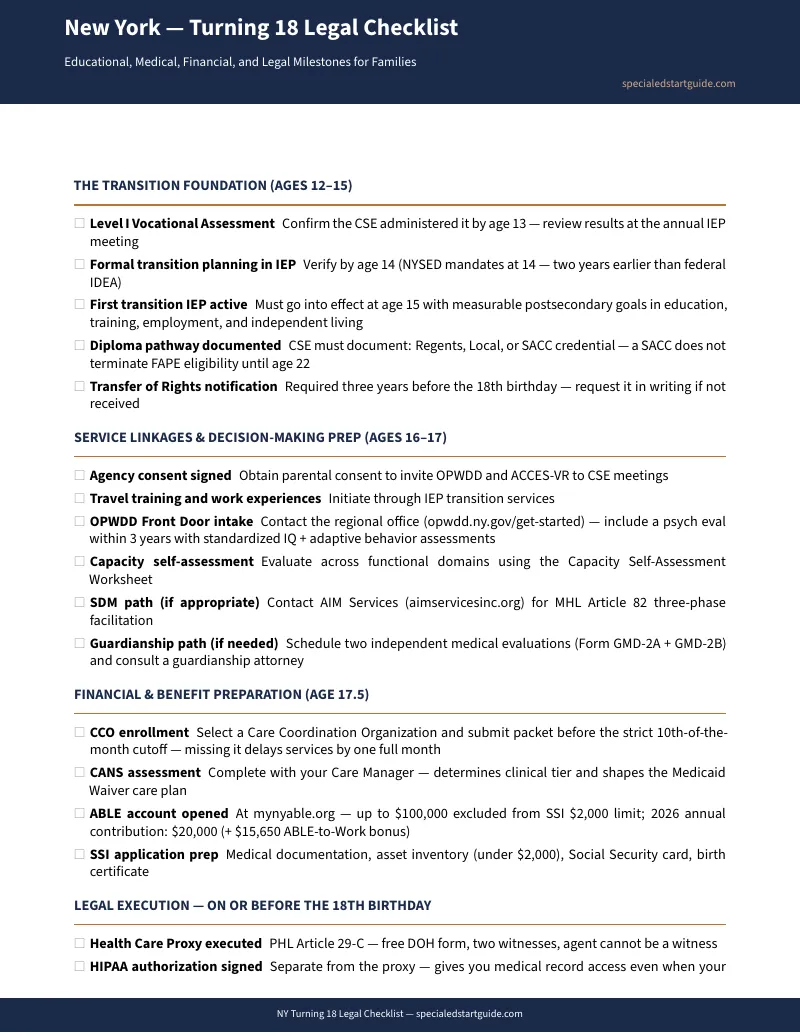
The free New York — Turning 18 Legal Checklist gives you the what: every milestone from age 12 through 22 on two printable pages. The full guide gives you the how — with the Capacity Self-Assessment Worksheet, step-by-step legal mechanism walkthroughs, agency preparation guides, financial planning tools, and a unified timeline that connects school, court, and state agencies into one actionable plan.
Start with the checklist. If you want the full system, the guide is here when you're ready.
Satisfaction Guarantee
If the guide doesn't help you understand your options and build a transition plan, email us within 30 days for a full refund. No forms. No questions.