Your Child Turns 18 in Eight Months. You Haven't Started the Legal Paperwork. Here's Everything You Need to Do — and the Order to Do It In.
The school just handed you a transfer-of-rights notice. It says that on your child's 18th birthday, every decision you've been making — IEP approvals, medical consents, bank account management — transfers to them. Automatically. Regardless of their disability. The notice is one page long and tells you nothing about what to do next.
You Googled "Maine guardianship turning 18" and found two kinds of advice. The first: disability advocacy sites explaining that guardianship strips civil rights and that you should explore alternatives. They're right — but they don't tell you how to actually set up those alternatives in Maine, what forms to use, or what to do when a hospital refuses to recognize your paperwork. The second: elder law attorneys offering $400 initial consultations and $1,500–$4,000 in planning fees. They're competent — but the price tag makes you wonder if there's a middle path.
The Turning-18 Legal Blueprint is that middle path. It maps Maine's complete decision-support spectrum — from a signed SDM agreement that costs nothing to execute, through powers of attorney and protective arrangements, all the way to the full guardianship court process — into a single step-by-step workbook with fillable worksheets, form-completion instructions, and the exact statutory citations Maine probate courts expect to see in your paperwork.
What's Inside the Guide
The 8-tier decision-support spectrum, ranked from least to most restrictive — because Maine's UGCOPAA legally requires probate courts to consider less-restrictive options before granting guardianship. The guide maps every option (SDM agreements, HIPAA and FERPA releases, Durable Financial POA, Advance Health Care Directive, Educational POA, Protective Arrangements under Form PP-601, limited guardianship, and full guardianship) with the capacity standard required for each one, so you can see exactly which instruments your child qualifies to sign and which might require court involvement.
Step-by-step form-completion instructions for the actual Maine Probate Court paperwork — because downloading blank PDF forms from a county website and figuring out what to write in each field are two very different things. Covers Form PP-201 (Guardianship Petition), Form PP-502 (Adult Guardianship Plan), Form PP-505 (Physician's or Psychologist's Report), and Form PP-601 (Protective Arrangement). Each form gets annotated guidance: what the court expects in each field, where families commonly make mistakes, and how to document that you've considered less-restrictive alternatives — the exact showing the court visitor will be looking for.
Out-of-court document drafting guidance for every non-guardianship instrument — because the single most common mistake families make is assuming they need guardianship when a combination of POAs and releases would provide the same practical protection without removing any civil rights. Execution requirements for each document under Maine law: who needs to sign, whether a notary is required, how many witnesses (the Advance Health Care Directive requires two in-person witnesses — electronic signatures don't count), and which institutions you need to distribute copies to.
The SSA Representative Payee setup that most families get wrong — because the Social Security Administration does not recognize state-issued powers of attorney or court-ordered guardianships for managing SSI or SSDI benefits. At all. You need a completely separate federal designation, a dedicated bank account with specific titling requirements, and an understanding of 2026 resource limits ($2,000 countable resources for SSI eligibility) and ABLE account rules ($20,000 standard annual contribution limit, $35,650 with the ABLE-to-Work extension). The guide covers the application process, reporting obligations, and how to avoid the resource traps that cause benefit suspensions.
The Supported Decision-Making reality check — because SDM is genuinely valuable, and also genuinely misunderstood. Disability Rights Maine and the Maine Parent Federation both promote SDM, and they're right to. But neither organization's public materials clearly explain that Maine has not enacted a standalone SDM-agreement statute — meaning an SDM agreement, on its own, does not legally bind third parties. A bank can refuse to follow instructions from an SDM supporter. A hospital can refuse to share records with an SDM team member. The guide shows you exactly how to pair an SDM agreement with HIPAA releases, FERPA releases, and powers of attorney so the combination actually holds up when a third party pushes back.
Ten fillable planning worksheets — not theoretical exercises, but the actual planning tools that reduce a complex legal transition into concrete steps: a Decision-Support Assessment that maps your child's abilities across life domains, a Court-Filing Preparation worksheet, an SSI/ABLE Financial Tracker, an Emergency Contacts and Backup Agents sheet, plus a Timeline Tracker, Court Visitor Interview Prep, SDM Team Planner, Document Execution Checklist, HIPAA/FERPA Release Planner, and Annual Reporting Calendar.
Who This Guide Is For
- Parents in Maine whose child is approaching 18 and who need to understand every legal option before making a decision that affects their child's civil rights — not just the option the school or a doctor mentioned in passing
- Parents who received the MUSER age-17 transfer-of-rights notice and realized they have months, not years, to get paperwork in place
- Families who want to avoid guardianship if possible but need to know exactly how to make the less-restrictive alternatives work in practice — including what to do when a bank or hospital doesn't cooperate
- Parents whose child already turned 18 without any legal arrangements in place, who need to set up protections retroactively
- Families who looked at attorney fees ($1,500–$4,000 for full planning) and need to understand what they can handle independently before deciding whether to hire counsel
Why Free Resources Aren't Enough for This Transition
Disability Rights Maine publishes an SDM handbook and alternatives-to-guardianship overview. They're the state's Protection and Advocacy agency, and their materials are authoritative — but they're also written from an organizational perspective that focuses on alternatives to guardianship. If your family determines that some level of court involvement is genuinely necessary, DRM's materials won't walk you through the petition process. They also won't represent you — DRM only takes intakes from individuals with disabilities who are resisting or trying to terminate existing guardianships.
The Maine Parent Federation offers transition guides and peer support. Their materials are parent-friendly and supportive — and also deliberately general, covering broad concepts rather than specific form-completion steps. When you're sitting at the kitchen table with a blank PP-201 petition form, the Federation's booklet tells you that guardianship exists. It doesn't tell you what to write in Box 4.
County probate court websites post blank PDF forms. Court clerks are legally prohibited from giving you legal advice — they can tell you which form to file, but they cannot tell you how to fill it out. And the forms themselves are scattered across 16 different county websites with varying levels of digital organization.
This guide exists because the gap between "understand your options" and "execute the paperwork correctly" is where most Maine families get stuck — and where the consequences of getting it wrong are measured in lost rights, locked-out medical conversations, and benefit suspensions.
What You Get
The Maine Adult Guardianship & Alternatives Guide (Turning 18) — a multi-chapter guide covering the complete transition, plus standalone planning tools:
- The complete guide — 8-tier decision spectrum, out-of-court document drafting, court filing process, financial transition planning, emergency provisions, modification and termination, Maine agencies directory, and privacy protections
- Decision-Support Assessment (decision-support-assessment.pdf) — map abilities across medical, financial, educational, residential, and social domains
- Court-Filing Preparation (court-filing-preparation.pdf) — forms, fees, 14-day service, and 10-day PP-505/PP-506 deadlines
- SSI/ABLE Financial Tracker (ssi-able-financial-tracker.pdf) — 2026 resource limits, Representative Payee reporting, and ABLE contributions
- Emergency Contacts & Backup Agents (emergency-contacts-backup-agents.pdf) — continuity if a primary agent is unavailable
- Timeline Tracker (timeline-tracker.pdf) — age 14 through the week after 18, including the court path if needed
- Court Visitor Interview Prep (court-visitor-interview-prep.pdf) — less-restrictive facts, dwellings, and communication notes for PP-506
- SDM Team Planner (sdm-team-planner.pdf) — 2–4 supporters plus the statutory instruments that actually bind third parties
- Document Execution Checklist (document-execution-checklist.pdf) — signing order, notary, two in-person AHCD witnesses, distribution log
- HIPAA/FERPA Release Planner (hipaa-ferpa-release-planner.pdf) — one authorization per provider, plus the school release
- Annual Reporting Calendar (annual-reporting-calendar.pdf) — PP-203, PP-502, PP-209, and conservator filings
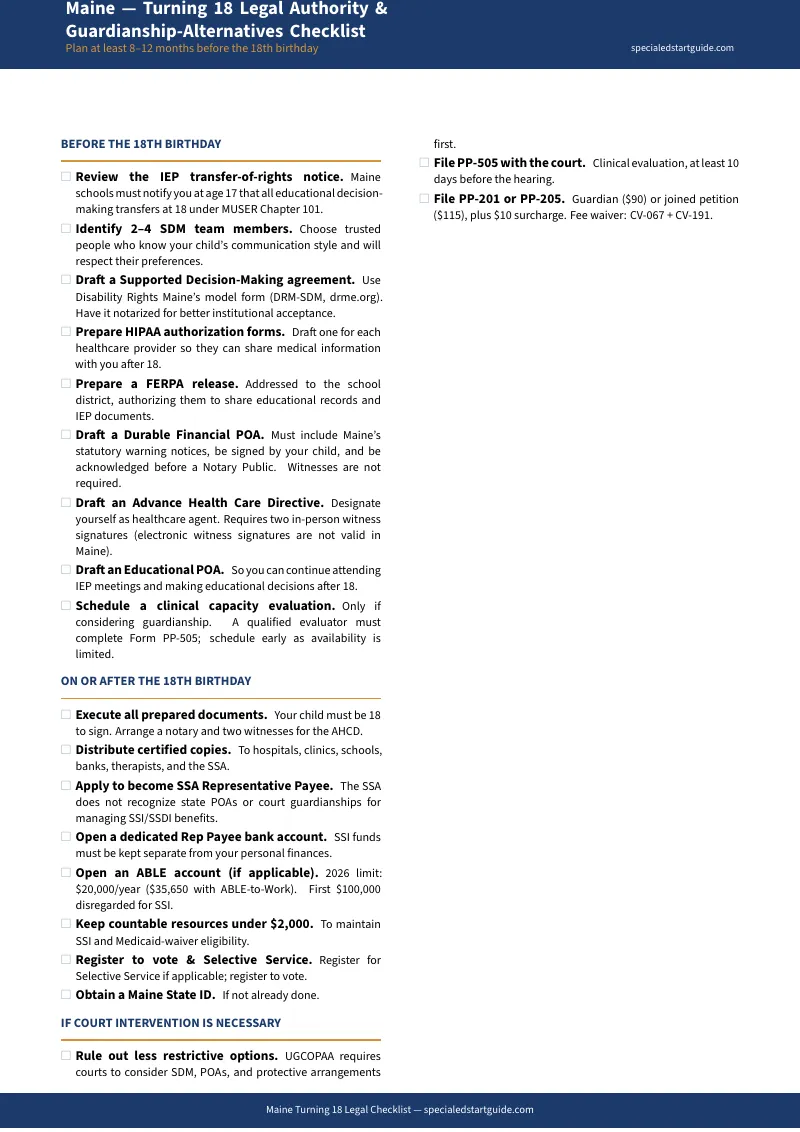
Plus the Maine — Turning 18 Legal Checklist — a standalone two-page checklist with 27 action items from age 14 through post-guardianship reporting, ready to print and use tonight.
— less than 15 minutes of a special-needs attorney's billing rate.
100% Satisfaction Guarantee
If the guide doesn't give you the clarity and tools you need, email [email protected] and we'll refund every cent. No forms, no hoops, no questions.
Your Child's 18th Birthday Doesn't Have to Be a Legal Crisis
Download the free Maine — Turning 18 Legal Checklist and start working through the transition timeline tonight. When you're ready for the full step-by-step system — form-completion instructions, document drafting guidance, financial transition tools, and the complete decision-support framework — upgrade to the full Guide.