
Your Child Needs an Assessment. Nobody Has Told You Which One, Where to Get It, or What to Do With the Results.
Your child's teacher flagged concerns at the last parent-teacher meeting. Or the polyclinic doctor wrote a referral letter to KKH and told you to wait. Or you have been watching your child struggle with reading for two years and you know — you know — something is going on that is not laziness, not attitude, not a phase they will grow out of.
So you started researching. You found the MOE Parents' Guide — a 30-page PDF that explains what SEN means without telling you what any of it costs, how long you will wait, or which specific tests your child needs. You went to the SG Enable website and found the Enabling Guide — a directory of services that does not compare public wait times against private costs, because the government has no incentive to help you choose. You searched KiasuParents and Reddit and found parents sharing contradictory advice about polyclinic referrals, private psychologists, SEAB deadlines, and assessment types they cannot name correctly.
Meanwhile, the clock is running. The polyclinic waitlist for a comprehensive assessment at KKH or NUH is 6 to 18 months. If your child is sitting the PSLE next October, you do not have 18 months. If your child is in Primary 3 and falling behind every term, you do not have 18 months of "wait and see" either. And if you decide to bypass the queue and go private, you are looking at SGD 1,500 to SGD 3,200 — without any guarantee that the report you pay for will actually unlock the school accommodations or SEAB exam arrangements your child needs.
The Singapore Special Ed Assessment Decoder is the Assessment Navigation System — a 13-chapter guide that maps every assessment type available in Singapore (developmental, psychoeducational, ASD, ADHD, speech, OT, behavioral), places the public and private pathways side by side with real costs and timelines, teaches you how to read the clinical report that comes back, and gives you the exact SEAB Access Arrangement blueprint so your child's assessment translates into actual exam accommodations — not a document that sits in a drawer.
What's Inside the Assessment Decoder
The Public vs. Private Pathway Comparison — With Real Numbers
No existing Singapore resource places the public and private assessment routes side by side with actual costs, actual wait times, and actual trade-offs. The polyclinic-to-KKH route is heavily subsidized but takes 6 to 18 months, and 53% of families report severe confusion navigating referral loops. The private route delivers results in 1 to 3 months but costs SGD 1,500 to SGD 3,200 depending on the assessment type. Both produce clinically valid reports — a registered private psychologist's report carries equal weight with MOE and SEAB. The Decoder maps the decision framework so you choose based on your child's timeline and your family's budget, not guesswork.
Every Assessment Type Explained — Because "Psychoeducational" Is Not One Test
A comprehensive psychoeducational assessment uses the WISC-V for cognitive testing and the WJ-IV for academic achievement — with Singapore-specific norms from the SG LEADS study. An ASD assessment requires the ADOS-2 and ADI-R. An ADHD evaluation needs multi-informant Conners 4 rating scales, structured clinical interviews, and evidence of symptoms across both home and school settings. The Decoder explains what each assessment measures, which specific instruments clinicians use, what the results mean, and what each one costs privately — so you never pay SGD 3,000 for a battery of tests that does not answer your actual question.
The SEAB Access Arrangement Blueprint — The Chapter That Protects Your Child's PSLE
SEAB requires two categories of evidence for exam accommodations: a medical diagnostic report and a school observation report. Both are mandatory. A clinical report alone is insufficient. The Decoder covers every available accommodation (extra time, separate room, rest breaks, word processor, human reader, human scribe), the principle SEAB uses to evaluate each request (accommodations cannot compromise the assessment objective of the subject — which is why human readers are approved for Mathematics but denied for English), the 2025 policy change that eliminated re-assessment requirements for permanent conditions, the exact application timeline (February of the exam year — not February when you start thinking about it), and what to do if SEAB rejects your application.
Report Interpretation — Because Clinicians Write for Other Clinicians, Not for You
Your child's assessment report contains standard scores, percentile ranks, index scores, and diagnostic codes. The Decoder teaches you what each number means in plain language: how to read WISC-V index scores (Verbal Comprehension, Visual Spatial, Fluid Reasoning, Working Memory, Processing Speed), why the discrepancy analysis is the most important section in the report, what red flags signal an incomplete report, and how to translate clinical findings into the specific classroom accommodations your child needs. Because a diagnosis without actionable recommendations is clinically interesting and practically useless.
The Private Assessment Cost Matrix — So You Know What You Are Paying For
Government resources deliberately omit private sector costs. The Decoder provides the current price ranges across major assessment types: basic cognitive testing (SGD 1,200–1,600), ADHD assessment (SGD 1,700–2,700), school readiness (SGD 1,600–2,600), comprehensive psychoeducational (SGD 2,400–3,000+), and ASD assessment (SGD 2,000–3,200). Each entry explains what is included in the fee — cognitive testing, clinical interviews, behavioral rating scales, the written report, and the feedback session — so you can compare quotes from different clinics and ensure you are not paying for tests your child does not need.
School Action Templates — Because the Report Is Your Leverage
Research shows 31% of diagnosed SEN students in mainstream Singapore schools receive no formal school-based support. The system allocates resources to the most disruptive students — a quiet child with inattentive ADHD or a compliant child with dyslexia gets overlooked. The Decoder includes 4 ready-to-use advocacy templates: requesting school-based screening from the Form Teacher and AED(LBS), submitting a private assessment report with specific accommodation requests, preparing a SEAB Access Arrangement application cover letter, and preparing for the polyclinic referral appointment. Each template is calibrated for the Singaporean school hierarchy — assertive enough to produce results, respectful enough to maintain a productive working relationship.
Financial Planning — Subsidies, Tax Relief, and Insurance
The Decoder maps every financial resource available to SEN families in Singapore: MediSave limitations for neurodevelopmental conditions and the workaround via co-occurring mental health needs, the SG Enable Assistive Technology Fund (up to 90% subsidy, income ceiling expanded to PCHI $4,800 in January 2026), the GOAL+ Sponsorship Scheme ($10,000 in matching top-ups for Special Needs Trust accounts), IRAS Child Relief (Disability) of $7,500 per child, and the rare private insurance policies that cover developmental diagnoses. Total cost planning framework included — from initial assessment through ongoing therapy and SEAB re-documentation.
Edge Cases — Twice-Exceptional, Bilingual, Expatriate, and Borderline IQ
Standard assessment protocols do not account for every child. The Decoder covers twice-exceptional (2e) children who are intellectually gifted and learning disabled simultaneously, bilingual assessment challenges when the child's dominant language is not English, the specific regulatory and financial landscape for expatriate families, and the borderline IQ dilemma (71–84) where a child is too high-functioning for SPED but struggling to keep up in mainstream. Each edge case includes specific advocacy strategies.
Who This Guide Is For
- Parents whose child has been flagged by a teacher or paediatrician and who need to decide between the public waitlist and a private assessment — without knowing what either route actually costs or how long it takes
- Parents sitting on a 6-to-18-month public waitlist who need to know what to do during the wait and whether getting a private assessment in parallel is worth the cost
- Parents who have received an assessment report full of percentile ranks, standard scores, and diagnostic codes and need to understand what it actually means for their child's schooling
- Parents who need SEAB Access Arrangements for the PSLE or O-Levels and cannot afford to submit an application that gets rejected because the report did not meet SEAB's specific documentation requirements
- Parents whose child is diagnosed but receiving no school-based support — who need the templates and the strategy to hold the school accountable
- Parents who are about to spend SGD 2,000 to SGD 3,200 on a private assessment and want to ensure every dollar translates into a report that actually unlocks accommodations — not an expensive document that confirms what they already suspected
Why Not Just Use the Free Resources?
- The MOE Parents' Guide defines SEN categories without telling you what anything costs. It explains that assessments can be done privately or at government hospitals, then provides zero cost data, zero wait time comparisons, and zero guidance on which specific tests your child needs. It uses phrases like "a variety of assessments" without naming the WISC-V, the ADOS-2, or the Conners 4 — the instruments that will actually be used on your child.
- SG Enable's Enabling Guide is a directory, not a decision tool. It lists subsidies and early intervention programmes without comparing public and private pathways, without addressing wait times, and without helping you evaluate whether a specific assessment route meets your child's timeline. It tells you what exists. It does not tell you how to choose.
- Hospital websites are information silos. KKH will describe its own assessment services but will not tell you that a private psychologist can deliver the same clinically valid report 12 months faster. NUH will not advise you that its waitlist is longer than IMH's for your child's specific condition. Each institution markets its own services without helping you compare across the system.
- Clinical Practice Guidelines are written for psychologists, not parents. The government's Professional Practice Guidelines contain the exact clinical criteria for SPED placement and accommodations — buried in dense medical and academic language that is virtually impenetrable for an anxious parent at 11pm trying to understand what a percentile rank of 8 means for their child's future.
- KiasuParents and Reddit offer raw solidarity and frequently outdated advice. Forum parents share experiences generously, but individual situations differ, assessment costs change annually, and the SEAB policy update in 2025 invalidated much of the older advice about re-assessment requirements. Building your child's educational strategy on someone else's two-year-old forum post is a risk you do not need to take.
Government resources describe what the system offers. This Decoder tells you how to use it — which pathway, which tests, which clinician questions, which SEAB documentation, and which financial subsidies — before you spend SGD 3,000 finding out the hard way.
— Less Than 1% of a Private Assessment
A comprehensive private psychoeducational assessment costs SGD 2,400 to SGD 3,200. An ADHD evaluation runs SGD 1,700 to SGD 2,700. If the report you commission does not meet SEAB's documentation requirements, the accommodation application is rejected — and your child sits the PSLE under standard conditions, which is exactly the outcome you were trying to prevent. For , you receive the strategic equivalent of a pre-assessment consultation: the complete assessment landscape mapped, every pathway compared with real costs and timelines, the SEAB blueprint that ensures your report actually works, and the advocacy templates that translate clinical findings into classroom action.
Your download includes 7 PDFs — the complete Assessment Decoder plus 6 standalone printable tools ready to use tonight.
- Complete Assessment Decoder Guide — 13 chapters covering the Singapore assessment landscape, every assessment type explained with specific instruments, public vs. private pathways with real costs, assessment preparation, report interpretation, mainstream school advocacy, SEAB Access Arrangement blueprint, SPED placement criteria and process, financial planning with subsidies and tax relief, re-evaluation and transition planning, edge cases, 4 advocacy templates, and a resource directory
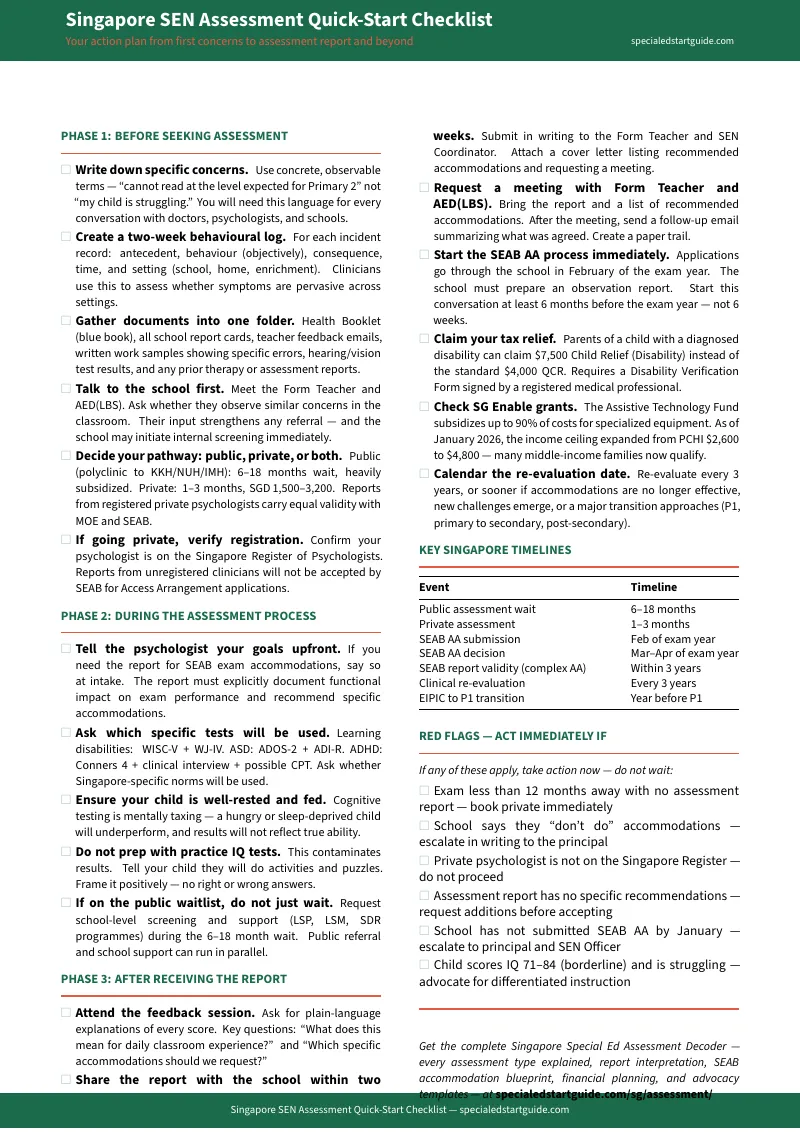
- Quick-Start Checklist — printable 18-item checklist covering the three phases (before assessment, during assessment, after receiving the report) with key timelines and red flags that require immediate action
- Advocacy Templates — 4 ready-to-use letter templates: requesting school-based screening, submitting a private assessment report, SEAB Access Arrangement application cover letter, and polyclinic referral preparation script
- SEAB Access Arrangements Blueprint — printable reference card with every accommodation type, documentation requirements, the 2025 policy change, and the critical February application timeline
- Assessment Cost Matrix — private assessment cost comparison across 5 assessment types with the public vs. private decision framework and 5 questions to ask before booking
- Report Reading Guide — bring this to your feedback session: standard scores table, WISC-V index score explanations, discrepancy analysis guide, and red flags checklist
Instant PDF download. Print the Checklist tonight. Bring the Report Reading Guide to your psychologist appointment this week.
Money-back guarantee, no time limit. If the Assessment Decoder does not change how you navigate Singapore's SEN assessment system, email us for a full refund. No questions asked.
Not ready for the full Decoder? Download the free Singapore Evaluation Request Letter — a template letter for requesting developmental assessment through MOE, polyclinic, or private clinics with a cost comparison framework. It is enough to start the process and understand the public vs. private decision — and it is free.
A private assessment costs up to SGD 3,200. The polyclinic wait is up to 18 months. SEAB's Access Arrangement deadline is February of the exam year — not February when you start thinking about it. 53% of families navigating the public system report confusion and referral loops. This Decoder ensures you spend your money on the right assessment, submit the right documentation, and secure the accommodations your child is entitled to — before the deadlines pass.