
You Spent $3,000 on a Diagnosis. The School Filed It Away. This Playbook Gets Those Recommendations Off the Shelf and Into the Classroom — Without Starting a War.
The psychologist's report is sitting in a manila folder somewhere in the General Office. It cost you $3,000 and six months of agonised waiting. It contains specific, carefully worded recommendations: chunked instructions for multi-step tasks, movement breaks every 30 minutes, 25% extra time for written work. None of it has been implemented. The Form Teacher says your child is "doing fine." Your child melts down every afternoon the moment they cross the threshold of home.
You have read the MOE parents' guide. It tells you to "work with the school." You have scrolled through 400 pages of KiasuParents threads. You found one useful tip buried on page 287 and three contradictory ones on page 312. You downloaded an IEP template from Etsy — it references 504 Plans and IDEA due process hearings, legal frameworks that do not exist in Singapore. You are exactly where you started: staring at a blank screen at 11 PM, trying to draft an email that sounds assertive enough to make the school act but not so aggressive that Mrs Tan decides your child is more trouble than the effort.
That email is the most important thing you will write this year. And you cannot afford to get the tone wrong.
In Singapore's school culture, aggressive advocacy backfires. Teachers who feel attacked become defensive, and overworked SEN Officers quietly deprioritise the families who make their day harder. But passive compliance — "waiting for the school to handle it" — produces exactly what you already have: meetings that end with vague promises and no documented follow-up.
The Singapore Special Ed Advocacy Playbook introduces the Collaborative Assertiveness System — a third way between submission and confrontation, built specifically for how Singapore schools actually work. Every template, every meeting script, every escalation pathway in this playbook is calibrated to preserve the teacher's professional dignity while creating documented accountability that moves your child's support from verbal assurances to implemented accommodations.
What's Inside the Playbook
7 Ready-to-Customise Email Templates
Not generic. Not American. Not written by someone who has never heard of SEAB or SEN Officers. These templates are structured for the exact scenarios Singapore parents face: requesting an initial SEN evaluation, documenting a verbal conversation the school would rather forget, following up on accommodations that were agreed to but never implemented, requesting SEAB Access Arrangements for the PSLE, and escalating to the HOD or Principal when the Form Teacher stops responding. Each template uses Singapore terminology, respects the institutional hierarchy, and is phrased as a partnership request — because "Could we schedule time to discuss how we might implement this together?" opens more doors than "Why aren't you doing your job?"
The MOE Escalation Hierarchy — Mapped and Explained
When the Form Teacher says no, most parents have no idea who to contact next. They either give up or fire off an angry email to the Principal, skipping three levels and burning every bridge. This playbook maps the complete internal hierarchy: Form Teacher → SEN Officer / Allied Educator → Year Head / HOD → Vice-Principal → Principal — and the external pathway: MOE Customer Service Centre → Cluster Superintendent → Quality Service Manager → Meet-the-People Session with your MP. Each level includes what to say, what to include, and the specific evidence that moves people at that tier.
IEP Meeting Preparation System
Walking into a case conference unprepared means the school controls the narrative. You sit through a list of your child's deficits, nod along to vague goals like "improve behaviour," and leave without a single documented accommodation. The playbook provides a complete pre-meeting checklist — what to request from the school two weeks before, how to prepare your own observation data, the exact questions to ask about measurability ("How will you know when this goal is met? What data are you collecting?"), and the one phrase that changes every IEP meeting: "I'd like to take this home to review before I sign."
SEAB Access Arrangements Strategy
Extra time. Separate testing rooms. Human readers. Word processors. SEAB provides real accommodations for the PSLE, N-Levels, and O-Levels — but the application requires evidence that accommodations are already embedded in daily classroom practice. If your child has never received extra time in school, the SEAB application dies on arrival. The playbook maps the full timeline from Primary 3 documentation through the P6 February application deadline, including the recertification trap: if your child was assessed at age 4, that report expires before PSLE. You need a fresh one — and the 18-month public hospital waitlist means you need to start now.
The Documentation System That Changes Everything
Before you send a single email, the playbook sets up a communication log: a simple spreadsheet that tracks every interaction — date, method, who, summary, agreed actions, follow-up date. This is the evidence file that transforms your advocacy from "parent complains" to "parent has documented a pattern of unimplemented recommendations over six months." When you eventually escalate — and you may need to — this log is the only thing that matters.
High-Stakes Scenario Playbooks
What do you do when the school says your child cannot attend a camp or learning journey without a private shadow teacher — at your expense? When a teacher tells you to "be stricter at home"? When suspension is threatened for behaviour that is a direct manifestation of your child's diagnosed condition? The playbook provides specific response frameworks for these scenarios, written with the understanding that your child still has to walk into that classroom tomorrow.
Advocacy for Private and International Schools
If your child attends an independent, private, or international school, the MOE escalation pathway does not apply. The playbook covers the different complaints bodies and regulatory frameworks — including the Council for Private Education, IB complaints mechanisms, and the reality of fee-funded accountability.
The Collaborative Assertiveness Framework
The core philosophy of the entire playbook. Three principles: frame every request as a partnership, not an accusation. Document everything, but position documentation as helpfulness. Escalate on process, not personality. The framework includes reframing exercises — converting aggressive instincts into collaborative language that achieves the same outcome without triggering the defensive response that kills progress in Singapore schools.
Who This Playbook Is For
- Parents whose child has a clinical diagnosis (ASD, ADHD, dyslexia, or another SEN) and a school that is not implementing the recommendations from the assessment report
- Parents preparing for an IEP meeting, case conference, or parent-teacher meeting who want to walk in with specific, measurable requests rather than general hope
- Parents who need to request SEAB Access Arrangements for the PSLE, N-Levels, or O-Levels and do not know where to start or what evidence is required
- Parents whose child is being excluded from activities, threatened with suspension, or subjected to punitive responses for SEN-related behaviour
- Parents who have been dismissed by the school — told their child is "fine in class," that they should "be stricter," or that the school "doesn't have the resources" — and need a way to escalate without burning the relationship
- Parents who have never put anything in writing and need a system to start creating a documented advocacy record
- Parents navigating private, independent, or international schools where the MOE framework does not apply
Why Not Free Resources?
Singapore has genuinely excellent free resources for SEN families. Here is why they leave parents stuck at the exact point where action is needed most:
- The MOE parents' guide explains the system — from the system's perspective. It describes available support programmes, lists school types, and outlines administrative processes. It does not tell you what to do when the Form Teacher brushes you off. It does not provide email templates. It does not acknowledge that 31% of diagnosed students receive no school-based support at all. The Playbook fills the gap between policy and practice.
- SG Enable and the Enabling Guide cover financial schemes and community inclusion — not school-level advocacy. They are the definitive source for grants, subsidies, and post-18 planning. They do not teach you how to write a follow-up email when the accommodations agreed in last month's meeting have not been implemented.
- EveryChild.SG publishes brilliant systemic research — aimed at MOE policy reform. Their "Mind the Gap" report documented the exact failures this playbook addresses. But their proposals are for institutional adoption, not individual parent download. They are lobbying for better systems. This playbook works within the system you have right now.
- KiasuParents and Reddit provide raw, unfiltered parent experiences — buried in 800-page threads. The critical tip about SEAB documentation timelines is on page 412. The useful email phrasing is contradicted three posts later. The subsidy advice is from 2022. The Playbook extracts verified, current, actionable guidance and organises it into a step-by-step system.
- Etsy and Gumroad sell advocacy templates built for American law. Templates referencing IDEA, 504 Plans, and due process hearings are legally meaningless in Singapore and culturally counterproductive. A demand letter phrased for US adversarial advocacy will get you flagged as a difficult parent within one email. Every template in this Playbook uses Singapore terminology and the Collaborative Assertiveness framework.
— Less Than Ten Minutes of Private Therapy
A single hour of private occupational therapy in Singapore costs $160 to $240. A psycho-educational assessment runs $2,000 to $3,400. That assessment produced specific recommendations — accommodations that would materially change your child's school experience. But if the school never implements them, every dollar you spent on that report is wasted. This playbook is the bridge between clinical recommendations and classroom reality: the communication system that ensures the school actually reads, acknowledges, and acts on what the professionals recommended.
Your download includes 9 PDFs:
- Complete Advocacy Playbook (guide.pdf) — 13 chapters covering the Collaborative Assertiveness framework, your documentation system, 7 ready-to-customise email templates, the full MOE escalation hierarchy, IEP meeting preparation, SEAB Access Arrangement strategy, high-stakes scenario playbooks, private and international school advocacy, funding and cost barriers, post-18 transition planning, twice-exceptional advocacy, building your support network, and sustainable self-care
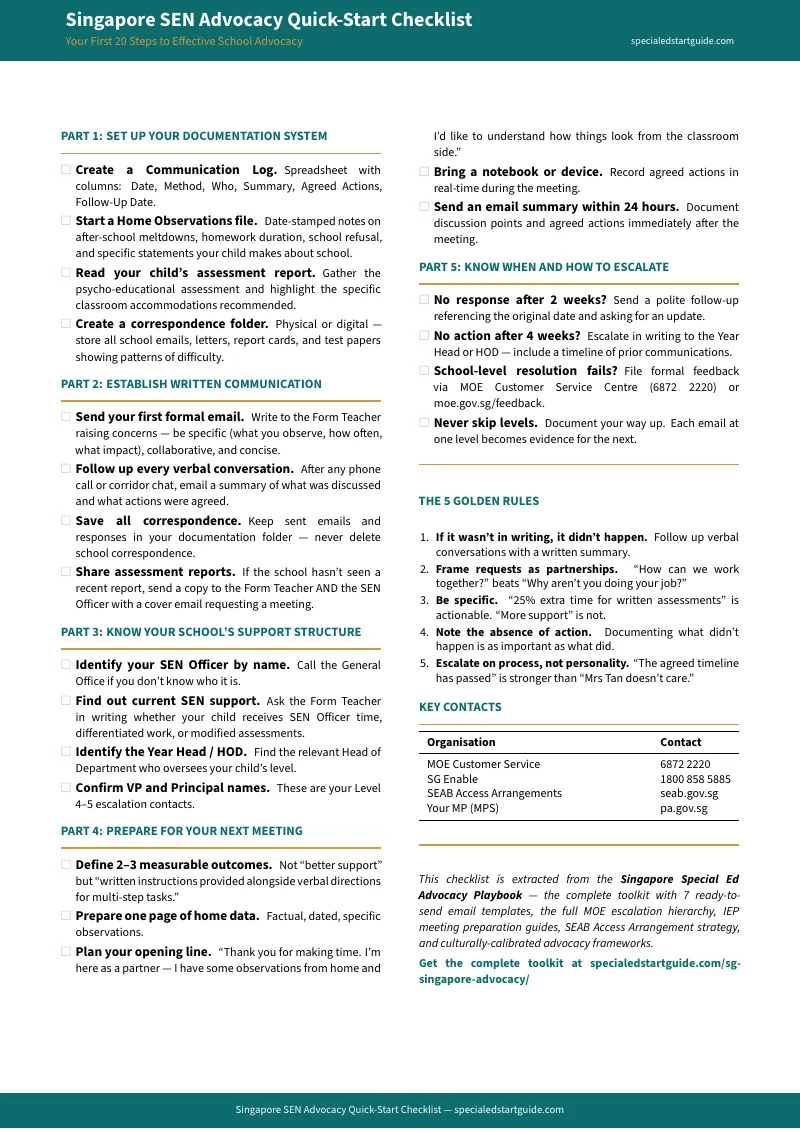
- Advocacy Quick-Start Checklist (checklist.pdf) — A 20-item printable action plan covering documentation setup, written communication habits, school support structure mapping, meeting preparation, and escalation pathways
- Email Templates (email-templates.pdf) — All 7 ready-to-send templates as a standalone printable: initial concern, post-meeting summary, accommodation request, follow-up, escalation to HOD, SEAB Access Arrangement request, and formal MOE complaint
- MOE Escalation Hierarchy (escalation-hierarchy.pdf) — The complete 8-level pathway from Form Teacher to Meet-the-People Session on a printable reference sheet
- Meeting Preparation Worksheet (meeting-preparation.pdf) — Before, during, and after checklists with the exact questions to ask and closing scripts
- SEAB Access Arrangements Timeline (seab-access-arrangements-timeline.pdf) — The P3-to-PSLE timeline, required documentation checklist, and the recertification warning
- Communication Log Template (communication-log-template.pdf) — Fillable log worksheet with the Three Rules of Documentation and Home Observations tracker
- High-Stakes Scenario Scripts (high-stakes-scenarios.pdf) — Response frameworks for dismissal, informal exclusion, SPED transfer pressure, suspected retaliation, and bullying
- Key Contacts Directory (key-contacts-directory.pdf) — Every government agency, social service organisation, and online community on one printable page
You can also download the Singapore Advocacy Dispute Letter Starter Kit for free — a standalone checklist covering the first 20 steps to effective school advocacy, from setting up your documentation system to knowing when and how to escalate.