
You Know Your Child Has Rights. The School Knows You Don't Know How to Enforce Them.
Your child's school told you they provide reasonable adjustments. They invited you to a Student Support Group meeting and wrote goals on the Individual Learning Plan. Then the term ended and nothing changed. The adjustments were "implemented where possible." The ILP goals were so vague — "will improve reading skills" — that no one could prove they weren't being met, because no one was measuring them in the first place.
You tried the Education Directorate website. It told you the same things the school did: your child has a right to reasonable adjustments under the Disability Standards for Education 2005. What it did not tell you is what to say when the principal claims the adjustment is too expensive, how to respond when the school uses "unjustifiable hardship" to deny support, or how to write an email that forces the school to commit to specific actions in writing instead of letting verbal promises dissolve over the holidays.
You called Advocacy for Inclusion. They're triaging based on crisis priority and the next available intake assessment is weeks away. ADACAS is in the same position. Your child's ILP review meeting is on Thursday.
The ACT Disability Support Blueprint is the structured system that closes the gap between what the law promises and what actually happens in your child's classroom. It gives you the meeting tactics, email scripts, legal frameworks, and escalation pathways that the Directorate's website leaves out — built specifically for the ACT's ILP process, NCCD funding model, and complaints framework.
What's Inside the Blueprint
The ACT Legal Framework Decoder
Three layers of law protect your child: the Disability Discrimination Act 1992, the Disability Standards for Education 2005, and the Human Rights Act 2004 (ACT). When a school says "we can't do that," you need to know which layer they're violating. This section translates all three into plain language with exact section references, so you can cite the specific obligation the school is failing to meet — not argue feelings against bureaucracy.
The ILP Quality System
A good ILP has goals that are specific, measurable, and time-bound — with a named person responsible for each one. Most ILPs in ACT schools have none of these things. This section walks you through evaluating your child's current ILP against the legal standard, rewriting vague goals into enforceable commitments, and ensuring every adjustment is documented with enough specificity that the school cannot claim it was "already being done" when it wasn't.
The SCAN Assessment Survival Guide
The Student Centred Appraisal of Need process determines your child's NCCD funding band — and it is notoriously deficit-focused. The 2023 ACT Auditor-General's report found that information provided to families in preparation for SCAN meetings "does not reflect better practice." This section shows you how to prepare evidence that maximises your child's resourcing band, what to do when a low SCAN score is used to deny ILP adjustments, and how to challenge the outcome through the proper channels.
The Meeting Equaliser
Student Support Group meetings feel rigged because they are structurally unbalanced: four or five school staff sit on one side of the table, and you sit on the other. This section gives you the meeting agenda, the conversational scripts, and the tactical responses for the phrases schools use to shut parents down — "we'll try our best," "resources are limited," "we need to consider all students." You walk in with a plan. You leave with documented commitments.
Copy-Paste Email Scripts
Every critical interaction with the school should happen in writing. This section gives you ready-to-send email templates for the situations ACT parents face most often: requesting an urgent ILP review, documenting a verbal refusal of an adjustment, following up after a meeting to lock in agreements, escalating to the Directorate when the school stonewalls, and requesting your child's NCCD data. Fill in the bracketed details and send. The paper trail starts tonight.
The Escalation Ladder
When the school says no and means it, you need to know exactly who to contact next — and in what order. This section maps the full ACT complaints pathway: Case Coordinator → Principal → Network Leader → Directorate Families and Students Unit → ACT Human Rights Commission → ACT Civil and Administrative Tribunal. Each step includes who to contact, what to include, what response to expect, and when to escalate further.
Who This Blueprint Is For
- Parents whose child has a disability — diagnosed, suspected, or under assessment — and is enrolled in or entering an ACT school
- Parents facing an ILP or Student Support Group meeting this term who want to walk in prepared with specific questions, legal references, and meeting tactics
- Parents whose child has been assigned a low NCCD funding band and is receiving inadequate Learning Support Assistant hours
- Parents who have been told the school "cannot afford" a reasonable adjustment — and want the exact legal response to that claim
- Defence families who have relocated to Canberra and are navigating the transfer of existing supports into the ACT's ILP and SCAN framework
- Parents whose child is being suspended, excluded, or placed on a reduced timetable because the school cannot manage disability-related behaviour
- Parents who have tried the Directorate's complaints process and hit a wall — and need the next escalation step
Why Not Just Use the Free Resources?
The ACT Education Directorate website will tell you that your child has a right to reasonable adjustments. Advocacy for Inclusion will confirm it. The Raising Children Network will explain what an ILP is. None of them will give you the email template to send tonight when the school refuses to put an agreed adjustment in writing.
- The Directorate tells you the rules. This Blueprint gives you the tactics for when the school breaks them.
- Advocacy for Inclusion is triaging crisis cases. This Blueprint is the advocate in your inbox at 10 PM the night before a meeting.
- Generic Australian guides cover federal law broadly. This Blueprint decodes the ACT's specific SCAN process, DECO roles, and Directorate complaints pathway — because federal law doesn't help you when the obstacle is an ACT network leader who won't return your calls.
- Etsy and TPT sell IEP planners for US families. They reference IDEA, Section 504, and IEP teams — none of which exist in the ACT. Using US terminology in an Australian meeting signals that you don't understand the system you're navigating.
Free resources explain what the law says. This Blueprint gives you the tools to make the school obey it.
— Less Than 10 Minutes With a Private Education Advocate
A private educational advocate in Canberra charges $150–$300 per hour. A specialist education lawyer charges $370 for an initial consultation alone. The meeting tactics, email scripts, and escalation pathways in this Blueprint cost a fraction of that — and you can use them at every meeting, every review, every year your child is in school.
Your download includes 10 PDFs:
- Complete Blueprint Guide — 12 chapters covering ACT legal frameworks, ILP development and review, NCCD funding and SCAN assessment, reasonable adjustment requests, Student Support Group meeting tactics, ILP goal writing, complaint escalation pathways, transition planning, working with NDIS providers, and your full legal rights reference
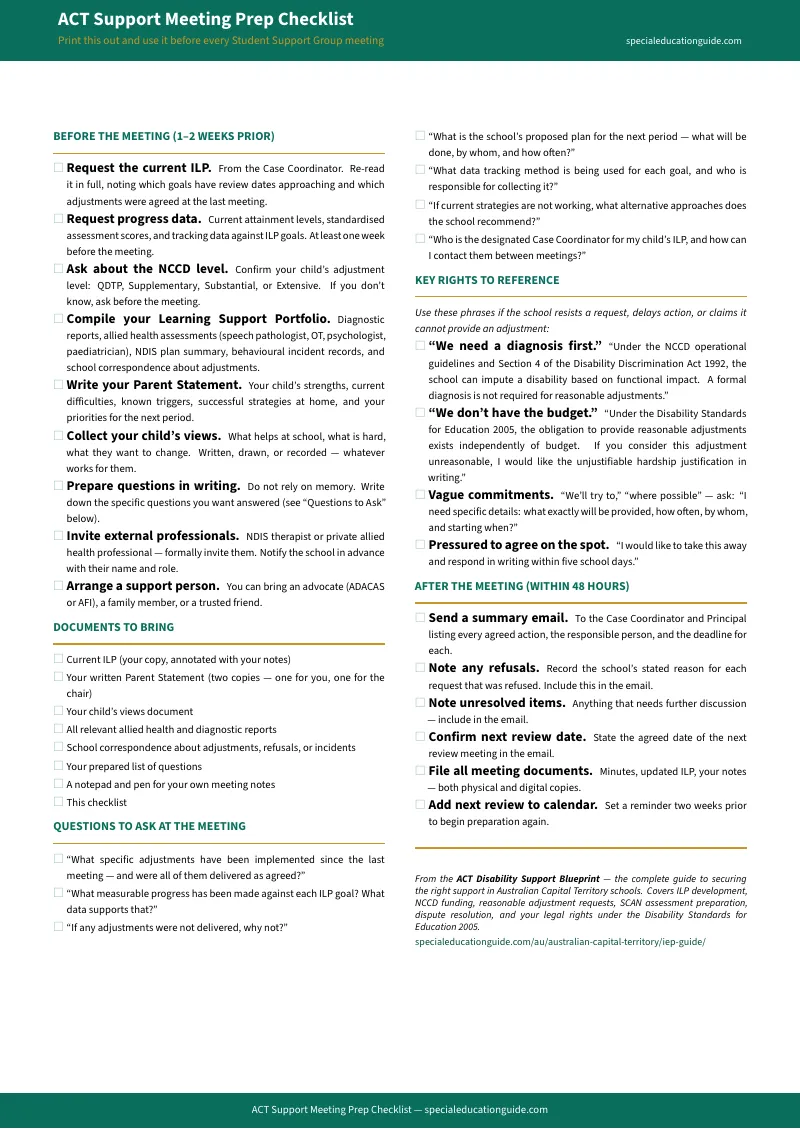
- ACT Support Meeting Prep Checklist — the pre-meeting preparation checklist, document pack list, questions to ask, key rights phrases, and post-meeting follow-up actions — print it and bring it to every meeting
- Email Templates — six copy-paste emails covering reasonable adjustment requests, post-meeting summaries, no-diagnosis-required responses, NCCD level inquiries, unjustifiable hardship challenges, and Directorate complaints
- Meeting Preparation Guide — the before, during, and after playbook for every Student Support Group meeting, including deflection tactics and word-for-word responses
- ILP Goal Writing Worksheet — the SMART framework, weak-vs-strong goal examples, and blank templates to draft your child's goals before the meeting
- SCAN Preparation Checklist — evidence portfolio checklist, parent statement prompts, and dispute steps for the ACT's most stressful assessment
- Escalation Pathway — the four-level complaints ladder from classroom teacher to ACAT, with contacts, deadlines, and what to include at each step
- Legal Quick Reference — every federal and ACT law that protects your child, plus six key phrases that carry legal weight in school correspondence
- Transition Planning Checklist — year-to-year, primary-to-high-school, and post-school transition steps to protect hard-won supports
- Key Contacts & Resources — every phone number, website, and advocacy service in one printable fridge sheet
Instant PDF download. Print the standalones tonight. Walk into your next meeting prepared.
Money-back guarantee, no time limit. If the Blueprint doesn't change how you approach your child's ILP meetings, email us for a full refund. No questions asked.
Not ready for the full Blueprint? Download the free ACT Support Meeting Prep Checklist — a one-page pre-meeting guide with what to bring, questions to ask, and key rights phrases to use when the school pushes back. It's enough to walk into your next meeting more prepared than last time, and it's free.
Your child's next ILP meeting will go one of two ways. This Blueprint determines which one.