
The School Hired a Shadow Teacher. You're Paying AED 50,000. Nobody Explained Your Options.
You moved to Dubai for a fresh start. You secured the apartment, sorted the visa, found a school that accepted your child's application — and then the meeting happened. The Head of Inclusion sat you down and told you your child needs a Learning Support Assistant. Not a suggestion. A condition of continued enrollment. The school handed you a name — their preferred agency — and a number: AED 4,500 per month. No breakdown. No alternatives. No explanation of whether this is a KHDA requirement, a school policy, or something the school invented to manage their own staffing ratios at your expense.
You went home and started searching. "Shadow teacher cost Dubai." "KHDA inclusion policy." "IEP in UAE." You found a KHDA parent guide — six steps to inclusive education, written in the formal language of a government brochure. It told you an IEP would be developed. It did not tell you what to do when the school sets goals so vague they're unmeasurable, or when the "progress review" consists of the Head of Inclusion reading from a form you've never seen. You found ADEK's inclusion policy — a dense compliance manual written for school operators, spanning dozens of pages of legal definitions. You found Reddit threads where parents share contradictory advice, half of it outdated. You priced an educational consultant: AED 500 to AED 2,000 for an initial session. You called one. They wanted to know your child's diagnosis before they'd even book the appointment.
The problem isn't that the UAE lacks inclusion protections. Federal Law No. 29 of 2006 guarantees your child's right to education. KHDA actively inspects and grades schools on inclusive practice. ADEK mandates documented support plans with measurable outcomes. The problem is that the entire system is built for institutional operators — not for the parent sitting across the table from three school administrators who've already decided what's going to happen.
The UAE Special Ed Blueprint is the Inclusion Navigation System that translates KHDA and ADEK policy from institutional compliance language into the tactical scripts, cost frameworks, and advocacy tools that give you equal footing at the IEP table.
What's Inside the Blueprint
The Legal Framework Decoded
Federal Law No. 29 of 2006, Dubai's Inclusive Education Policy Framework, ADEK's 2024/2025 School Inclusion Policy, and Cabinet Resolution No. 3 of 2018 — translated from government gazette language into plain-language leverage. When a school tells you they "cannot accommodate" your child, this chapter tells you exactly which law they're invoking, what evidence they're legally required to produce, and the specific words to include in your written response. When a school tells you a formal diagnosis is required before they'll provide any support, this chapter explains why that's wrong under KHDA's dual-track identification system — and how to push back without destroying the relationship.
KHDA vs. ADEK vs. MOE — Which Rules Apply to Your School
Dubai private schools operate under KHDA. Abu Dhabi private and charter schools operate under ADEK. Northern Emirates schools (Sharjah, Ajman, RAK, UAQ, Fujairah) fall under MOE. The rules governing assessment requirements, fee structures, LSA mandates, and inclusion team composition differ across all three. Most parents don't know which regulator governs their child's school — and that ignorance costs them leverage in every conversation. This chapter maps each authority's requirements side by side so you know exactly which framework applies and which policies to cite.
The Assessment and Diagnosis Roadmap
Where to get a psycho-educational assessment in the UAE. What it costs (AED 2,000 to AED 5,000+ for a comprehensive report). Which clinics are recognized by KHDA and ADEK. What the assessment report needs to contain for school placement, IEP development, PoD Card applications, and exam accommodations. How to navigate the gap between a private clinical assessment and the school's internal observation — because the school's evaluation and the psychologist's report often tell different stories, and knowing how to reconcile them is the difference between an IEP that works and one that sits in a filing cabinet.
IEP Development and Enforcement
How IEPs work in the UAE — and how they don't. The IEP is not a legally binding contract like a US IEP under IDEA or a UK EHCP. It is an internal strategy document, developed collaboratively, enforced through regulatory inspection rather than through due process hearings. This means your advocacy approach must be collaborative, not adversarial — and the tactics you used in your home country will actively damage the relationship you need to get results. This chapter teaches you how to review proposed goals for SMART criteria, how to push back on vague objectives that make "progress" impossible to measure, how to catch copy-pasted goals from the previous term, and how to build the documentation trail that holds the school accountable at the next review.
The Shadow Teacher Financial Framework
LSA costs in the UAE range from AED 3,000 to AED 6,000 per month — AED 30,000 to AED 60,000 per year — as a cost entirely on top of base tuition. When the school mandates an LSA, you need to know three things immediately: whether you can source your own rather than using the school's preferred agency, how to get an itemized breakdown of the cost instead of accepting a lump sum, and whether the school employs LSAs directly on staff (in which case KHDA directives indicate parents should not incur additional charges). This chapter decodes the entire LSA financial structure and gives you the specific questions to ask before you sign anything.
School Evaluation and Placement
How to evaluate a school's inclusion department during a tour — the questions that distinguish genuine inclusive practice from performative compliance. How to interpret KHDA inspection reports and ADEK compliance ratings. The practical differences between mainstream inclusion, specialized provisions within mainstream schools, and dedicated SPED centres (Al Noor, Rashid Centre, Manzil, Sanad Village). When the school claims "Inability to Accommodate," what evidence they must produce under ADEK policy — and what your rights are when you believe the decision is premature.
Government Support Cards: PoD Card and Sanad Card
The federal MOCD PoD Card and the Dubai-specific CDA Sanad Card offer tangible financial benefits — Salik toll exemptions, RTA parking privileges, telecom discounts from Etisalat and du, fee waivers, and more. But the application process is deliberately opaque. Parents report rejections for insufficient medical documentation, 60-day lockout periods before reapplication is permitted, and conflicting advice about which card to apply for first. This chapter provides the exact medical report requirements, the authority that issues each card (CDA for Dubai, MOCD for federal), and the step-by-step application process with troubleshooting for common rejection reasons.
Long-Term Planning: Visa, Insurance, and Transitions
How your child's SEN status intersects with UAE visa requirements and health insurance coverage. What happens when you transfer between emirates — and between regulatory authorities. Planning for transitions from early intervention through primary, secondary, and post-school pathways. The questions to ask now that will save months of disruption later.
Who This Blueprint Is For
- Expatriate parents relocating to the UAE who assumed their home country's special education framework (IEPs, EHCPs, NDIS) would transfer — and discovered that the UAE's privatized system operates on fundamentally different principles
- Parents whose school just mandated an external shadow teacher at AED 4,000+ per month with no explanation of alternatives, no cost breakdown, and no discussion of whether the school's own staff could provide the support instead
- Parents who've been told their child "cannot be accommodated" — but nobody showed them the formal evidence, followed the required KHDA or ADEK process, or explained their right to challenge the decision
- Parents confused by the difference between KHDA (Dubai), ADEK (Abu Dhabi), and MOE (Northern Emirates) — and unsure which rules apply to their school, their child's IEP, or their fee dispute
- Parents who've tried to apply for the PoD Card or Sanad Card and been rejected, locked out for 60 days, or received conflicting advice about which medical documentation is required
- Parents whose child has an IEP on paper but receives none of the agreed support in the classroom — the accommodations never arrive, the goals are unmeasurable, and the "review meeting" consists of the school reading from a form
- South Asian and Arab expatriate families weighing the cost of UAE private school inclusion (tuition plus LSA plus therapy) against returning home or switching to a SPED centre — and needing an objective framework to make that decision without pressure from the school or a clinic trying to sell services
- Emirati families navigating the intersection of federal government support and private school placement — deciding between mainstream inclusion, specialized provisions, and dedicated centres like Sanad Village or the Rashid Centre
Why Not Just Use the Free Resources?
The UAE has genuine free resources on inclusive education. KHDA publishes an "Advocating for Inclusive Education" parent guide. ADEK releases detailed inclusion policies. Therapy clinics run informative blogs and webinars. Here's why parents still arrive at IEP meetings feeling outmatched:
- KHDA's parent guide is a six-step summary, not a toolkit. It tells you an IEP will be developed. It does not tell you what to do when the school sets goals so vague that "progress" becomes whatever the school says it is. It validates your right to inclusive education — it does not arm you with the words to use when the school demands AED 50,000 for a shadow teacher and tells you the conversation is not negotiable.
- ADEK's inclusion policy is a compliance manual for school operators. Dozens of pages defining "Standard Inclusive Provision," "Accommodations and Modifications to Teaching," and "Inability to Accommodate" notification procedures. It tells school principals what they must do. It does not tell you — the parent — what to say when the principal doesn't do it.
- Clinic blogs are lead-generation content. The speech therapy centre's article on "Signs Your Child May Need Support" is designed to bring you through their door at AED 400 to AED 1,000 per session. Their content rarely advises you on negotiating school fees, independently applying for government discount cards, or challenging a school's assessment — because empowering you to navigate the system independently doesn't generate clinic revenue.
- International guides use the wrong framework entirely. American IEP templates reference IDEA and FAPE — laws with zero jurisdiction in the UAE. British EHCP guides assume state-funded provision and Local Authority obligations. Walking into a UAE school quoting IDEA doesn't just fail — it signals that you don't understand the local system, which makes it easier for the school to control the conversation.
- Reddit and Facebook groups give you anecdotes, not frameworks. One parent says the Sanad Card took two days. Another says the process was impossible. One parent says their school hired the LSA at no cost. Another was charged AED 60,000. Without a systemic framework, you cannot tell which experience applies to your child, your school, or your emirate.
Government agencies publish the policy. Clinics explain the condition. The Blueprint gives you the playbook.
— Less Than a Single Therapy Session
A single consultation with a private educational psychologist in Dubai or Abu Dhabi costs AED 400 to AED 1,000. An educational placement consultant charges AED 500 to AED 2,000 for an initial profile evaluation. A comprehensive psycho-educational assessment runs AED 2,000 to AED 5,000+. Private SEN tutors average AED 121 per hour. A shadow teacher costs AED 30,000 to AED 60,000 per year. Even if you eventually need professional help, the documented preparation you build with this Blueprint saves thousands — because you arrive with organized evidence, specific regulatory citations, and clear questions instead of a folder of anxiety.
Your download includes the complete 14-chapter guide, a printable IEP Meeting Prep Checklist, and 6 standalone reference printables — 8 PDFs total:
- Complete Blueprint Guide (guide.pdf) — 14 chapters covering the legal framework, KHDA/ADEK/MOE regulatory comparison, assessment pathways, IEP development and enforcement, shadow teacher cost framework and negotiation, school evaluation and placement, PoD Card and Sanad Card applications, visa and insurance considerations, and advocacy strategies built for the UAE's collaborative system
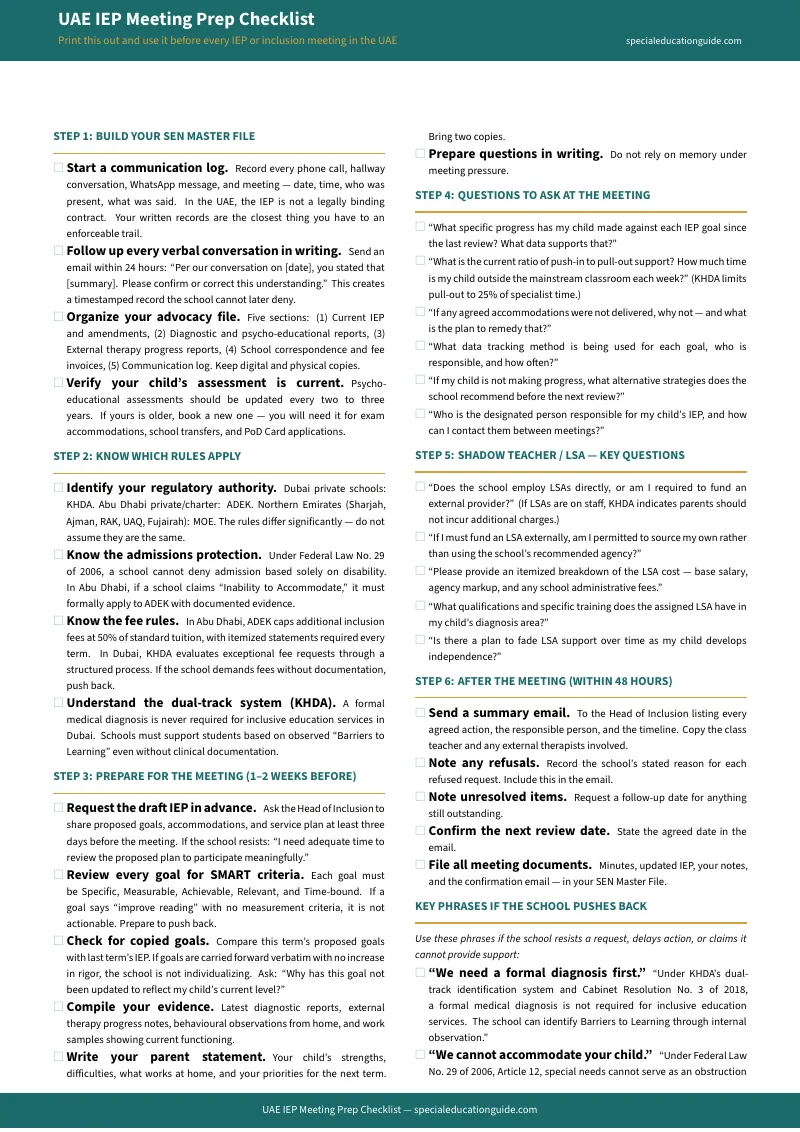
- IEP Meeting Prep Checklist (checklist.pdf) — printable quick-reference covering SEN Master File setup, regulatory authority identification, IEP meeting preparation, questions to ask at the meeting, shadow teacher/LSA key questions, and post-meeting documentation protocol
- KHDA vs ADEK vs MOE Quick Reference (regulatory-comparison.pdf) — one-page comparison card showing how Dubai, Abu Dhabi, and Northern Emirates authorities differ on diagnosis requirements, fee caps, admission protections, and complaint channels
- Shadow Teacher Cost & Negotiation Framework (shadow-teacher-framework.pdf) — cost breakdown, school-hired vs parent-hired LSA comparison, evaluation checklist, and the specific questions to ask before signing any agreement
- IEP Meeting Scripts (iep-meeting-scripts.pdf) — word-for-word responses for 7 common school pushback scenarios, each citing the specific UAE law or KHDA/ADEK policy that supports your position
- PoD Card & Sanad Card Application Guide (pod-sanad-card-guide.pdf) — step-by-step application process for both government support cards with benefits comparison, medical report requirements, and rejection troubleshooting
- Assessment & Diagnosis Quick Reference (assessment-roadmap.pdf) — the two assessment pathways, clinic list with costs, the 9 diagnostic categories, and what the assessment report must contain
- School Tour Inclusion Questions (school-evaluation-questions.pdf) — 5 interview-style questions to ask the Head of Inclusion during school visits, plus green and red flags for reading KHDA/ADEK inspection reports
Instant PDF download. Print the standalones tonight and bring them to your next school meeting, shadow teacher negotiation, or school tour.
Money-back guarantee, no time limit. If the Blueprint doesn't change how you navigate your child's education in the UAE, email us for a full refund. No questions asked.
Not ready for the full Blueprint? Download the free UAE IEP Meeting Prep Checklist — a structured quick-reference covering KHDA/ADEK regulatory identification, IEP meeting preparation, shadow teacher questions, and post-meeting documentation. It's enough to walk into your next meeting prepared, and it's free.
Your child has the right to inclusive education in the UAE. The school knows the policy. After tonight, so will you.