
Your Child Needs an Assessment. The School Gave You a Deadline. Nobody Gave You a Price List.
The inclusion coordinator just told you your child needs a psychoeducational assessment. Not a suggestion — a condition. Maybe admissions won't process the application without a clinical report. Maybe the school says your child can't advance to the next grade without a formal diagnosis. Maybe you've been handed a clinic name and told to "get it sorted" before the next term starts.
You went home and searched. "Assessment cost Dubai." "ADHD diagnosis UAE." "Shadow teacher fees." You found a KHDA parent guide — 34 pages of policy language explaining the six steps to inclusive education. It told you assessment would be part of the journey. It did not tell you whether AED 8,500 is a reasonable price for that assessment. You found a clinic's website quoting AED 6,000 for a "standard psychoeducational" and AED 10,000 for a "combined ADHD and autism evaluation" — but nothing explaining whether your child actually needs both, or whether the clinic is bundling tests to maximize the invoice. You found Reddit threads with contradictory advice, half of it from 2018. You priced an educational consultant: AED 150 for 15 minutes. An advocacy specialist: AED 500 to AED 1,100 per hour. And the assessment hasn't even started yet.
Here is the core problem: the schools, the clinics, and the regulatory agencies all know the assessment rules intimately. They use those rules every day to protect their budgets, fill their appointment books, and manage their compliance obligations. You — the parent — are expected to navigate this system under emotional pressure, against a school-imposed deadline, with no pricing benchmarks, no regulatory translation, and no one explaining the difference between what the school can legitimately require and what they're demanding because you don't know enough to push back.
The UAE Special Ed Assessment Decoder is the Assessment Defence System that gives you the same regulatory knowledge, pricing benchmarks, and negotiation tools that schools and clinics use — so you stop paying for what you don't understand and start making informed decisions about your child's assessment, your family's finances, and your rights under UAE law.
What's Inside the Assessment Decoder
The Legal Foundation for Assessment
Federal Law No. 29 of 2006 guarantees your child's right to assessment and inclusive education. KHDA's Dubai Inclusive Education Policy Framework mandates that schools provide support based on observed need — not diagnostic labels. ADEK's School Inclusion Policy requires every school to appoint a Head of Inclusion and follow documented support pathways. But knowing that laws exist is not the same as knowing how to use them. This chapter translates each statute into the specific leverage it gives you: when a school insists on a private assessment before providing any support, you'll know whether that demand is legitimate under their emirate's framework — or whether they're skipping mandatory steps that cost them nothing and cost you AED 8,000.
Three Assessment Pathways Compared
Government healthcare clinics (DHA, DOH, SHA), private practices, and school-based screening — each with different costs, wait times, insurance implications, and report formats. Most parents are steered toward private clinics by the school without knowing that government pathways exist, that school-based screening is mandatory before external referral under KHDA, or that the choice of pathway affects whether insurance will cover the cost. This chapter maps all three options side by side so you choose the right assessment before spending a dirham.
The KHDA vs. ADEK vs. SPEA Regulatory Breakdown
Dubai private schools operate under KHDA. Abu Dhabi schools operate under ADEK. Sharjah schools fall under SPEA. A family moving 90 minutes from Dubai to Abu Dhabi crosses a hard regulatory border that changes everything — from what the school can demand regarding assessment, to how much they can charge for a Learning Support Assistant, to whether a clinical diagnosis is required for admission. This chapter maps each authority's requirements so you know which framework governs your school and which policies to cite in your next meeting.
The Assessment Tool Decoder
What the WISC-V, WIAT-III, ADOS-2, CARS2, BASC-3, and Vineland-3 actually measure, when each is appropriate for your child, and how clinics bundle them into packages that may include tests your child does not need. When a clinic quotes AED 10,000 for a "comprehensive evaluation," this chapter tells you which instruments are essential for your child's specific referral question and which are add-ons that inflate the price without changing the outcome.
The Clinic Pricing Benchmark
No parent-facing resource in the UAE publishes what assessments should cost. This chapter does. A standard psychoeducational assessment (WISC-V plus WIAT-III) runs AED 5,000 to AED 5,500. An ADHD diagnostic package costs AED 6,000 to AED 7,000. An autism diagnostic (ADOS-2 plus cognitive testing) runs AED 7,000 to AED 8,500. A combined ADHD and autism evaluation reaches AED 8,000 to AED 10,000. Initial consultations add AED 850 to AED 1,000 on top. When you walk into a clinic with these benchmarks, you can tell whether a quote is the market rate or a premium you should question.
How to Read Your Child's Clinical Report
Clinical psychologists write reports for other clinicians, not for parents sitting in school meetings. Your AED 8,000 report arrives full of standard scores, percentile ranks, confidence intervals, and diagnostic classifications — but no translation into what these numbers mean for your child's classroom accommodations, exam arrangements, or IEP goals. This chapter walks you through extracting the findings that matter for school: which scores indicate a need for extra time, which justify a reduced workload, and which support a formal KHDA or ADEK category placement. It also tells you what to do when the recommendations are vague — because "provide support as needed" in an AED 8,000 report is not what you paid for.
The Shadow Teacher Financial Defence
This is where assessment results turn into the largest expense most families don't see coming. If the assessment recommends Level 3 support, the school may demand you hire a Learning Support Assistant at AED 30,000 to AED 80,000 per year — on top of tuition. In Dubai, KHDA requires that LSA arrangements be governed by a formal Memorandum of Understanding at cost with no profit margin, and include a phase-out timeline. Standard Provision — the SENCO, classroom differentiation, basic accommodations — must be free. In Abu Dhabi, ADEK caps additional support fees at 50% of base tuition. This chapter gives you the exact language to use when a school demands an unregulated private arrangement with no cost breakdown and no regulatory justification.
The Person of Determination (PoD) Card
Application process, what it unlocks (RTA parking, Salik exemptions, telecom discounts), and a frank breakdown of where expatriate entitlements end and Emirati-only benefits begin. Government portals present a unified picture of "equal access" — then families discover that federal financial stipends, priority placements at elite specialized centres, and monthly social assistance are reserved exclusively for UAE nationals. This chapter gives expatriate families realistic expectations so you plan your finances based on what you can actually access, not what the government brochure implies.
Insurance Recovery for Assessments
Insurers routinely reject claims filed as "educational assessment." The key is framing: the clinician should use CPT billing codes categorising the evaluation as a neurodevelopmental diagnostic assessment, and the pediatrician's referral letter should emphasise medical necessity — not educational performance. Recent DHA mandates have expanded mental health coverage provisions. This chapter provides the specific billing code guidance and referral framing that can turn an AED 8,000 out-of-pocket expense into a reimbursable medical claim.
Templates Included
Pre-assessment document checklist, questions for the assessor before you book, assessment result action plan, school support request letter, shadow teacher fee negotiation scripts, and insurance claim filing guide. Print them tonight. Bring them to your next school meeting, clinic appointment, or shadow teacher negotiation.
Who the Assessment Decoder Is For
- Parents whose school just demanded a private psychoeducational assessment as a condition of continued enrollment or grade progression — and who have no benchmark for whether the quoted price is standard, inflated, or includes tests their child doesn't need
- Parents holding a 20-page clinical report full of percentile scores, cognitive indices, and diagnostic codes — with no guidance on how to translate those findings into specific IEP accommodations, exam arrangements, or enforceable school support
- Parents who've been told their child needs a shadow teacher at AED 50,000 to AED 80,000 per year — and who don't know what the school is legally required to provide for free versus what they can legitimately charge
- Expatriate families unsure whether the Person of Determination Card benefits they've read about actually apply to non-nationals, or whether the government support system is effectively reserved for Emirati citizens
- Parents navigating bilingual assessment concerns — worried that an English-only evaluation on an Arabic-English child will produce artificially low scores and lead to misdiagnosis or overdiagnosis
- Families who moved between emirates and were told their child's existing assessment report is "not valid" — without being told which rejection reasons are regulatory requirements and which are the school's preference
- Parents whose health insurance rejected the assessment claim — not realising that the billing code, referral framing, and clinician's diagnostic language determine whether insurers cover a AED 5,000 to AED 10,000 evaluation
Why Free Resources Leave You Exposed
- KHDA's parent guide describes the policy framework — not the financial reality. It explains the six-step inclusion journey. It does not mention that a full psychoeducational assessment costs AED 5,000 to AED 10,000, that a shadow teacher adds AED 30,000 to AED 80,000 per year, or that the school's first demand for a private assessment may violate KHDA's own requirement that school-based screening comes first. You get the theory of inclusion without the financial defence to survive it.
- ADEK's inclusion policy is a compliance manual for school principals. Buried in dozens of pages of regulatory language is the sentence that could save you AED 20,000: additional support fees cannot exceed 50% of base tuition. A parent searching for immediate help during a school crisis is unlikely to find that clause — or know how to invoke it. The schools know. Their compliance officers read this document. You should too.
- Clinics explain the condition — not the cost. A clinic's website tells you about the WISC-V and ADOS-2. It does not tell you whether you need both, whether the AED 10,000 "comprehensive package" includes instruments your child's referral question doesn't require, or whether a government pathway at lower cost would produce an equally valid report. Clinics profit from executing assessments, not from advising you on which ones to skip.
- Forum advice is anecdotal and outdated. A 2018 ExpatWoman thread recommending a clinic that has since closed. A Reddit post claiming "the school must pay for the shadow teacher" without citing which emirate or which regulatory clause. One parent says the PoD Card took two days. Another says the process was impossible. Without a systematic framework, you cannot tell which experience applies to your child, your school, or your emirate.
Government agencies publish the policy. Clinics explain the condition. This guide gives you the financial and regulatory defence.
— Less Than a Single Clinic Intake Appointment
A 15-minute guidance session with a UAE inclusion specialist costs AED 150. An initial clinic intake costs AED 850 to AED 1,000. A full psychoeducational assessment costs AED 5,000 to AED 10,000. An annual shadow teacher can cost AED 80,000. At every step of this process, someone profits from your uncertainty.
This guide costs less than a single clinic consultation — and it covers the regulatory knowledge, pricing benchmarks, report interpretation skills, and negotiation scripts that determine whether your family spends AED 5,000 or AED 100,000 over the next 12 months.
Your download includes the complete 11-chapter guide, a printable Assessment Quick Start Checklist, and 4 standalone reference cards — 6 PDFs total:
- Complete Assessment Decoder Guide (guide.pdf) — 11 chapters covering the legal foundation, three assessment pathways, KHDA vs ADEK vs SPEA regulatory comparison, assessment tool decoder, clinic pricing benchmarks, bilingual assessment guidance, clinical report interpretation, shadow teacher financial defence, Person of Determination Card, insurance recovery strategies, re-evaluation rules, cross-emirate portability, and ready-to-use templates
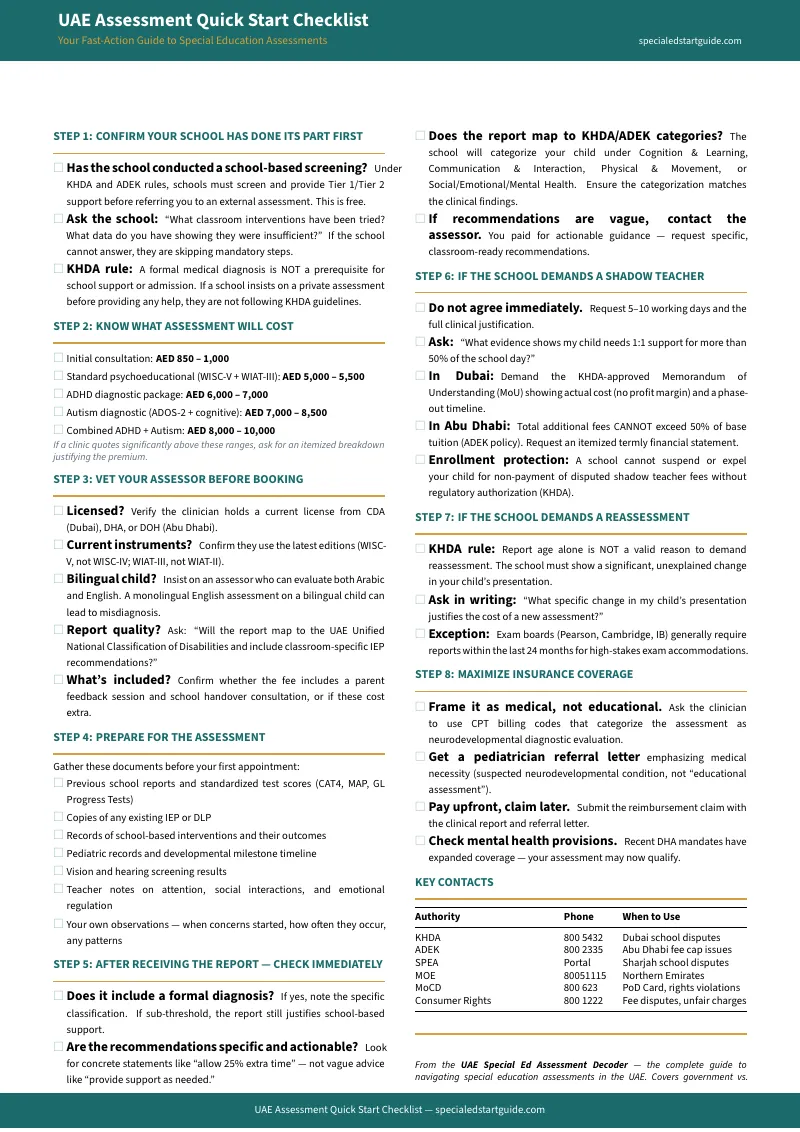
- Assessment Quick Start Checklist (checklist.pdf) — 8-step printable quick-reference covering school obligation verification, assessment cost benchmarks, assessor vetting questions, document preparation, report review, shadow teacher defence, reassessment challenges, and insurance recovery tactics
- Assessment Pricing Benchmark (pricing-benchmark.pdf) — printable reference card with market rates for every assessment type, the full cost timeline from Day 1 through triennial reassessment, shadow teacher fee caps, and insurance recovery tips
- Assessment Report Decoder (report-decoder.pdf) — how to read your child's clinical report, score interpretation table, KHDA categorisation guide, assessment tools quick reference, and a fillable Action Plan worksheet for IEP meetings
- Letter Templates (letter-templates.pdf) — 3 fill-in-the-blank letters: school-based assessment request citing KHDA/ADEK directives, shadow teacher fee challenge script with MoU and fee cap references, and insurance claim filing guide with CPT billing codes
- Key Contacts and Resources (assessment-contacts.pdf) — every regulatory authority, health authority, and government assessment clinic with phone numbers, websites, and a fillable personal contacts section
Instant PDF download. Print the standalones tonight and bring them to your next school meeting, clinic appointment, or shadow teacher negotiation.
Money-back guarantee, no time limit. If the Assessment Decoder doesn't change how you navigate your child's evaluation, email us for a full refund. No questions asked.
Not ready for the full guide? Download the free UAE Assessment Quick Start Checklist — an 8-step printable covering school obligation verification, assessment cost benchmarks, assessor vetting questions, document preparation, report review, shadow teacher fee defence, reassessment challenges, and insurance recovery tactics. Print it tonight and bring it to your next school meeting or clinic appointment — it's free.
The schools and the clinics know the rules. After tonight, so will you.