
The School Said "We Don't Have the Resources." The Constitution Says That's Not Their Call.
You already know the system is broken. Your child was turned away at admission because the principal said the school "can't cope." The District-Based Support Team assessment that was supposed to happen weeks ago has been on a waiting list for over a year. Your child was suspended for behaviour directly linked to their disability — and nobody at the school mentioned support measures or an Individual Support Plan before handing down the punishment. Or your child sits in a mainstream classroom every day, falling further behind, while the school insists it is "doing its best" without providing a single documented accommodation.
You are not imagining this. Up to 70% of children with disabilities in South Africa are entirely outside the formal education system — an estimated 500,000 to 950,000 children denied their right to learn. In some Eastern Cape districts, waiting lists for a single special school exceed 550 learners. In KwaZulu-Natal, 38 special schools were forced to close in 2025 because the provincial department failed to pay subsidies. And across every province, the pattern repeats: schools refuse admission, districts delay assessments, and parents exhaust themselves pleading with officials who count on them not knowing the law.
But here is what schools do not want you to know: South Africa's Constitution gives your child one of the strongest education rights in the world. Unlike housing or healthcare, the right to basic education under Section 29(1)(a) is an unqualified, immediately realisable right. The Constitutional Court has confirmed this repeatedly. "We don't have the resources" is not a constitutional defence when it results in the denial of basic education.
The South Africa Special Education Parent Rights Compass is the Constitutional Enforcement Toolkit — the tactical system that turns the gap between what the Constitution guarantees and what schools actually deliver into documented, enforceable legal demands that principals, districts, and provincial departments cannot ignore.
What's Inside the Rights Compass
The Fill-in-the-Blank Legal Letter Library
Every template cites the exact South African statute. Challenge an admission refusal — citing SASA Section 5 and the Constitutional Court's Juma Musjid ruling that the state must act with "immediate effect." Demand an Individual Support Plan — referencing the SIAS policy's SNA 2 process and your right as a parent to be central to the decision. Challenge an unlawful suspension — invoking Section 8(5)(b) of SASA and the BELA Act's requirement for age-appropriate disciplinary proceedings. Demand a DBST assessment within a stated timeframe. Request exam concessions under SIAS Annexure B. These are not generic advocacy letters — they cite the specific South African laws, policies, and Constitutional Court judgments that school governing bodies and district officials recognise as legally binding.
The SIAS Policy Decoded
The Screening, Identification, Assessment and Support policy is a 100-page government framework that most parents have never heard of — but it dictates every step your school is supposed to follow. The Compass translates SIAS into a plain-language walkthrough: what the three stages are, which forms the school must complete (Learner Profile, SNA 1, SNA 2, SNA 3, Annexure A1, Annexure A2), what your rights are at each stage, and exactly what to demand in writing when the school skips a step. The ISP is your child's equivalent of an IEP — and if the school hasn't created one, that's a documented violation you can escalate.
The Complaint Pathway Roadmap
When the school ignores your letters and the district ignores your calls, you need to know which complaint body to use and how to use it. The Compass walks you through five escalation pathways — step by step, in plain language — so you can act immediately without waiting months for a lawyer or an overwhelmed NGO to call you back:
- SAHRC complaint — using Annexure A, free of charge, with the power to investigate, mediate, and subpoena documents
- Equality Court under PEPUDA — Form 2 at any Magistrate's Court, no fees, no lawyer required, and once you show a prima facie case, the burden shifts to the school
- MEC appeal under SASA Section 5(9) — your statutory right when admission is refused
- PAIA request — to force the release of waiting list data, SGB minutes, and assessment reports that schools and districts refuse to share
- Public Protector complaint — for systemic maladministration by provincial departments
The Landmark Case Summaries
South African courts have consistently ruled in favour of children with disabilities — but most parents don't know these cases exist, let alone how to cite them. The Compass includes plain-language summaries of the judgments that matter most, with the exact phrases to quote in your letters to signal legal literacy: Juma Musjid (right to education is immediately realisable), Western Cape Forum (severity of disability cannot justify exclusion), Phakamisa (right extends to all children regardless of documentation), and Equal Education v WCED (failure to plan placements violates the Constitution). When a principal reads a letter quoting High Court judgments by name, the conversation changes.
The Exam Concessions Guide
Your child may be entitled to extra time, a scribe, a reader, or alternative assessment formats — but schools frequently fail to apply or inform parents of these rights. The Compass covers the SIAS Annexure B (Form DBE 124) application process, SACAI school timelines, what your psycho-educational report must include, and how to appeal a refusal with additional specialist evidence.
Who This Guide Is For
- Parents whose child was refused admission to a mainstream or full-service school — and who need to compel the school to provide written reasons, then escalate through the MEC appeal, SAHRC, or Equality Court
- Parents whose child is enrolled but receives no accommodation — no ISP, no curriculum differentiation, no specialist support — and who need to force the school to implement the SIAS process
- Parents whose child was suspended or faces expulsion for disability-related behaviour — and who need to challenge the disciplinary action as unlawful under SASA and the BELA Act
- Parents stuck on a DBST waiting list — months or years with no assessment — who need to escalate through PAIA, the SAHRC, or the Equality Court to force the district to act
- Parents in Gauteng, KwaZulu-Natal, or the Western Cape navigating overcrowded systems where schools use administrative barriers to discourage enrolment of learners with disabilities
- Parents in the Eastern Cape, Limpopo, Mpumalanga, or North-West facing acute resource shortages and geographic isolation from special schools
- Parents of children with ASD, ADHD, specific learning disabilities, intellectual disabilities, or physical disabilities at any level of the system — mainstream, full-service, or special school
- Grandparents and extended family caregivers who are the primary advocates for a child's education but feel excluded from the SIAS process
Why Not Just Use the Free Resources?
South Africa has serious free advocacy resources. SECTION27 publishes the Basic Education Rights Handbook. The Equal Education Law Centre issues detailed policy briefs. The SAHRC provides child-friendly complaint factsheets. Here is why parents still lose disputes after consulting all of them:
- SECTION27's handbook is a 500-page legal textbook. It is legally exhaustive and academically rigorous. It is also paralysing to read the night before a suspension hearing or an admission deadline. It explains what the Constitution says — it does not give you the fill-in-the-blank letter that cites SASA Section 5 and Juma Musjid to demand admission by 8 AM tomorrow. Its format is informational, not operational.
- The EELC and SECTION27 serve the entire country with limited staff. They triage hundreds of cases and must prioritise systemic public interest litigation. If your child's case involves quiet service erosion rather than dramatic exclusion, you may wait months for individualised help. Your child cannot afford to wait.
- The SIAS policy document outlines a system that does not exist. It describes a functional process — screening, identification, assessment, support — that assumes every school has a trained SBST, every district has a responsive DBST, and every province funds its special schools. The policy tells you what should happen. It does not tell you what to do when none of it actually happens.
- The SAHRC provides complaint forms but no strategic guidance. Knowing that you can lodge a complaint is not the same as knowing how to frame the complaint, what evidence to attach, and which legal provisions to cite. A poorly framed complaint gets lost in the bureaucracy. A precisely cited one triggers an investigation.
- Private education lawyers charge R1,800+ for a 50-minute consultation. If the matter proceeds to litigation, costs escalate into tens of thousands of Rands. Most South African families cannot afford this — and lawyers achieve better results when the parent arrives with organised documentation and a clear legal timeline.
The free resources explain what South African law says. This Compass gives you the enforcement tools to make schools and districts comply.
— Less Than One-Third of a Single Lawyer Consultation
A 50-minute consultation with an education lawyer in South Africa averages R1,800. A private educational psychologist assessment costs thousands more. If this Compass helps you secure an admission, halt an unlawful suspension, or force the development of an Individual Support Plan, it pays for itself many times over. It gives you the legal letter templates, complaint procedures, and case citations that advocates use — so you can either handle the dispute yourself or arrive at a paid consultation with an organised case file that saves hours of billable time.
Your download includes the complete Rights Compass guide plus standalone printable PDFs:
- Complete Rights Compass Guide — 12 chapters covering constitutional protections, the SIAS policy decoded, common scenarios with step-by-step responses, PEPUDA and the Equality Courts, exam concessions, PAIA information requests, the full complaint pathway roadmap, and ready-to-use legal letter templates
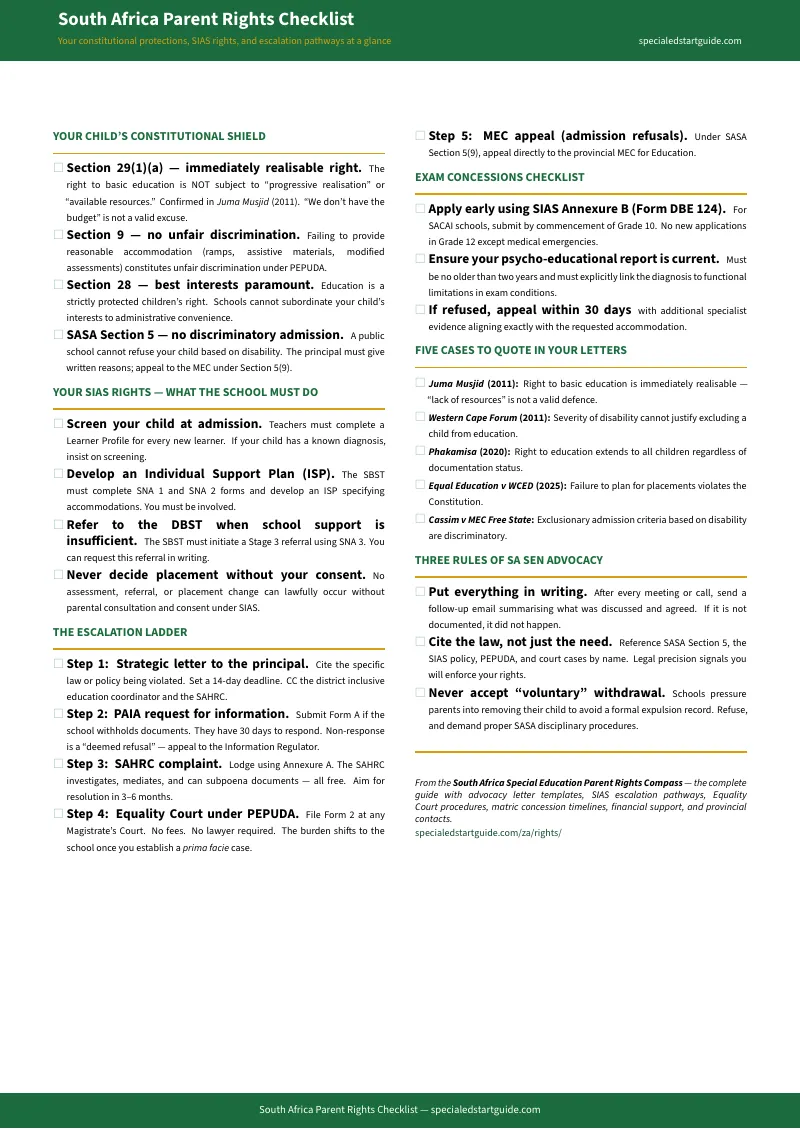
- Parent Rights Quick Reference Checklist — the printable quick-reference covering your constitutional shield, SIAS rights, the escalation ladder, exam concession steps, and five landmark cases to quote in your letters
- Admission Refusal Letter Template — citing SASA Section 5 and the Juma Musjid ruling, ready to fill in and send
- ISP Demand Letter Template — citing the SIAS policy's SNA 2 process and your right to participate
- Suspension Challenge Letter Template — citing SASA Section 8(5)(b) and the BELA Act on age-appropriate discipline
- SAHRC Complaint Guide — step-by-step Annexure A walkthrough with evidence checklist
- Equality Court Filing Guide — Form 2 walkthrough for PEPUDA complaints at any Magistrate's Court
- PAIA Request Template — Form A for compelling release of school and district documents
Instant PDF download. Print the letter template that matches your situation tonight. Send it tomorrow morning.
Money-back guarantee, no time limit. If the Rights Compass does not change how you advocate for your child in the South African education system, email us for a full refund. No questions asked.
Not ready for the full guide? Download the free South Africa Parent Rights Quick Reference — a printable checklist covering your constitutional protections, SIAS rights, the escalation ladder, exam concession steps, and five landmark cases to cite in your letters. It is enough to understand your child's rights tonight, and it is free.
Your child's right to education is written into the Constitution. When the system violates it, South African law gives you the tools to fight back. This Compass puts those tools in your hands.