Six Agencies. One Birthday. No Filing Sequence — Until Now.
Your child's 18th birthday is approaching and you just realized that everything changes at once. Legal decision-making transfers to them. Parental income stops counting for SSI. The Social Security Administration switches from the childhood disability standard to a stricter adult threshold that initially denies many recipients. And if the SSA says no, Wyoming's 1634 Medicaid link means cash and coverage are both at risk in the same envelope unless you request benefit continuation and, if WDH issues a termination notice, a fair hearing.
You call the Social Security office. They tell you to gather medical records. You call the Wyoming Department of Health. They say Medicaid is automatic — but nobody explains that "automatic" only works if SSI is approved, and that a denial puts both cash and coverage at risk unless you request benefit continuation. You try to apply for the Supports Waiver and learn that Wyoming requires a full clinical and financial eligibility determination before they will even put you on the waitlist — 415 individuals deep with $30,000 per funded slot. And the Comprehensive Waiver? No general waitlist at all. Access requires the Extraordinary Care Committee to approve emergency placement.
Meanwhile, the school transition coordinator hands you a folder of brochures and tells you to "start reaching out." Nobody maps the filing sequence. Nobody explains which step unlocks the next. And nobody mentions that the 10-day window for requesting benefit continuation after a denial is different from the 60-day appeal window — and missing the first one means months without Medicaid while you fight the second.
The Wyoming Adult Benefits Coordination System is the cross-agency filing manual that maps every step — SSI redetermination, representative payee setup, 1634 Medicaid protection, DAC and SSDI benefits, the Supports and Comprehensive Waiver applications, ECC petitions, WYABLE accounts, self-directed care employer-of-record setup, employment pathways, IEP transition, and guardianship alternatives — in the sequence Wyoming requires, with the evidence strategies and decision tools for each agency.
What's Inside the Coordination System
The Age-18 Redetermination Blueprint
The SSA's age-18 review evaluates your young adult under the adult disability standard — the inability to perform Substantial Gainful Activity ($1,690/month in 2026). The guide breaks down the five-step sequential evaluation, explains how to translate IEP goals and psychoeducational evaluations into the clinical language that satisfies the adult standard, and maps the evidence file you need to compile before the review begins. If the redetermination results in a denial, the 10-day benefit continuation request and the 60-day appeal timeline are laid out step by step — because in a 1634 state, these deadlines protect both cash and Medicaid simultaneously.
The 1634 Medicaid Protection Plan
Wyoming's 1634 agreement means SSI approval automatically enrolls your young adult in Medicaid — no separate application, no WDH paperwork. The guide explains how to protect this link during the redetermination process, how to navigate annual Medicaid renewals, how the Employed Individuals with Disabilities (EID) program works for ages 16 to 64 with income up to 300% of the federal benefit rate, and how Section 1619(b) preserves Medicaid coverage when your young adult starts earning above the SGA threshold.
The Chapter 46 Waiver Navigation System
Wyoming's Developmental Disabilities Section administers both the Supports and Comprehensive Waivers under Chapter 46. The Supports Waiver requires full eligibility determination — including a psychological evaluation less than five years old from a licensed, Medicaid-enrolled Wyoming clinician — before waitlist placement. The Comprehensive Waiver has no open waitlist; access requires the Extraordinary Care Committee to certify that the individual's needs exceed the Supports Waiver budget cap and that their life or health is in immediate jeopardy. The guide maps both application pathways, the ECC petition packet requirements, and the evidence strategies for each.
The Waitlist Coordination System
While on the Supports Waiver waitlist, your case manager can bill for Targeted Case Management — up to 120 fifteen-minute units per plan year, funded by state dollars. Beyond that, direct services are structurally unavailable. The guide maps every interim resource, explains how to document unmet needs to preserve your position, and covers the EID Medicaid buy-in as a parallel coverage pathway. When a funded slot opens, the documentation strategies in this section ensure you pass the second-stage review without delay.
The DAC Benefits Calculation and Transition Plan
When a parent retires, becomes disabled, or dies, a young adult with disability onset before age 22 becomes eligible for Disabled Adult Child benefits — up to 50% of the parent's benefit (75% if deceased). The Social Security Fairness Act of 2025 repealed the WEP and GPO, meaning Wyoming public employees' families now receive full, unreduced DAC amounts. The guide includes worked dollar examples showing exactly how to calculate the SSI-to-DAC transition and how to protect Medicaid through Section 1619(b) when DAC income exceeds the SSI threshold.
WYABLE Account Setup and Resource Protection
Wyoming has no state-run ABLE program, so residents choose any out-of-state plan — and since Wyoming has no state income tax, there is no tax-deduction disadvantage to shopping nationwide. The guide covers account setup, the $20,000 standard contribution limit, ABLE-to-Work provisions for additional contributions, the expanded disability onset age of 46 under the 2026 ABLE Age Adjustment Act, and how to coordinate ABLE savings with representative payee accounts to prevent accidental resource limit violations. The first $100,000 is excluded from the SSI resource limit entirely.
The Self-Directed Employer Toolkit
Wyoming's provider shortage — driven by the 2025 ARPA rate collapse that dropped the behavioral technician code 97153 from $19.23 to $7.00 per unit — forced many families toward self-directed care under Chapter 46, Section 12. Even with the July 2026 rate restoration, the provider network remains fragmented. If you choose self-direction, you become the Employer of Record: recruiting staff, contracting with the Financial Management Service (ACES$), managing budgets, and maintaining compliance documentation. The kit includes the Self-Directed Budget Tracker for approved line items, monthly spend, timesheets/EVV, and ACES$ / FMS reconciliation.
The Legal Decision-Making Toolkit
Your young adult becomes a legal adult at 18. If they have capacity, a Durable Power of Attorney and Healthcare Directive preserve their autonomy while giving you the authority to act. If capacity is limited, Wyoming courts can grant guardianship — but the guide also covers supported decision-making agreements and limited guardianship as less restrictive alternatives. The comparison framework helps you evaluate which option preserves the most independence while providing the support your young adult actually needs.
Employment Pathways and Work Incentives
The Wyoming Division of Vocational Rehabilitation offers Pre-Employment Transition Services starting at age 14 and the Pathways to Progress transition program. The guide explains the SSI earned-income calculation ($1 reduction for every $2 earned after the first $85), the Student Earned Income Exclusion (sheltering up to $2,290/month for students under 22), the Plan to Achieve Self-Support, Trial Work Period rules, and how to coordinate work earnings with WYABLE contributions and Medicaid protection.
Who This Guide Is For
- Parents whose teenager is approaching 18 and who need to coordinate SSI redetermination, 1634 Medicaid protection, Supports Waiver application, and legal decision-making before the birthday — not after
- Parents who received the SSA age-18 redetermination letter and need to understand what evidence to compile, how the adult disability standard works, and what happens if the initial determination is denied
- Families managing the Supports Waiver waitlist who need interim services through Targeted Case Management and the EID Medicaid buy-in while documenting unmet needs for the second-stage review
- Families of Wyoming public employees — teachers, law enforcement, state workers — whose DAC benefit calculations changed after the 2025 WEP/GPO repeal and who need to protect Medicaid during the SSI-to-DAC transition
- Parents who have been told their young adult needs the Comprehensive Waiver but who do not know how to petition the Extraordinary Care Committee or what evidence the ECC packet requires
- Families choosing self-directed care under Chapter 46 who need the Self-Directed Budget Tracker to stay inside the funding letter and reconcile with ACES$ / FMS
- Parents whose young adult wants to work but fears losing SSI and Medicaid — and who need to understand earned-income exclusions, Section 1619(b), WYABLE coordination, and DVR pathways
Why Not Just Use the Free Resources?
Wyoming has solid free transition resources. The Parent Information Center publishes advocacy materials. The SSA website explains federal rules. The Department of Health posts the TOOL19 Supports Waiver guide. Here is the problem with assembling your plan from these sources:
- Each agency explains its own process in isolation. The SSA does not mention Medicaid waivers. The Department of Health does not explain how SSI denial affects waiver eligibility timing. DVR does not cover representative payee rules. No single free resource maps the cross-agency sequence — which step unlocks which, and what order prevents administrative gaps in coverage.
- Free resources do not teach evidence strategy. The SSA form instructions tell you which boxes to check. They do not tell you how to translate a psychoeducational evaluation into the clinical language that satisfies the adult standard, or how to prepare adaptive behavior documentation that meets the waiver eligibility threshold.
- Wyoming's waiver rules are buried in provider-facing manuals. Chapter 46 regulations, the ECC petition process, and self-directed care compliance requirements are scattered across hundreds of pages of technical documentation written for case managers, not families.
- Legislative changes move faster than agency websites. The WEP/GPO repeal fundamentally changed DAC benefit calculations for public employee families. The ABLE Age Adjustment Act expanded eligibility to disability onset before age 46. The 2026 waiver rate restoration altered the provider landscape. Free resources routinely lag these changes by months or years. This guide reflects verified 2026 law.
The guide does not replace a special needs planning attorney or a disability advocate. It prepares you so that if you do hire one, you have already organized the clinical records, asset documentation, and agency paperwork — and you spend their hourly rate on strategy, not on explaining the basics.
What You Get
- The Full 14-Chapter Guide — Step-by-step navigation across SSI, Medicaid, Supports and Comprehensive Waivers, DAC benefits, WYABLE, self-directed care, employment pathways, IEP transition, and the legal decision-making framework, with worked dollar examples and evidence strategies
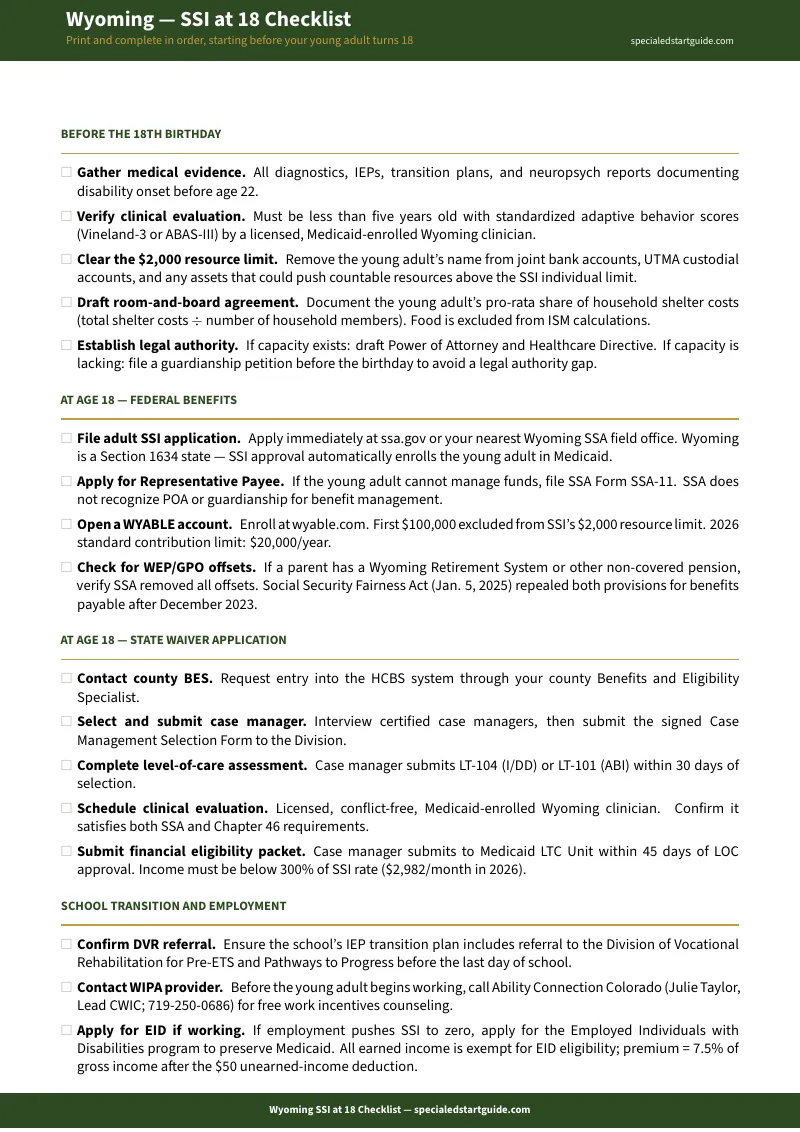
- The Free Checklist — A two-page chronological timeline covering every major filing and deadline from twelve months before age 18 through ongoing adult services
- Printable Standalone Tools — Transition Timeline Planner, SSI Documentation Checklist, Room-and-Board Calculator, Room-and-Board Agreement, Waiver Application Tracker, Agency Communication Log, Self-Directed Budget Tracker, and Key Contact Directory
Everything is formatted as downloadable PDFs. No subscriptions, no recurring charges — buy once and keep the files permanently.
The 30-day satisfaction guarantee applies. If the guide does not help you navigate Wyoming's adult benefits system more confidently, email [email protected] for a full refund. No hoops.
The free checklist gives you the sequence. The full guide gives you the system — every evidence strategy, every filing deadline, every cross-agency coordination point, in the order Wyoming requires.