
The District Knows NDCC 15.1-32. Now You Will Too.
You walked into that IEP meeting prepared — or you thought you did. You downloaded the procedural safeguards from the NDDPI website. You called Pathfinder Parent Center. You wrote your concerns in a notebook. And then the team smiled, told you they needed "more RTI data before we can evaluate," and sent your child back to Tier 2 interventions for another cycle.
You left the meeting without an evaluation date. Without new services. Without Prior Written Notice explaining why they refused your request — because you didn't know to ask for one.
The problem isn't that you're uninformed. The problem is that North Dakota's special education system is built to be navigated by professionals, not parents. Over 170 school districts stretched across a state where 54% of administrators say it's very difficult or impossible to fill special education positions. A network of 30 Multidistrict Special Education Units and REAs where your child's speech therapist might visit the county twice a month. A data migration (BRIDGE) that's converting years of IEP records into static PDFs. And a state that publishes procedural safeguards but zero fill-in-the-blank templates for enforcing them.
The North Dakota IEP & 504 Blueprint is the tactical enforcement toolkit that bridges the gap between knowing your rights and actually exercising them — with every template, script, and checklist grounded in NDCC 15.1-32, ND Administrative Code 67-23, and the realities of rural service delivery.
What's Inside the Blueprint
The NDCC 15.1-32 Legal Template Library
Every letter cites the exact North Dakota Century Code and Administrative Code. Request an initial evaluation and start the district's 60-school-day clock. Demand compensatory education when speech therapy sessions went undelivered because the itinerant SLP from the REA only visits twice a month. Formally request an Independent Educational Evaluation at public expense when you disagree with the district's findings. Request Prior Written Notice after a verbal denial at the IEP table. These aren't generic IDEA samples — they're North Dakota-specific enforcement tools that create a legally binding paper trail the moment you hit send.
The Rural REA Strategy Guide
Approximately 97% of North Dakota public schools are served by Regional Education Associations that pool specialists across vast rural areas. Generic national guides advise parents to "demand a speech therapist." In rural North Dakota, that shared therapist physically visits your county on a rotating schedule. The Blueprint teaches you how to negotiate around these constraints — demanding district-funded teletherapy, contracted private providers, mileage reimbursement for travel to urban specialists, or out-of-district placement when your school cannot provide FAPE due to geographic limitations. Chapter 5 addresses the small-town dynamic directly: how to advocate firmly without burning bridges in a community where the special education director is your neighbor.
The Non-Categorical Delay Pathway
North Dakota Century Code allows a "Non-Categorical Delay" classification for children ages 3 through 9 — a state-specific eligibility pathway that generic national guides never mention. If your young child is showing delays but doesn't have a clear medical diagnosis yet, you don't have to wait for one. The Blueprint explains the NCD criteria (1.5 standard deviations below the mean in two developmental areas, or 2.0 SD in one area) and how to use this classification to secure services immediately while a more specific diagnosis is still being explored.
The BRIDGE Migration Protection Chapter
From 2024 through 2026, NDDPI is migrating the state's special education data system from TieNet to Infinite Campus. Historical IEP records are being converted to static PDF files — only about 20 data fields migrate as active data. Reference access to the old TieNet system is scheduled to end permanently by April 2027. The Blueprint tells you exactly what to document independently, what to request copies of now, and how to protect your child's service history during this transition so nothing falls through the cracks.
The Compensatory Education Calculator
When the district fails to deliver the therapy minutes written in the IEP — because the SLP quit, the OT position at the special education unit is vacant, or the itinerant provider from the REA only comes every other week — your child is owed compensatory education hours. The Blueprint shows you how to document missed sessions, calculate the service gap, and file a state complaint that forces the district to outsource services to a private provider at their expense.
IEP Meeting Scripts and Checklists
What to say when the team tells you "we need more RTI data before we can evaluate." What to say when they offer a 504 instead of an IEP. What to say when the LEA representative claims they don't have authority to commit resources. Each script cites the NDCC section or IDEA provision that proves them wrong — so you're not arguing opinions, you're citing law. The pre-meeting checklist covers one-party recording consent under NDCC 12.1-15-02, required team composition under ND Admin Code 67-23, and the specific documents to bring.
Goal-Tracking Worksheets
IEP goals are legally required to be measurable — with baselines, targets, and mastery criteria that meet the Endrew F. standard. But many goals in North Dakota IEPs are written so vaguely that progress is impossible to track. The worksheets give you a structured format to log data between meetings, compare school-reported progress against your own observations, and arrive at the annual review with documentation that either confirms the program is working or proves it isn't.
The Dispute Resolution Roadmap
When informal advocacy fails, you have four options in North Dakota: requesting a Facilitated IEP Meeting through NDDPI, filing a State Complaint with the Office of Specially Designed Services, requesting mediation, or filing for a due process hearing before an Administrative Law Judge from the ND Office of Administrative Hearings. The Blueprint explains when each option is appropriate, the timelines involved, and how the paper trail you've been building with the advocacy templates becomes the evidence that wins your case — or convinces the district to settle before you reach a hearing.
Who This Blueprint Is For
- Parents whose child is stuck in MTSS/RTI while the school says "we need more intervention data" — and who need the legal language to force an evaluation within 60 school days
- Parents who've been told their child "doesn't qualify" for an IEP despite a medical diagnosis — and who need the two-pronged eligibility test explained in plain English with the NDCC citations to challenge the determination
- Parents of young children (ages 3–9) who may qualify under North Dakota's Non-Categorical Delay classification — a state-specific pathway that national guides don't cover
- Parents in rural North Dakota where IEP services go undelivered because the district physically lacks a speech therapist or occupational therapist — and who need to know how to demand compensatory education or teletherapy solutions
- Military families PCSing to Minot AFB or Grand Forks AFB with an existing out-of-state IEP — who need the transfer rules and how to prevent service gaps during the transition
- Native American parents navigating IEPs in Bureau of Indian Education schools on Fort Berthold, Turtle Mountain, or Standing Rock — where federal jurisdictional rules differ from state schools
- Parents in Fargo, Bismarck, or Grand Forks dealing with large district bureaucracies that delay evaluations, under-staff IEP meetings, and predetermine outcomes before you arrive
- Parents preparing for their first IEP meeting who don't want to walk in blind against a team that does this every day
Why Not Just Use the Free Resources?
North Dakota has dedicated free special education resources. Pathfinder Parent Center hosts workshops. The Protection & Advocacy Project files systemic complaints. NDDPI publishes procedural safeguards. Here's why parents still struggle after consulting all of them:
- NDDPI's procedural safeguards are a legal disclosure, not a toolkit. Sixty-plus pages of dense bureaucratese that inform you of abstract rights but provide zero templates, conversational scripts, or tactical strategies for enforcing those rights in a hostile meeting. The state publishes them to satisfy compliance requirements — not to arm you for the IEP table.
- Pathfinder Parent Center is funded by the state — and it shows. Pathfinder provides invaluable community support and workshops. But as a state-funded entity, their materials are inherently diplomatic. They explicitly state they are "not a legal firm or legal service agency." When a school district turns hostile, you need adversarial tactics — fill-in-the-blank demand letters citing specific administrative codes — that grant-funded non-profits are structurally unable to publish.
- The Protection & Advocacy Project cannot be your personal advocate. P&A takes cases based on strict priority criteria and caseload limits. They file systemic investigations — like their landmark restraint and seclusion inquiry into Fargo Public Schools — but routinely cannot take individual IEP disputes. The Blueprint provides the immediate self-advocacy tools for an IEP meeting happening next week, rather than waiting months to be told your case doesn't meet this year's priority scope.
- National guides like Wrightslaw miss everything specific to North Dakota. Wrightslaw explains federal IDEA law brilliantly. It does not address NDCC 15.1-32 timelines, the Non-Categorical Delay classification, the REA-based itinerant service model, the BRIDGE data migration, military family IEP transfer rules at Minot or Grand Forks AFB, or Bureau of Indian Education jurisdictional splits. Generic federal templates leave out every local lever that actually determines your outcome.
The free resources explain what the law says. The Blueprint gives you the tools to make the district follow it.
— Less Than 6 Minutes of a Special Education Advocate
Private special education advocates in North Dakota charge $150–$400 per hour. Even if you eventually need professional help, the meticulous paper trail you build with this Blueprint saves thousands in billable hours — because you're handing your advocate an organized case, not a shoebox of unsigned IEP copies and half-remembered conversations.
Your download includes the complete guide plus standalone printable tools ready to bring to your next meeting:
- Complete Blueprint Guide (guide.pdf) — 12 chapters covering evaluations, IEP development, 504 plans, rural REA strategies, the Non-Categorical Delay pathway, transition planning, military family transfers, BIE school navigation, compensatory education, the BRIDGE migration, and dispute resolution
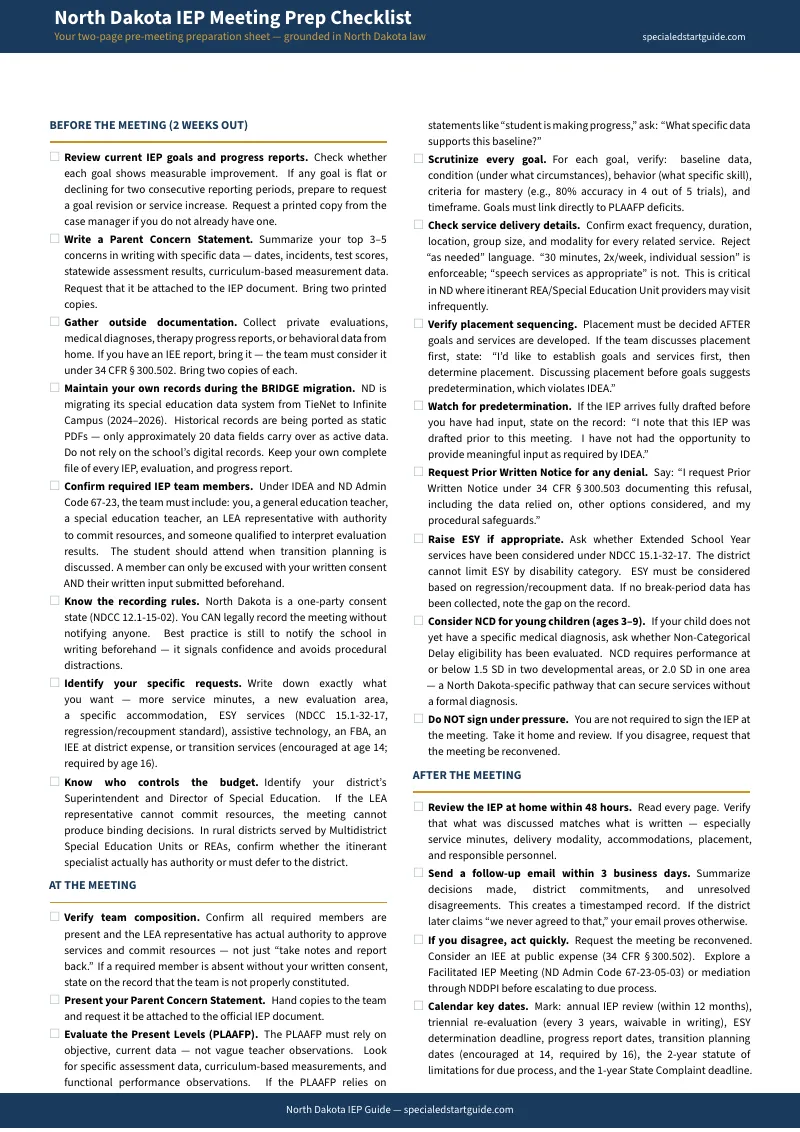
- IEP Meeting Prep Checklist (checklist.pdf) — the before/during/after checklist with North Dakota timelines, NDCC citations, one-party recording consent rules, and red flags requiring immediate action
- Advocacy Letter Templates (advocacy-letters.pdf) — 5 fill-in-the-blank letters citing NDCC 15.1-32 and ND Admin Code 67-23: evaluation requests, Prior Written Notice demands, IEE requests, missed services documentation, and facilitated IEP meeting requests
- IEP Meeting Scripts (iep-meeting-scripts.pdf) — 8 word-for-word responses to common district pushback, each citing the specific NDCC section or IDEA provision
- Goal-Tracking Worksheet (goal-tracking-worksheet.pdf) — fillable progress monitoring form with quarterly tracking columns and an observation log for documenting data between annual reviews
- North Dakota Timeline Cheat Sheet (nd-timeline-cheatsheet.pdf) — every legal deadline on two pages: evaluation, IEP, discipline, dispute resolution, and transition timelines with citations
- Compensatory Education Tracker (compensatory-education-tracker.pdf) — missed service log for documenting undelivered therapy sessions, calculating owed hours, and building your State Complaint evidence
Instant PDF download. Print the checklist tonight. Walk into tomorrow's meeting with NDCC 15.1-32 on your side.
Money-back guarantee, no time limit. If the Blueprint doesn't change how you approach IEP meetings in North Dakota, email us for a full refund. No questions asked.
Not ready for the full Blueprint? Download the free North Dakota IEP Meeting Prep Checklist — a printable pre-meeting checklist with the NDCC timelines, required team composition, recording consent rules, and red flags that require immediate action. It's enough to walk into your next meeting prepared, and it's free.
Your child's right to a Free Appropriate Public Education doesn't yield to staffing shortages or geographic isolation. The district knows NDCC 15.1-32. After tonight, so will you.