
Your child is turning 18 in Mississippi — and the rules don't work the way anyone expects
The school district starts sending home transition paperwork. A doctor's office mentions HIPAA. A disability caseworker tells you to "look into guardianship." And suddenly you're trying to figure out whether you need to file a petition in chancery court before the birthday — while someone else tells you Mississippi's age of majority is actually 21, so maybe you have more time.
Here's what makes Mississippi uniquely disorienting: both things are true at the same time. Your child's general age of majority is 21 — IEP rights, chancery court adult status, and parental custody all continue past 18. But HIPAA medical privacy, healthcare consent, FERPA postsecondary privacy, contractual capacity for personal property, and SSI eligibility all shift at 18. The result is a three-year limbo where your child has independent authority over their health and finances, but you still control their education, and you cannot petition for adult guardianship or conservatorship until they reach 21.
Most families discover this gap the hard way — locked out of a medical portal at 18, unable to open a bank account for SSI benefits without a representative payee appointment, or blindsided by a county clerk who rejects their self-filed petition because of Rule 6.01.
The Dual-Age Decision System —
The Mississippi Adult Guardianship & Alternatives Guide is built around the specific legal architecture that makes Mississippi different from 48 other states. It walks you through every option — from documents you can prepare at the kitchen table to a full chancery court petition — organized around the dual-age-threshold reality of ages 18 and 21, so you choose the right level of protection for your child's actual needs instead of defaulting to the most restrictive option because nobody explained the alternatives.
What's Inside
- Functional Capacity Assessment Checklist — a structured evaluation across healthcare, financial, daily living, and legal comprehension domains. Your child's results determine which legal track applies: private documents they can sign themselves, the healthcare surrogate pathway for emergencies, Representative Payee for SSI, or a court-supervised appointment under the GAP Act.
- Power of Attorney Execution Guide — how to set up a Mississippi durable financial power of attorney and a healthcare power of attorney, including the capacity threshold your child must meet to sign, the notarization requirements, and the specific risk scenarios where a POA may not be sufficient.
- Healthcare Directive Walkthrough — the complete process under Mississippi's Uniform Health-Care Decisions Act for establishing a healthcare agent appointment and advance directive, including what happens if your child revokes it during a period of poor judgment.
- HIPAA Authorization Setup — the forms your child needs to sign before their 18th birthday so you retain access to medical records, doctor conversations, and patient portals.
- Representative Payee Process — how to apply for SSA Representative Payee status to manage your child's SSI benefits without a court-ordered conservatorship, including the annual accounting requirements.
- Full Chancery Court Process — every step from initial petition through Guardian ad Litem appointment, the dual-physician GAP Act medical evaluations, the chancellor's hearing, and final order, with post-appointment obligations (annual well-being reports, conservator bonding, 90-day inventory filing) so nothing surprises you after the appointment.
- Emergency Guardianship Procedures — when and how to petition for temporary emergency guardianship in crisis situations, including the 60-day order window and the process for converting to a permanent appointment.
- Special Needs Trust Overview — how an SNT works alongside guardianship or its alternatives to protect your child's SSI and Medicaid eligibility, including the September 2024 rule change that eliminated the ISM food penalty for trust distributions used to purchase groceries.
- Successor Guardian Planning — how to ensure continued protection if you become incapacitated or pass away, including naming backup fiduciaries and coordinating with trust instruments.
- Cost Breakdown — the $158 baseline filing fee, medical evaluation costs, attorney retainer ranges ($1,500 to $2,500 for uncontested cases), Guardian ad Litem fees ($500 to $3,000), and surety bond premiums, so you can budget before committing to any path.
Who This Is For
- Parents whose child's 18th birthday is approaching — and who are getting conflicting advice from school staff, doctors, and relatives about whether guardianship is necessary.
- Parents confused by the 18-versus-21 split — who need to understand which rights shift now and which don't transfer for three more years, so they can protect the areas that matter without court involvement where it isn't needed.
- Families earning too much for free legal aid — the Mississippi Volunteer Lawyers Project limits pro bono guardianship clinics to households under 200% of the federal poverty guidelines. If you're in the "missing middle" — too high for free help, too stretched for a full-retainer attorney — this guide helps you arrive at that first attorney consultation organized and informed, cutting billable hours.
- Parents who want to preserve their child's autonomy — the GAP Act requires courts to prioritize the least restrictive alternative. This guide helps you evaluate whether a power of attorney, healthcare directive, or Representative Payee arrangement covers your child's needs before you pursue a court order that removes civil rights.
Why Free Resources Aren't Enough
Disability Rights Mississippi (DRMS) provides essential advocacy for civil rights and school accommodations, but their charter prohibits them from drafting estate planning documents or handling private guardianship cases. The Mississippi Volunteer Lawyers Project runs pro bono guardianship clinics — but only for families under 200% of the federal poverty guidelines. National document generators sell template packages, but none of them address the GAP Act, Mississippi's dual-age-threshold system, or the chancery court rules that vary from county to county.
These resources explain what the legal options are. What they don't do is help you decide which option fits your child, then execute it. They don't include a capacity assessment. They don't compare your costs across alternatives. They don't walk you through the dual-physician medical evaluation timeline or warn you that chancery clerks won't accept your petition without an attorney under Rule 6.01.
This guide fills the gap between "here are your options" and "here's how to actually do this in your county, with your child's specific needs, on your timeline."
The Cost of Getting It Wrong
File for full guardianship when a power of attorney would have covered it, and you've spent thousands in legal fees to remove rights your child could have kept. Wait until after the 18th birthday to prepare HIPAA authorization, and the first time your child is hospitalized, you'll be standing in a waiting room while doctors refuse to tell you what's happening. Skip the Representative Payee application and try to open a bank account for SSI benefits, and the bank will send you to chancery court for a conservatorship you may not need.
None of these mistakes are easy to undo. The guide exists so you can make this decision with complete information instead of pressure and guesswork.
Satisfaction Guarantee
If the guide doesn't help you make a clearer, more confident decision about your child's transition to adulthood, reach out for a full refund. No questions, no hoops.
Start With the Free Checklist
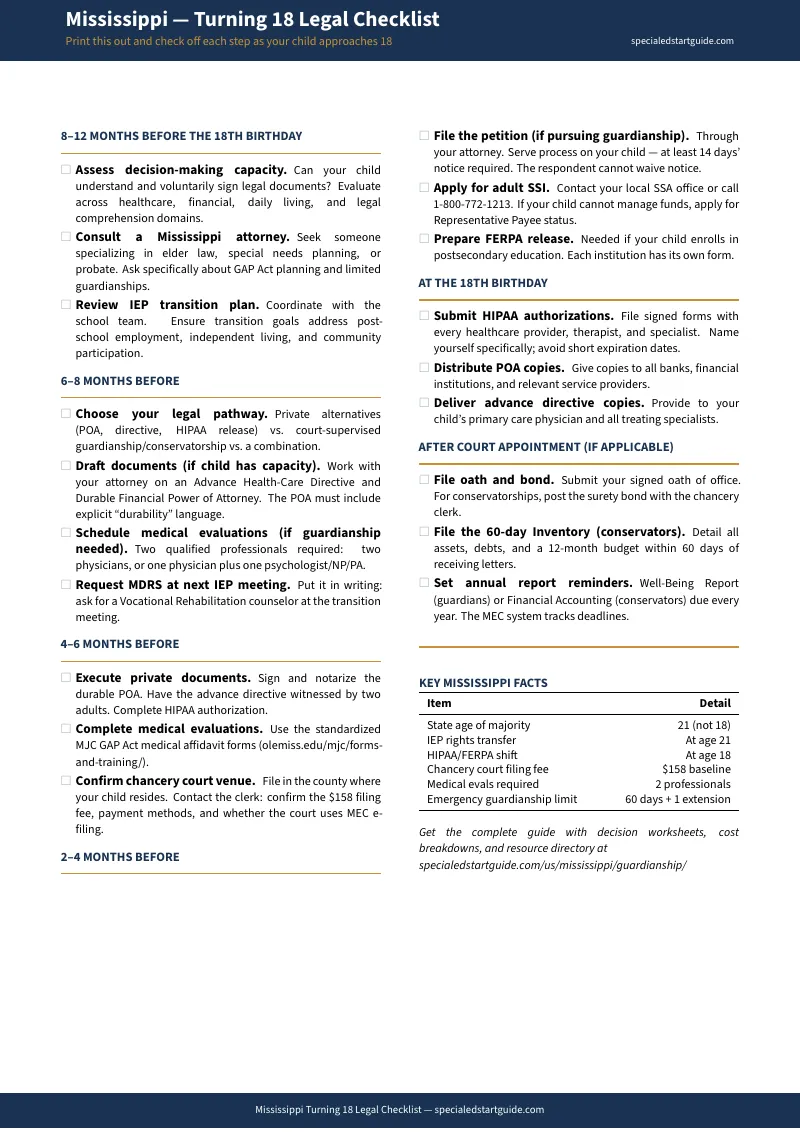
Download the Mississippi — Turning 18 Legal Checklist — a one-page overview of every milestone, deadline, and decision point between now and your child's transition. If the checklist confirms you need deeper guidance, the full guide is ready when you are.