
The School Said They "Cannot Accommodate." Nobody Told You Saudi Law Says Otherwise.
You moved to Saudi Arabia for the opportunity of a lifetime — Aramco, NEOM, KAUST, a defense contract in Riyadh, a hospital post in Jeddah. The compound is comfortable. The salary is generous. The school accepted your child's application. Then came the meeting. The Learning Support Coordinator sat you down and explained, carefully and firmly, that your child's needs "exceed the scope of what the school can provide." Not a discussion. A verdict. You were handed a list of private therapy clinics — in Arabic — and told to "explore external options."
You went home and started searching. "Special education Saudi Arabia." "IEP rights international school Riyadh." "Autism schools Jeddah expat." You found the Ministry of Education website — a portal promising a "Special Education Guide" and a "Parents' Guide" behind links that led to Arabic-only documents or dead pages. You found Reddit threads where exhausted parents asked desperate questions: "Is it expensive to go in a special school for a kid with autism in Jeddah? And do they accept expat kids?" The responses were anecdotal, contradictory, and devoid of any legal or strategic framework. You priced an educational consultant: 97,000 SAR annually. You called a private ABA provider: 200 to 400 SAR per hour, no insurance coverage, no guarantee the school would let them set foot on campus.
The problem is not that Saudi Arabia lacks special education protections. The Kingdom's Rules and Regulations of Special Education Programs (RRSEP) was explicitly modeled on the US Individuals with Disabilities Education Act (IDEA) — IEPs, Least Restrictive Environment, multidisciplinary evaluation. The 2023 Rights of Persons with Disabilities Act prohibits disability discrimination across public and private sectors. Vision 2030 is investing billions in inclusion reform. The problem is that every one of these protections was designed for the Arabic-language public school system — and your child is at an international school where none of these frameworks are transparently enforced for English-speaking families.
The Saudi Arabia Special Education Blueprint is the Expat Advocacy System that translates RRSEP rights and Saudi disability law from opaque government portals and Arabic-first bureaucracy into the culturally aligned negotiation scripts, cost frameworks, and strategic tools that give you real leverage inside the meeting room.
What's Inside the Blueprint
The Legal Framework Decoded — RRSEP, RPDA, and What They Mean for Your Child
The RRSEP mandates IEPs, Least Restrictive Environment, and multidisciplinary evaluation across ten disability categories. The 2023 Rights of Persons with Disabilities Act adds 33 articles of anti-discrimination protection covering both public and private sectors. But Saudi international schools typically create Individual Learning Plans (ILPs) — internal documents the school can modify or withdraw at will — not legally binding IEPs. When a school tells you "Saudi regulations don't apply to us," this chapter explains exactly how they do — and gives you the specific language to reference RRSEP and RPDA standards during negotiations without sounding like an aggressive outsider quoting foreign law.
The RRSEP-to-IDEA Crosswalk Matrix
If you know US IDEA or UK SEND, you arrive in Saudi Arabia expecting a familiar system — and discover that none of the terminology matches. This one-page visual cheat sheet maps what you expect from your home country's framework directly to the equivalent article in RRSEP. "Free Appropriate Public Education" becomes "education in the best educational environment." "Due process hearing" becomes "no equivalent — collaborative negotiation." This tool transforms your demands from "American rights a Saudi school doesn't recognize" into "Saudi standards the school is supposed to follow." The difference is everything.
International School Placement — Admissions, Refusals, and the Grey Zone
Expatriate children are structurally funneled into international schools by a 15% non-Saudi enrollment cap and Arabic-only public school curriculum. These schools are private businesses. When your child requires SEN support, the school's operational model is threatened. This chapter maps how top-tier Saudi international schools (AISJ, BISR, DISR, ISG, and others) actually handle inclusion — what they publish versus what happens inside the building. How they "counsel out" families. How to evaluate a school's inclusion capacity before you enroll. And what to do when you're already enrolled and the school starts pushing you toward the exit.
Evaluation and Assessment — What It Costs and Where to Go
A private psycho-educational evaluation in Saudi Arabia costs thousands of riyals. If your child was diagnosed in the US, the UK, or Australia, your existing reports may not be accepted — they must be professionally translated into Arabic and validated through approved local channels. This chapter maps the private clinics serving English-speaking families in Riyadh, Jeddah, and the Eastern Province, explains what the assessment report needs to contain for school placement and APD registration, and shows you how to coordinate between external clinical findings and the school's internal observations when the two tell different stories.
ILP Development and Enforcement
The ILP at a Saudi international school is not a legally binding contract. There is no due process hearing, no tribunal, no enforcement mechanism beyond the relationship you build with the school administration. This chapter teaches you how to review proposed goals for measurability, catch copy-pasted goals carried forward verbatim from last term, push for data-tracking methods rather than subjective teacher opinion, and build the documentation trail that holds the school accountable at the next review — all within the collaborative, relationship-based framework that actually produces results in Saudi Arabia.
Cultural Advocacy — Why Western Confrontation Fails and What Works Instead
Western parents arrive conditioned to advocate aggressively — threatening legal action, quoting statutory rights, demanding compliance. In Saudi Arabia, this approach is catastrophically counterproductive. The Kingdom operates on wasta — a system of influence, social capital, and personal connections that determines institutional outcomes more reliably than documented regulations. This chapter teaches you to build alliances with school leadership using culturally aligned strategies: face-saving language, relationship-based negotiation, and corporate leverage through your employer's HR — because a formal inquiry from Aramco or NEOM lands differently than a parent threatening to "go to the Ministry."
Private Therapy Navigation — ABA, Speech, OT, and the Integration Challenge
ABA therapy runs 200 to 400 SAR per hour in Saudi Arabia. Intensive programs easily exceed 200,000 SAR per year out-of-pocket, and standard expat health insurance rarely covers it. But isolated after-school therapy does not solve the core problem: daily integration in the mainstream classroom. This chapter maps the therapy landscape in Riyadh, Jeddah, and the Eastern Province, explains how to negotiate with the school to allow external therapists on campus, and shows you how to build an Integrated Service Agreement so you don't pay double for redundant services while your child receives fragmented support.
Government Support — APD Registration, Even as an Expatriate
The Authority for the Care of Persons with Disabilities (APD) provides disability registration, support services, and access to accommodations for standardized testing (Qiyas). Expatriates with valid residency can register — a step most expat families don't know is available. This chapter provides the registration process, the medical documentation requirements, and what concrete benefits registration unlocks.
Exit Planning — Leaving Saudi Arabia Without Gaps in the Record
Your contract is two to three years. When it ends, your child needs to transfer into a new school system with complete documentation. This chapter covers how to build a portable SEN record, secure continuity letters from the school, maintain therapy documentation, and ensure your child's ILP data translates into the receiving country's framework — whether you're heading to the US, UK, UAE, or anywhere else.
Who This Blueprint Is For
- Expatriate parents relocating to Saudi Arabia who assumed their home country's special education protections (IEPs under IDEA, EHCPs, NDIS) would transfer — and discovered that international schools in the Kingdom operate as autonomous private businesses with no transparent external enforcement of inclusion standards
- Parents whose international school just told them their child "cannot be accommodated" — without producing formal evidence, following a documented process, or explaining the RPDA protections that may apply
- Parents at Aramco, NEOM, KAUST, SABIC, or multinational corporations who receive generous school allowances but zero tactical guidance on how to actually secure special education services within the schools those allowances fund
- Parents navigating the gap between Saudi Arabia's ambitious Vision 2030 inclusion promises and the reality inside their child's classroom — where the school struggles to hire a single qualified SEN teacher due to visa delays and global talent shortages
- Parents paying 200,000+ SAR per year for private ABA, speech, or occupational therapy because the school refused to integrate services — and needing a framework to coordinate external therapy with the school rather than funding two parallel systems
- Parents who've relied on conflicting advice from compound gossip, Facebook groups, and Reddit threads — and need a structured, legally grounded roadmap instead of anecdotes that may be outdated, localized, or simply wrong
- Parents considering repatriation or family separation because they believe navigating Saudi Arabia's special education system is impossible — and wanting one last, low-cost attempt to make it work before fracturing the family across countries
Why Not Just Use the Free Resources?
Saudi Arabia has free resources on disability and special education. The Ministry of Education publishes guides and regulations. International schools post inclusion policies on their websites. Expat forums share raw, unfiltered experiences. Here's why parents still arrive at school meetings feeling outmatched:
- The Ministry of Education portal is designed for the Arabic public school system. The MoE lists promising titles — "Special Education Guide," "Parents' Guide," "Disability Law." The links frequently break. When the documents download, they address Arabic-language public schools and specialized state institutes (Al Noor, Amal) — not the international school where your child is enrolled. No existing government resource explains how RRSEP applies to the private, English-medium schools that expat families are structurally required to attend.
- International school inclusion policies are legal shields, not parent tools. AISJ outlines Universal Design for Learning and Multi-Tiered Systems of Support. DISR details "compensation for disadvantages" during exams. These policies dictate what the school will and will not do. They do not teach you how to negotiate when the school refuses to do what the policy promises. They protect the institution's right to refuse — they don't empower you to push back.
- APD registration is opaque by design. The Authority for the Care of Persons with Disabilities portal provides electronic services for disability evaluation and priority card registration. Navigating the portal requires deep knowledge of Saudi civil procedures. Foreign medical evaluations require professional Arabic translation and local validation — a process that can stall your child's educational placement for months if you don't know the exact requirements upfront.
- Forum advice is cathartic, not strategic. Expatriate mothers share stories of raising children with special needs on Facebook and Reddit. They warn about waitlists, recommend therapists, and vent about schools. The information is anecdotal, localized to a specific compound or school year, and almost never cites actual legal frameworks. It is emotional support — not a systematic methodology for securing your child's educational rights.
- International guides use the wrong framework entirely. American IEP templates reference IDEA and FAPE. British EHCP guides assume Local Authority obligations. Walking into a Saudi international school quoting IDEA doesn't just fail — it signals that you don't understand the local system, which makes it easier for the school to dismiss your requests.
Government portals publish the law in Arabic. Schools publish the policy that protects them. The Blueprint gives you the playbook that protects your child.
— Less Than One Hour of Private Therapy
A private ABA session in Riyadh or Jeddah costs 200 to 400 SAR per hour. A comprehensive psycho-educational evaluation runs several thousand riyals. An educational consultant charges 97,000 SAR annually. Even if you eventually need professional support, the documented preparation you build with this Blueprint saves thousands — because you arrive at every meeting with organized evidence, specific regulatory references, and culturally calibrated language instead of a folder of anxiety and a printout from Reddit.
Your download includes the complete 15-chapter guide, a printable IEP Meeting Prep Checklist, and 4 standalone reference tools — 6 PDFs total:
- Complete Blueprint Guide (guide.pdf) — 15 chapters covering the RRSEP legal framework, RRSEP-to-IDEA crosswalk, Rights of Persons with Disabilities Act (2023), international school admissions and placement, evaluation and assessment pathways, ILP development and enforcement, cultural advocacy and wasta-informed negotiation, private therapy navigation and costs, shadow teacher frameworks, government support through APD registration, gender and access considerations, compound community resources, and exit planning
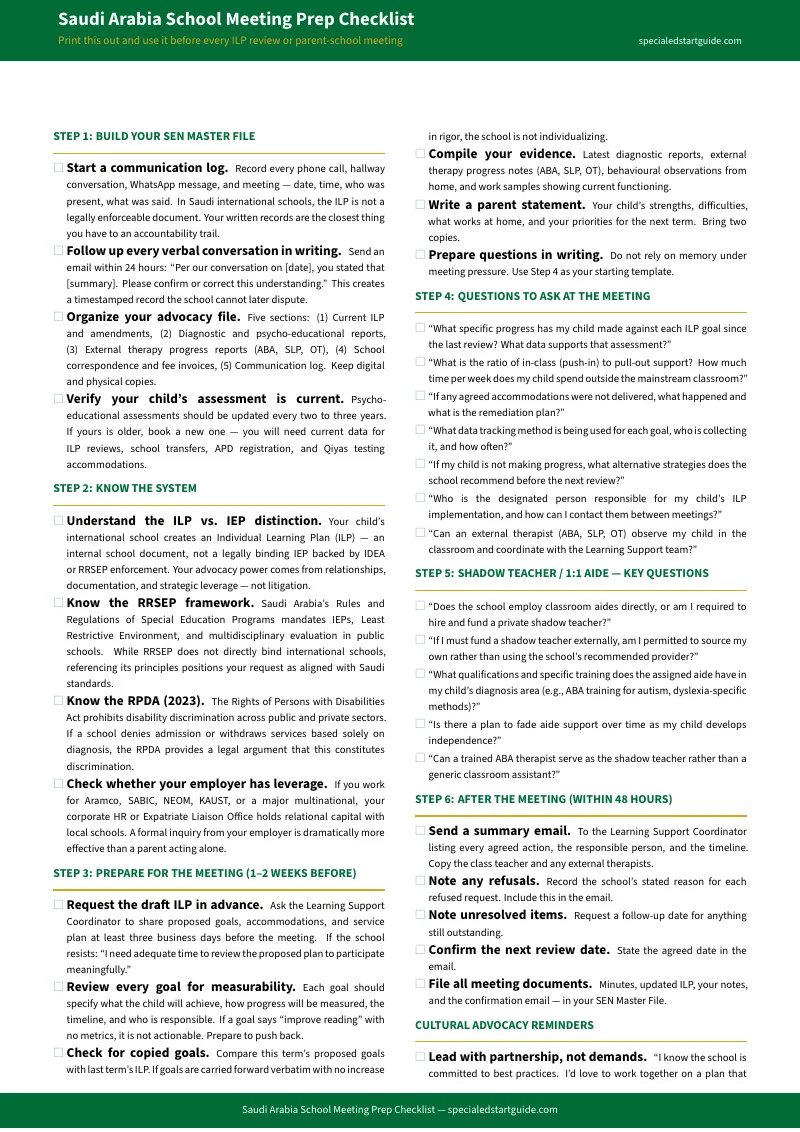
- IEP Meeting Prep Checklist (checklist.pdf) — printable 7-section quick-reference covering SEN Master File setup, system context, meeting preparation, questions to ask at the meeting, shadow teacher and 1:1 aide questions, post-meeting documentation protocol, and cultural advocacy reminders with key contact information and timelines
- RRSEP-to-IDEA Crosswalk (rrsep-idea-crosswalk.pdf) — one-page negotiation cheat sheet mapping Western special education expectations directly to Saudi RRSEP equivalents, with the exact framing language to use when the school says "we are not obligated"
- Arabic-English SEN Glossary (arabic-english-glossary.pdf) — one-page reference card with Arabic script, phonetic transliteration, and plain-English definitions for every critical special education term you will encounter in meetings, medical appointments, and government portals
- APD Registration Guide (apd-registration-guide.pdf) — step-by-step registration process for the Authority for the Care of Persons with Disabilities, document requirements checklist, and Qiyas testing accommodation procedures
- ILP Goal Review Worksheet (ilp-goal-review-worksheet.pdf) — fillable meeting worksheet with goal evaluation questions, before/during/after meeting protocols, and space to document agreed actions, refusals, and follow-up deadlines
Instant PDF download. Print the checklist and worksheets tonight and bring them to your next ILP review, enrollment conversation, or therapy coordination meeting.
Money-back guarantee, no time limit. If the Blueprint doesn't change how you navigate your child's education in Saudi Arabia, email us for a full refund. No questions asked.
Not ready for the full Blueprint? Download the free Saudi Arabia School Meeting Prep Checklist — a structured quick-reference covering RRSEP basics, ILP vs. IEP distinctions, meeting preparation steps, shadow teacher questions, and cultural advocacy reminders. It's enough to walk into your next meeting prepared, and it's free. The full Blueprint adds the 15-chapter guide, RRSEP-to-IDEA Crosswalk, Arabic-English SEN Glossary, APD Registration Guide, and ILP Goal Review Worksheet.
Your child has the right to education in Saudi Arabia. The law exists. After tonight, you'll know exactly how to use it.