
The School Said Your Child "Might Be Better Suited Elsewhere." The Meeting Was in English. The Paperwork Is in Dutch. Your IEP Is Worthless Here.
You relocated to the Netherlands for the job — knowledge migrant visa, 30% ruling, an apartment in the Randstad that costs more than your mortgage back home. The international school seemed fine until your child started struggling. The school's response was polite, concerned, and entirely unhelpful: "We think your child might benefit from a different setting." They mentioned an Intern Begeleider, an Orthopedagoog, something about an OPP. They handed you a form. In Dutch. They suggested you "discuss it with the Samenwerkingsverband." They did not explain what any of these words mean.
You went home and searched "Dutch special education English." You found a government page that says schools have a "duty of care." You found Reddit threads from parents whose children were sent home indefinitely — thuiszitters, they're called, and there are over 10,000 of them in the Netherlands. You found an educational consultant in The Hague who charges €1,150 to €1,590 to navigate the system for you. You found your child's US IEP or UK EHCP sitting in a drawer, legally meaningless in a country that doesn't recognize foreign educational plans. You found Facebook groups where parents alternate between panic and acronyms: TLV, SWV, SBO, MDO, GPO. Nobody agrees on what any of them actually mean for your child.
You found nothing that explains what happens when a Dutch school says no. Nothing that tells you how the academic tracking system — where your 12-year-old is permanently sorted into vocational, general, or pre-university education based on a single test and a teacher's recommendation — interacts with your child's unrecognized disability. Nothing that teaches you how to advocate effectively in a consensus-driven culture where the American and British instinct to demand your rights can trigger a formal "breakdown of trust" that gives the school legal grounds to push your child out entirely.
The problem is not that the Dutch system lacks protections. It has a legally binding Zorgplicht (Duty of Care), a national disputes commission, and regional funding for support. The problem is that every protection operates in Dutch, relies on cultural norms no expat would intuit, and is administered by 75 autonomous regional consortia that each make their own rules. The system was designed by consensus, for people who grew up inside it.
The Netherlands Special Education Blueprint is the Passend Onderwijs Decoder that translates the Dutch special education system — from Zorgplicht and Samenwerkingsverband coordination to OPP meetings, TLV applications, and the Geschillencommissie Passend Onderwijs dispute process — into the plain-English strategic framework, meeting preparation tools, and letter templates that give you equal footing at the school table, for less than the cost of two coffees in Amsterdam.
What's Inside the Blueprint
How the Dutch System Actually Works — Not How It Looks on Paper
The 2014 Passend Onderwijs reform abolished the old "backpack" funding model and replaced it with block grants to 75 regional consortia called Samenwerkingsverbanden. This means the support your child receives depends entirely on which postal code you live in, which consortium controls the budget, and which support profile the school has published. This chapter decodes the three foundational principles — Zorgplicht, regional funding, and consensus-based decision-making — and explains exactly how each one affects your child's case. It includes a direct comparison table showing how the Dutch OPP differs from a US IEP, UK EHCP, and Australian ILP in legal status, funding structure, and dispute resolution.
The Key Players — Who Actually Controls Your Child's Education
The Intern Begeleider (IB) is the most important person in your child's educational life in the Netherlands — the internal support coordinator who controls what information flows to the consortium, what funding applications get submitted, and how your child's needs are characterized in official documentation. The Orthopedagoog conducts diagnostic testing that determines your child's entire trajectory. This chapter maps every role — classroom teacher, IB, orthopedagoog, school director, SWV coordinator — and explains who holds actual decision-making power versus who merely advises.
School Types and the Tracking System — The Decision That Terrifies Every Expat Parent
At age 12, Dutch children are sorted into VMBO (vocational), HAVO (general), or VWO (pre-university) tracks. This decision is based on a standardized test and the teacher's recommendation. For a neurodivergent child who tests poorly in Dutch — or whose ADHD, autism, or dyslexia wasn't recognized because the foreign assessment was never translated — the tracking system can permanently underestimate their academic potential. This chapter covers the full school landscape: mainstream, SBO (Speciaal Basisonderwijs), SO (Speciaal Onderwijs) Clusters 1-4, and Praktijkonderwijs — and explains how to secure the testing accommodations that prevent unfair tracking.
International Schools and Special Needs — The Expensive Trap
International school tuition runs thousands of euros per year — and many families discover too late that their international school's learning support stops at "we can't accommodate your child." This chapter explains which international schools receive Dutch government subsidies (and are therefore bound by Zorgplicht), which operate fully privately, and what happens when the school suggests you pay out-of-pocket for a private one-to-one aide or withdraw your child. It covers how the regional Samenwerkingsverband interacts with subsidized international schools.
Common Expat Scenarios — Scripted Responses for Real Situations
The school says your child "would benefit from a quieter environment." The IB says an OPP "isn't necessary yet." The SWV is recommending a TLV and you don't know whether to fight it. Your child hasn't attended school in three weeks and nobody has offered an alternative. Each scenario includes what the school is actually communicating in Dutch cultural context, what your legal position is, and the specific steps to take — including exact language for the follow-up email.
Advocacy That Works in the Dutch System — Without Triggering a Trust Breakdown
This is the chapter that no free resource covers. In the US, parents threaten due process. In the UK, parents appeal to the SEND Tribunal. In the Netherlands, aggressive demands trigger a formal verstoorde vertrouwensrelatie (breakdown of trust) — a recognized legal mechanism that lets the school expel or refuse your child. This chapter teaches evidence-based, collaborative advocacy that works with the Dutch consensus model: how to leverage the school's own SOP against it, how to frame requests as shared problem-solving, and how to document everything without poisoning the relationship.
Letter Templates — Ready to Customize and Send
Five letter templates covering the situations expat parents encounter most: formally registering your child to trigger Zorgplicht, requesting a copy of the school's SOP, requesting OPP revisions, objecting to a proposed TLV, and filing a complaint with the Geschillencommissie Passend Onderwijs. Each template includes the Dutch legal references so the school knows you understand the framework.
The Dutch-English Special Education Glossary — Every Term, Legally Explained
Not just translated — operationally defined. The glossary doesn't just tell you that Zorgplicht means "duty of care." It tells you that Zorgplicht legally places the burden of finding an alternative placement on the school — not on you — and is only triggered when you submit registration in writing. Every term includes the Dutch original, its English equivalent, and a plain-language explanation of its legal and procedural weight.
Who This Blueprint Is For
- Knowledge migrant families on 30% ruling visas who discovered that corporate relocation packages handle apartments and tax filings but go silent the moment you mention speciaal onderwijs
- Partners of Dutch nationals who need to co-navigate the system in English while their partner handles the Dutch communication — because understanding the strategy matters even when you're not the one in the meeting
- International school families whose school just said it "cannot accommodate" their child and who need to understand what the regional Samenwerkingsverband actually offers before being pushed into an expensive private solution
- Families arriving from the US, UK, Australia, or Canada expecting their existing IEP, EHCP, or equivalent to transfer — and discovering that the Netherlands operates on an entirely different legal and pedagogical model
- Parents whose child has been streamed into VMBO and who suspect the recommendation was based on Dutch language limitations or unrecognized disability rather than actual academic potential
- Parents of children at risk of becoming thuiszitters — sitting at home without education — who need the dispute escalation pathway before the situation becomes permanent
- Embassy, consulate, and international organization staff in The Hague, Amsterdam, or Rotterdam whose postings last three to five years — too short to learn the system by trial and error, too long to ignore it
Why Not Just Use the Free Resources?
The Dutch government maintains information portals. Free educational consultants exist. Expat community forums discuss these issues daily. Here's why expatriate parents still arrive at school meetings unable to advocate effectively:
- The government portal explains the law, not the reality. Rijksoverheid.nl says schools have a "duty of care." It does not tell you that individual schools publish their own Schoolondersteuningsprofiel (SOP) that lets them define the limits of what they will support — and that this SOP, not the law, is what the school quotes when they tell you they "cannot meet your child's needs."
- The free national helpline operates in Dutch. Ouders & Onderwijs runs the definitive parent support line. Their English website displays a permanent warning: "AI-generated translations. May contain errors." In a domain where the difference between instemmingsrecht (right of consent) and adviesrecht (right to advise) can determine your child's entire educational trajectory, AI translation is not a basis for advocacy.
- Free state mediators have a 3-4 week wait — and work only in Dutch. Onderwijsconsulenten are genuinely helpful independent mediators. They take weeks just for an intake call. If you don't speak Dutch, you are legally required to arrange and pay for your own interpreter. Your child cannot afford three months of inaction while you wait.
- Facebook groups give you anecdotes, not strategy. The Amsterdam Mamas education group and the ESENG network are excellent peer communities. They are also region-specific — a tactic that worked with the SWV in Haarlem may be entirely invalid in Eindhoven, because the 75 Samenwerkingsverbanden operate with massive autonomy over their own budgets and inclusion criteria. You need a systemic framework, not a random success story from a different region.
- Relocation agents stop where special education starts. A full-service relocation package costs €4,950 and includes "school enrollment." It does not include advocacy training, dispute resolution, OPP review, or the translation of a single Dutch educational term. The crisis happens months or years after the agent's contract ends.
The government publishes the law in Dutch. Free mediators operate in Dutch. Expat forums crowdsource Dutch acronyms. The Blueprint gives you the strategic playbook in the one language you actually speak.
— Less Than Two Coffees in Amsterdam
A single introductory consultation with an educational consultant costs €90 for 30 minutes. The specialized Special Needs Package runs €1,150 to €1,590. A full-service relocation agent charges €4,950 for a family — and doesn't cover special education. Even a professional interpreter for one meeting with the Samenwerkingsverband costs more than this guide. If you eventually need a consultant for a specific dispute, the systemic knowledge you build with this Blueprint saves hundreds — because you arrive understanding the framework, speaking the right terminology, and asking targeted questions instead of paying someone to explain basics.
Your download includes 4 PDFs:
- Complete Blueprint Guide (guide.pdf) — 13 chapters covering how the Passend Onderwijs system works in practice, key players and documents (Intern Begeleider, Orthopedagoog, OPP, TLV), school types and the VMBO/HAVO/VWO tracking system, international schools and special needs, common expat scenarios with scripted responses, the healthcare-education intersection (Jeugd-GGZ, CJG), advocacy strategy for the Dutch consensus culture, OPP meeting preparation, dispute resolution and escalation (Onderwijsconsulenten, Geschillencommissie Passend Onderwijs), letter templates, a comprehensive Dutch-English SEN glossary, support networks and resources, and a 90-day action plan
- Letter Templates (letter-templates.pdf) — 5 ready-to-customise letters extracted as a standalone printable: formal registration to trigger Zorgplicht, SOP request, OPP handelingsdeel consent response, post-meeting summary email, and Education Inspectorate MELDING notification — each with Dutch legal references and fill-in-the-blank placeholders
- Dutch-English SEN Glossary (dutch-english-glossary.pdf) — standalone quick-reference card with every Dutch special education term operationally defined across 8 categories: core legal terms, people and roles, school types, secondary tracking, support and funding, dispute resolution, healthcare, and cultural terms
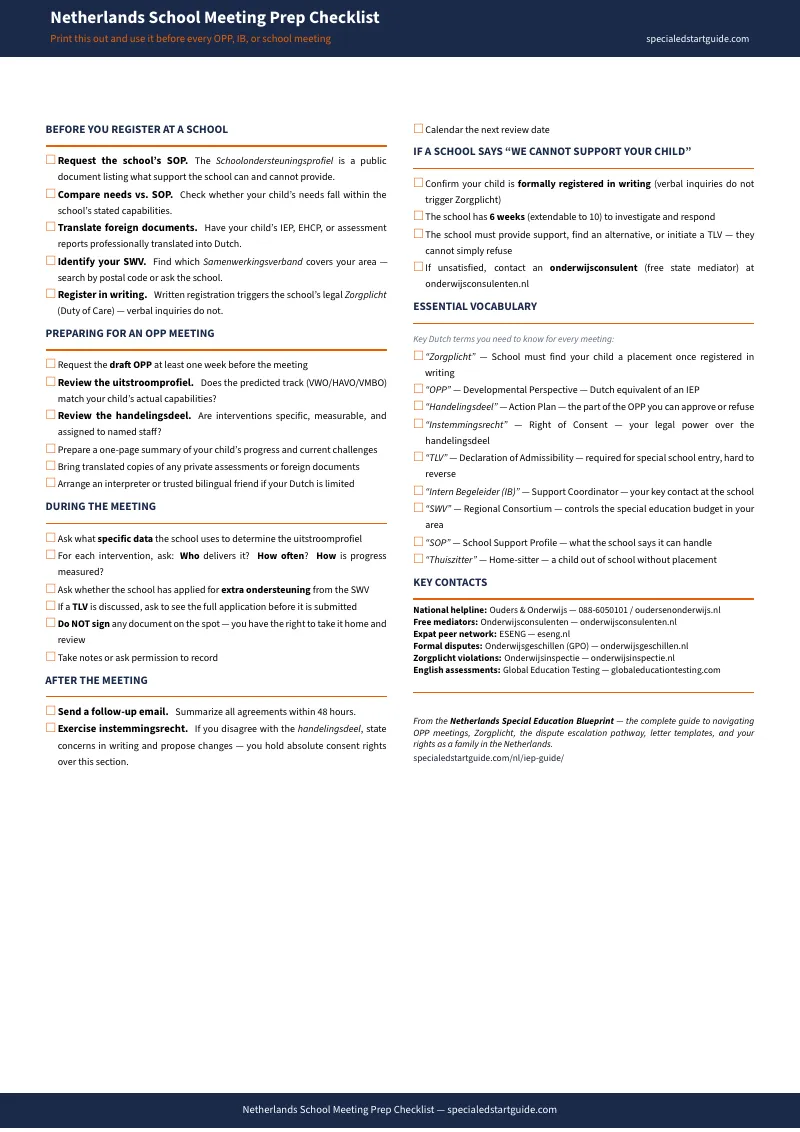
- Netherlands School Meeting Prep Checklist (checklist.pdf) — printable quick-reference covering school registration, OPP meeting preparation, in-meeting questions, post-meeting follow-up, Zorgplicht enforcement steps, essential Dutch-English vocabulary, and key contact organisations
Instant PDF download. Print the checklist tonight and bring it to your next school meeting.
Money-back guarantee, no time limit. If the Blueprint doesn't change how you navigate your child's education in the Netherlands, email us for a full refund. No questions asked.
Not ready for the full Blueprint? Download the free Netherlands School Meeting Prep Checklist — a structured quick-reference covering Passend Onderwijs basics, OPP meeting preparation, essential questions, Dutch-English terminology, and key contacts. It's enough to walk into your next meeting prepared, and it's free.
Your child has legal protections in the Netherlands. The school knows exactly what they are — in Dutch. After tonight, so will you.