
Your Child's Foreign IEP Is Invisible to the Korean System. The School Just Smiled and Filed It Away.
You arrived in Seoul, Pyeongtaek, or Busan with an IEP that took years to build — evaluations, meetings, hard-won accommodations. You handed it to the homeroom teacher or the international school admissions office, expecting the professional courtesy of recognizing documented special educational needs. Instead, you got one of three responses: polite confusion, a flat rejection, or a nod followed by nothing happening.
The Korean teacher filed your English-language document and returned to a classroom of 30 students racing through a curriculum designed to produce Suneung (수능) test scores. Your child sat at the back. Nobody was hostile — they just didn't know what to do with a foreign document the system has no obligation to follow. Meanwhile, you Googled "special education Korea expat" and found a Reddit thread from 2019, a Korean government website that auto-translated into gibberish, and a consultancy quoting $5,000 to attend your first school meeting.
The South Korea Special Education Blueprint is the Expat Advocacy Navigation System — the plain-English operational playbook that translates the Special Education Act (장애인 등에 대한 특수교육법), the three-tier placement continuum, the IEP committee process, disability registration pathways, visa-based welfare eligibility rules, and cultural advocacy strategies into the specific, sequential action plan that puts you on equal footing at the school table. Without hiring a bilingual consultant at ₩200,000+ per hour to explain what the coordinator just said.
What's Inside the Blueprint
The Special Education Act — Decoded from Legislative Korean into Parental Leverage
The Act mandates free special education from ages 3 to 20. It recognizes ten disability categories. It explicitly prohibits refusing admission based on disability. But the enforcement gap between law and classroom reality is enormous — Korean IEP disputes go through administrative committees, not courtrooms. When the school tells you "we don't have resources for that," this chapter tells you exactly which article obligates them to provide it, which Office of Education you escalate to, and how to frame the request so the principal sees cooperation as the path of least resistance rather than confrontation.
The Three Placement Tiers — What Each One Actually Looks Like at 8:30am
Full inclusion in regular classes (일반학급) with itinerant support → Special classes within mainstream schools (특수학급) with resource room pull-out → Dedicated special education schools (특수학교). This chapter goes beyond the legal definitions. It explains what "integration" means in a Korean classroom driven by Education Fever — why it sometimes means your child is physically present but pedagogically abandoned. It covers the 1:4 teacher-to-student ratio in special classes, what the resource room actually provides, and how to evaluate which placement genuinely serves your child versus which placement is administratively convenient for the school.
The IEP Process — From Eligibility Screening to Annual Review
The Korean IEP (개별화 교육계획) is legally mandated under Article 22 but functionally different from anything you experienced in the US, UK, or Australia. No due process hearings. No administrative law judges. This chapter walks you through the Individualized Education Support Committee, annual goal-setting requirements, biannual evaluation cycles, and the specific documentation techniques that ensure your child's IEP contains measurable, time-bound objectives rather than the polite platitudes that schools default to when parents do not push back with precision.
Disability Registration and the Welfare Card — The Benefits Gatekeeper
The 복지카드 (Welfare Card) unlocks government-subsidized therapy vouchers worth hundreds of thousands of won per month, tax deductions, transit discounts, and priority service access. The registration process involves medical diagnosis, disability determination by the National Pension Service, and formal card issuance. This chapter maps the entire three-stage pathway — and delivers the critical news most expats discover too late: your visa status determines whether you can access any of it.
Visa-Based Welfare Eligibility — The Definitive Breakdown
E-2 English teachers and E-7 professionals: excluded from disability registration. All therapy costs out-of-pocket. F-2 residents, F-5 permanent residents, and F-6 marriage migrants: eligible for the Welfare Card and subsidized services. SOFA military families: separate pathway through USFK. This chapter ends the forum speculation and contradictory advice. You will know — definitively, with legal citations — exactly what your visa category qualifies you for and what alternatives exist if you are excluded.
Cultural Advocacy — Results Without Triggering Institutional Resistance
Western advocacy says "assert your rights." Korean school culture says "maintain harmony." Deploying American-style demands in a Korean IEP meeting does not just fail — it triggers defensive solidarity among the educators who control your child's daily experience. This chapter teaches the culturally calibrated approach: building pre-meeting relationships (사전 관계 구축), framing accommodation requests as reducing the teacher's classroom burden, understanding the difference between genuine agreement and polite deflection, and knowing when the principal's "we will review this carefully" actually means your request has been declined.
The Hagwon Dilemma — Why the Shadow System Rejects Your Child
Korean education operates on a dual track: public school plus private hagwon. Parents spend 26 trillion won per year on after-school academies. For a neurodivergent child, hagwons represent a paradox — academic support that refuses to accommodate different learning styles. This chapter covers what happens when hagwons expel your child, how to find the rare academies that genuinely accommodate neurodiversity, and why understanding the hagwon ecosystem is essential context for every school conversation about support services.
International Schools — The Hidden Rejection Reality
Seoul Foreign School, Korea International School, Chadwick International, Dulwich College Seoul — elite institutions with annual tuition exceeding 30 million won. Their Learning Support departments exist for mild to moderate needs. For anything beyond that, admission is declined or conditional on families funding a dedicated aide at ₩2,000,000+ per month. This chapter explains what each major school actually provides, the common rejection scenarios, and why understanding the Korean public system is essential contingency planning even for families currently enrolled in private education.
USFK Military Families and EFMP
EFMP screens your family for Korea assignment eligibility. DoDEA schools at Camp Humphreys, Osan, and USAG Daegu provide baseline IEP continuity. But capacity is limited, specialized therapists are chronically short-staffed, and EFMP offers zero guidance for off-base Korean services. This chapter covers how to document local Korean school capabilities for EFMP appeals, navigate off-installation therapy resources, and bridge the gap between the DOD system and Korean municipal support — the "Off-Base Expansion" that no military resource provides.
The Korean-English-Hangeul SEN Terminology Glossary
Not translations — operational definitions. Every official term you will encounter at school meetings, medical appointments, government offices, and therapy evaluations: English meaning, Hangeul script, Romanized pronunciation, and a plain-language explanation of what the term means for your advocacy. Because knowing that 특수교육지원센터 means "Special Education Support Centre" is useless if you do not know it is the institution where the formal eligibility process begins.
Who This Blueprint Is For
- Corporate expat families in Seoul, Songdo, and Busan whose relocation packages cover housing and schooling but not the cultural minefield of advocating for a neurodivergent child in a system built on academic conformity
- USFK military families at Camp Humphreys, Osan Air Base, and USAG Daegu who need off-base Korean resources because DoDEA school capacity is limited or the waitlist is too long for their child's needs
- English teachers (EPIK, TALK, hagwon) on E-2 visas who work inside the Korean education system daily but cannot navigate it for their own children — and whose visa status excludes them from the subsidized therapy vouchers available to permanent residents
- Foreign spouses of Korean nationals (F-6 visa) who need independent English-language understanding of the system to co-advocate effectively rather than relying on translated summaries filtered through cultural assumptions about disability and face-saving
- Diplomatic families on 2–3 year rotational assignments who cannot afford to lose an entire year to cultural confusion while their child sits unsupported in a classroom racing toward the Suneung
- Parents whose international school just rejected their child — or conditionally accepted them at ₩2,000,000+/month for a private aide — and who are suddenly facing the Korean public system with no preparation and no English-language guidance
Why Not Just Use the Free Resources?
The National Institute of Special Education (국립특수교육원) has an English website. It contains a mission statement, an organizational chart, and a historical timeline. No IEP templates. No parent advocacy guides. No translated forms. Seoul Global Center offers free legal counseling — for visa questions and lease disputes, not for arguing Article 22 compliance with a school principal. The US Center for Parent Information and Resources published a Korean-English glossary — designed for Korean immigrants navigating IDEA in America, not for American parents navigating the Special Education Act in Korea. It translates the wrong system in the wrong direction.
- Government websites describe the system in institutional Korean. They do not explain how to activate it as an English-speaking outsider, how cultural norms shape what actually happens in meetings, or what advocacy strategies produce results rather than polite dismissal.
- Expat forums provide emotional support and outdated anecdotes. Reddit threads cite personal experiences from 2018, conflate different visa categories, and oscillate between "Korea is hopeless for SEN" (wrong — the Act is legally robust) and "just enroll in an international school" (wrong — they reject complex needs). Forum advice is unmoderated, legally uncited, and frequently contradicts itself within the same thread.
- Consultants charge ₩200,000–500,000 per hour. For families who need complex legal representation, that investment makes sense. For the 95% of expat families who simply need to understand the system, the terminology, and the cultural dynamics — a ₩200,000 consultation to explain what a Special Education Support Centre is and how to request an eligibility screening is an expensive way to get information this guide provides in five minutes.
Free resources describe the system. Consultants navigate it for you at premium rates. This Blueprint teaches you to navigate it yourself.
— Less Than One Session at an English-Speaking Clinic
A single developmental evaluation at an English-speaking clinic in Seoul costs ₩400,000–700,000. A bilingual educational consultant charges ₩200,000–500,000 per hour. International school tuition exceeds 30 million won per year — and still cannot guarantee your child a place. Missing the eligibility screening window delays your child's IEP by months. Not knowing which visa categories qualify for therapy vouchers means potentially spending hundreds of thousands of won per month on services available at a fraction of the cost.
Your download includes the complete guide, a quick-reference checklist, and 8 standalone printable tools — 10 PDF files:
- Complete Blueprint Guide (guide.pdf) — 17 chapters covering the Special Education Act, the three placement tiers, the IEP process (개별화 교육계획), disability registration and the Welfare Card (복지카드), visa-based welfare eligibility rules, cultural advocacy strategies, the hagwon dilemma, international school SEN limitations, USFK EFMP integration, therapy services and voucher access, ADHD medication in Korea, dispute resolution and escalation, and the complete Korean-English-Hangeul SEN terminology glossary
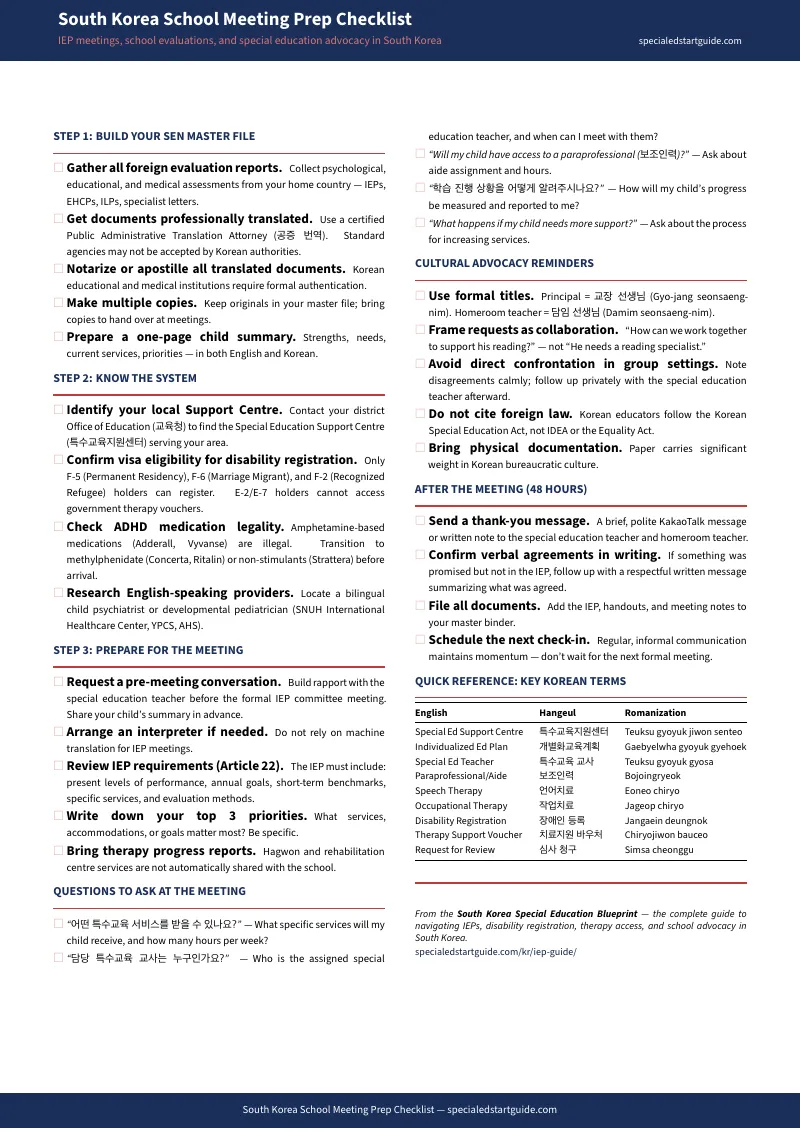
- School Meeting Prep Checklist (checklist.pdf) — printable quick-reference covering IEP process timeline, meeting preparation, cultural communication strategies, key Korean phrases, and critical action items
- ADHD Medication Reference Card (adhd-medication-reference.pdf) — pre-arrival safety guide showing which medications are illegal in Korea, legal alternatives, MFDS import license steps, and a transition timeline to hand to your prescribing doctor
- Foreign IEP Transfer Checklist (foreign-iep-transfer-checklist.pdf) — step-by-step document preparation for before departure and after arrival, covering translation, notarization, and Special Education Support Centre submission
- Cultural Advocacy Scripts (cultural-advocacy-scripts.pdf) — word-for-word meeting phrases and reframing strategies for before, during, and after Korean school meetings
- Visa Eligibility Matrix (visa-eligibility-matrix.pdf) — one-page reference showing exactly which visa types qualify for disability registration, the Welfare Card, and therapy vouchers
- Disability Registration Pathway (disability-registration-pathway.pdf) — the three-stage Welfare Card registration process mapped as a visual flowchart with benefits unlocked at each stage
- Dispute Resolution Roadmap (dispute-resolution-roadmap.pdf) — four-level escalation ladder from school-level resolution through the National Human Rights Commission
- Korean-English-Hangeul SEN Glossary (sen-glossary.pdf) — every official term from school meetings, medical appointments, and government offices with Hangeul script, Romanization, and operational definitions
- Key Contacts, Costs, and Timelines (key-contacts-costs.pdf) — fridge-sheet reference with English-speaking providers, estimated therapy and evaluation costs, and process timelines
Instant PDF download. Print the standalones tonight — bring the glossary and advocacy scripts to your next school meeting, hand the medication reference to your doctor, and stick the contacts sheet on your fridge.
Money-back guarantee, no time limit. If the Blueprint doesn't change how you navigate your child's education in South Korea, email us for a full refund. No questions asked.
Not ready for the full Blueprint? Download the free South Korea School Meeting Prep Checklist — a structured quick-reference covering IEP process basics, disability registration steps, Special Education Support Centre navigation, meeting preparation and cultural framing, and key Korean-English SEN terminology. It's enough to walk into your next meeting prepared, and it's free. The full Blueprint adds 8 standalone printable tools — advocacy scripts, visa eligibility matrix, glossary, medication reference, and more.
Your child's foreign IEP doesn't work here. The Korean system has its own pathway — and the legal protections are real. After tonight, you'll know exactly how to activate them.