
The CAC Waitlist Is 6 Months. Private EPs Charge HK$10,000. Your Child Can't Wait for Either.
The teacher flagged a concern three months ago. The school suggested you "monitor the situation." You searched online. You found the Education Bureau's 60-page Operation Guide — written for school principals, not parents. You found Reddit threads from 2019 with advice that's now factually wrong. You found the Heep Hong Society's developmental milestones — useful for toddlers, silent on how to navigate the school system once your child is in P2 and falling behind.
Then you called the Child Assessment Centre. Median wait for stable cases: 16 weeks territory-wide. In the New Territories East cluster: 29 weeks. Only 67.7% of assessments are completed within six months. Meanwhile, your child is sitting in a classroom receiving zero targeted support because without an assessment on the Special Education Management Information System (SEMIS), the school receives zero funding from the EDB to help them.
You looked into private assessments. HK$7,500 to HK$17,500. Out-of-pocket — over 90% of standard health insurance excludes psycho-educational testing. And then you'd need to understand the report, translate it into school demands, and navigate a system where IEPs are not legally binding the way they are in the US or UK.
The Hong Kong Special Ed Assessment Decoder is an Assessment Navigation System — the only guide that walks Hong Kong parents from first teacher concern through government or private assessment, report interpretation, SEMIS registration, and school negotiation in a single, structured document built specifically for the EDB's 3-Tier system, the nine SEN categories, and the HKDSE accommodation deadlines that most families don't discover until it's too late.
What's Inside the Assessment Decoder
The Public vs. Private Decision Matrix
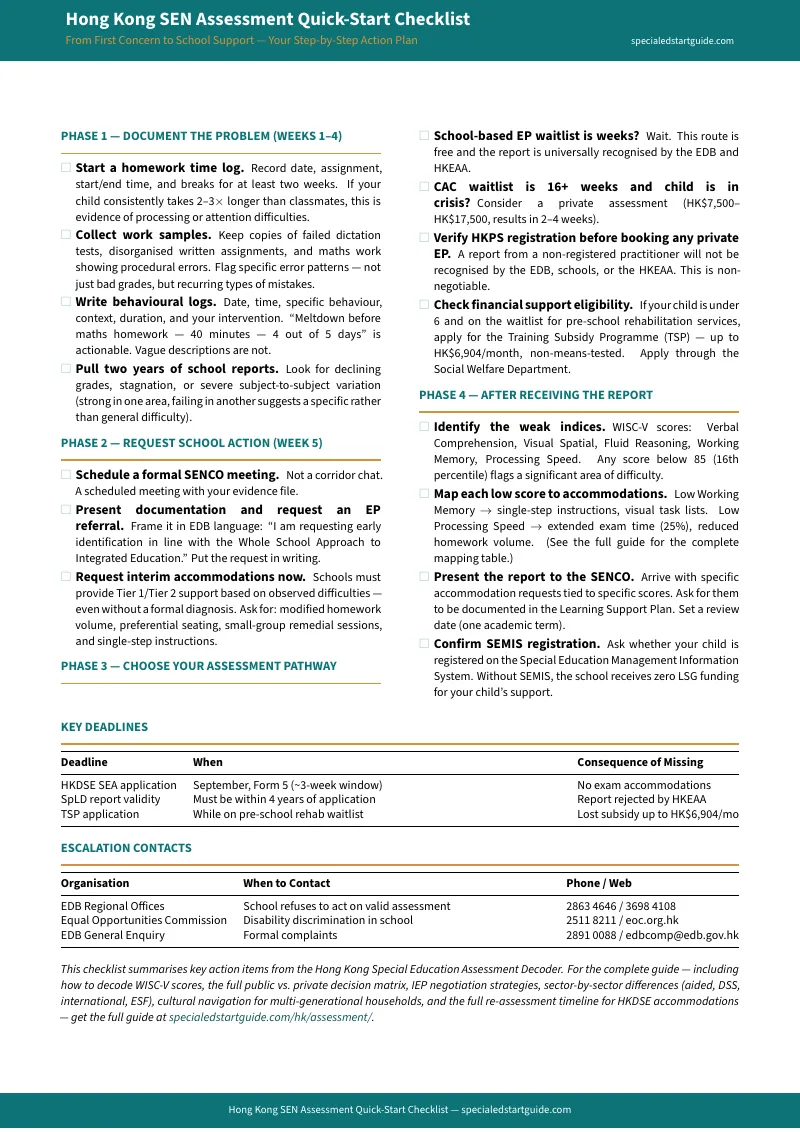
A side-by-side breakdown of the three assessment pathways: the Department of Health's Child Assessment Centres (free, 16-29 week median wait), the school-based EDB Early Identification Programme (free but heavily triaged), and private Educational Psychologists (HK$7,500-HK$17,500, results in 2-4 weeks). Each pathway includes real costs, actual wait times, what you get, and what you don't — so you stop guessing and make the decision based on your child's specific urgency.
The WISC-V Score Translator
The EP hands you a report full of standard scores, percentile ranks, and five cognitive indices. The school expects you to understand it. Neither of them explains what these numbers mean for your child's classroom. The Decoder maps each WISC-V index — Verbal Comprehension, Visual Spatial, Fluid Reasoning, Working Memory, Processing Speed — to the specific accommodations you should demand. Low Working Memory? Single-step instructions and visual task lists. Low Processing Speed? 25% extended exam time and reduced homework volume. You arrive at the SENCO meeting with data, not hope.
The Funding Mechanism Explained
Your child's assessment triggers the Learning Support Grant: approximately HK$16,000 per year for Tier 2, HK$64,000 for Tier 3. But the school pools that money across all SEN students — the HK$64,000 generated by your child is not ring-fenced for your child. The Decoder explains how this "holistic deployment" actually works, so you can ask the SENCO the right question: "What proportion of the LSG generated by my child's assessment is being directed toward their identified needs?"
IEP Negotiation — Hong Kong Rules, Not American
In the US, an IEP is federally mandated and legally binding. In Hong Kong, the EDB mandates a formal IEP only for Tier 3 students. For everyone else, schools are "encouraged" — not required. The Decoder gives you conversation scripts and email templates that use the EDB's own language and the Equal Opportunities Commission's Code of Practice to negotiate accommodations, even when the school claims your child doesn't qualify.
International School and ESF Realities
International schools operate entirely outside the EDB's LSG funding. Many cap SEN enrolment per grade level — some with undisclosed quotas. An assessment identifying significant needs can actually work against admission at competitive institutions. ESF runs its own Levels of Adjustment Framework and its own Admissions and Review Process. The Decoder maps how assessment results play out across public aided, DSS, international, and ESF sectors — because the same report produces completely different outcomes depending on which school holds it.
The HKDSE Deadline That Catches Everyone
Special Examination Arrangements — extra time, rest breaks, enlarged papers, assistive technology — require an application submitted through the school in a three-week window in September of Form 5. SpLD assessment reports must be issued within four years of the application deadline. A diagnosis obtained in Primary 2 is entirely invalid for HKDSE purposes. The Decoder includes the re-assessment timeline so you plan backward from the exam, not forward from the diagnosis.
The Subsidy Money Most Families Miss
If your child is under 6 and on the waiting list for subvented pre-school rehabilitation services, the Training Subsidy Programme (TSP) pays up to HK$6,904 per month — non-means-tested. The On-site Pre-school Rehabilitation Services (OPRS) now covers nearly 90% of kindergartens with zero waiting time. The Decoder details the exact Social Welfare Department application procedures so you claim what you're entitled to while the CAC grinds through its queue.
Who This Guide Is For
- Parents whose child was just flagged by a teacher — and who received sympathy but no roadmap for what happens next
- Families sitting on the CAC waitlist, watching months tick by while their child falls further behind without any targeted support in the classroom
- Parents considering a private assessment who need to know which clinics are HKPS-registered, what the real costs are, and how schools actually treat private reports versus government reports
- Anyone holding a psycho-educational report full of standard scores and percentile ranks who has no idea what those numbers mean for their child's school support
- Expatriate families relocating to Hong Kong with an overseas IEP or Statement of SEN that does not automatically transfer to the local system
- Parents of secondary students who need to plan the HKDSE Special Examination Arrangements application before the Form 5 September window closes
- International school parents navigating SEN admissions — where a diagnosis can either unlock support or trigger quiet exclusion, depending on the institution
- Multi-generational households where grandparents resist the idea of assessment, and you need to reframe it as a competitive tool rather than a label
Why Not Just Use the Free Government Resources?
The EDB publishes extensive SEN documentation. The Heep Hong Society provides developmental milestone checklists. The SNNHK runs expert webinars. The Equal Opportunities Commission publishes 100-page policy papers. Here is why families still spend months confused after reading all of them:
- The EDB Operation Guide was written for school principals and SENCOs, not parents. It outlines performance indicators and funding structures. It does not tell you how to respond when a school refuses to act on your private assessment, or how to escalate when the SENCO says your child is "manageable" at Tier 1.
- Community forums are empathetic but dangerous for strategic advice. A well-meaning parent in a Facebook group might give you advice based on their 2019 experience — but TSP subsidy rates, OPRS coverage, and HKDSE application procedures change annually. Outdated advice can cost you thousands in missed subsidies or a year of delayed intervention.
- NGO resources stop at the school gates. Heep Hong excels at developmental milestones and home-based training for young children. They do not cover how to decode a WISC-V report, negotiate with a school's Student Support Team, or plan a re-assessment timeline for HKDSE accommodations.
- Google returns US and UK guides that do not apply here. Searching "special education assessment" yields thousands of results about IDEA, 504 plans, and EHCPs — laws and frameworks that do not exist in Hong Kong. Reading them wastes time and creates false expectations about what the local system is required to provide.
- No single document connects the entire pathway. Building a complete picture currently requires the EDB website for policy, the DH website for CAC wait times, the SWD website for subsidies, the HKEAA website for exam accommodations, and scattered Facebook threads for EP recommendations. The Decoder consolidates all of it.
Free resources describe the system as it should work. The Decoder gives you the strategy for navigating it as it actually works — where schools triage aggressively, IEPs are not guaranteed, and the difference between Tier 1 and Tier 3 is HK$48,000 in annual funding that your child may or may not see.
— Less Than 15 Minutes With a Private EP
Private educational psychologist consultations in Hong Kong cost HK$1,500 to HK$3,450 per hour. If you spend the first 45 minutes asking the EP to explain the difference between Tier 2 and Tier 3, how the CAC waitlist works, and whether a private report will be accepted by your child's school, you've just spent over HK$2,000 on questions this guide answers in Chapter 2.
Your download includes 9 PDFs ready to use immediately:
- Complete Assessment Decoder (guide.pdf) — 11 chapters covering the assessment landscape, the three assessment pathways (CAC, school-based, private) with real costs and wait times, how assessment results drive school funding, decoding the WISC-V and psycho-educational reports, navigating common scenarios (school dismissal, waitlist survival, rejected reports, minimal support), assessment across school sectors (aided, DSS, international, ESF), strategic timing and re-assessment planning, building your evidence file, cultural realities and family dynamics, support networks and escalation contacts, and the complete decision framework
- Quick-Start Checklist (checklist.pdf) — a 15-item action plan from documenting the problem through requesting school action, choosing your assessment pathway, and presenting the report with specific accommodation demands
- Assessment Pathways Comparison (assessment-pathways.pdf) — side-by-side reference card comparing the CAC, school-based, and private routes with costs, wait times, and trade-offs on one page
- WISC-V Score Translator (score-translator.pdf) — maps each cognitive index to specific classroom accommodations, with a fillable section to record your child's scores before the SENCO meeting
- School Negotiation Scripts (negotiation-scripts.pdf) — word-for-word responses for the four most common school pushbacks, plus three email templates for formal requests and escalation
- HKDSE Re-Assessment Timeline (hkdse-timeline.pdf) — backward planning from the Form 5 September deadline with validity windows, milestone dates, and all available exam accommodations on one page
- Evidence File Builder (evidence-file-builder.pdf) — fillable homework time logs, behavioural observation logs, work sample checklists, and a one-page summary template that transforms parental concern into objective data
- Escalation Contacts Directory (escalation-contacts.pdf) — EDB Regional Office phone numbers, NGO support organisations, and EOC complaint procedures on one page
Instant PDF download. Read Chapter 2 tonight for the public vs. private decision matrix. Use Chapter 4 to decode the assessment report you're about to receive — or the one already sitting in your kitchen drawer that nobody explained.
Money-back guarantee, no time limit. If the Assessment Decoder does not give you a clear, actionable understanding of Hong Kong's SEN assessment system — and the strategy to turn your child's results into real classroom support — email us for a full refund. No questions asked.
Not ready for the full guide? Download the free Hong Kong Evaluation Request Letter (evaluation-letter.pdf) — a formal template for requesting a Child Assessment Centre referral, initiating school-based assessment, or coordinating with a private EP, plus a pre-send checklist and key reminders. It covers the first step. The full Decoder covers every step after — decoding the report, mapping scores to accommodations, negotiating with the school, and planning the HKDSE re-assessment timeline that determines whether your child sits the exam with support or without.
The system does not advocate for your child. The school's incentives are not aligned with yours. The report is written in a language designed for clinicians. But with the right decoder, you become the translator, the strategist, and the only advocate your child actually has.