
The School Said Your Child Needs an MDPH Dossier. The Form Is 20 Pages. It's in French. You Have No Idea Where to Start.
You moved to France for the posting — corporate transfer, diplomatic assignment, university research position, your partner's career. You enrolled your child in the local école because international school fees in Paris start at €15,000 per year before SEN surcharges, and France is supposed to have an excellent public education system. Then the teacher mentioned your child is struggling. Or the directeur used a phrase you'd never encountered: Projet Personnalisé de Scolarisation. They said something about the MDPH. They handed you a form. It was 20 pages long, entirely in French, and filled with acronyms — AESH, CDAPH, AEEH, GEVA-Sco, EPE — that Google Translate renders as meaningless alphabet soup.
You went home and searched "MDPH guide in English." You found service-public.fr confirming the system exists — in French. You found SPRINT France, which provides a directory of bilingual therapists but whose published guide on hiring an AVS dates back to 2017. You found Reddit threads where American parents offered IDEA-based advice that carries zero legal weight in France. You found a relocation agency quoting €100+ per hour to act as an administrative middleman. You found a bilingual lawyer at €200-€400 per hour. You found nothing that explained, step by step, in English, how to actually fill out the Cerfa 15692*01, write the Projet de Vie that the MDPH committee uses to decide your child's entire educational future, or navigate the 6-18 month processing timeline without a single returned-for-missing-documents reset.
The problem is not that France's special education system lacks protections. The Loi du 11 février 2005 guarantees every disabled child the right to attend their local school. The MDPH must legally process your dossier within four months. Your child can receive a dedicated classroom aide (AESH), financial support (AEEH), specialised equipment, and exam accommodations. The problem is that the entire system is medically gatekept, administratively driven, and operates exclusively in French bureaucratic terminology — and the only people who currently explain it in English charge fees that dwarf the actual cost of the administrative process itself.
The France Special Education Blueprint is the MDPH Dossier Decoder that translates France's special education bureaucracy, Cerfa form logic, Projet de Vie strategy, and AESH advocacy process from institutional French into the plain-English roadmap, meeting preparation tools, and bilingual terminology guide that give you complete administrative command — without paying a relocation consultant €100 per hour to explain what Équipe de Suivi de Scolarisation means for your child.
What's Inside the Blueprint
The Legal Foundation — What French Law Actually Guarantees Your Child
The Loi du 11 février 2005, the Code de l'éducation, and the 101 département MDPH system — translated from legislative French into plain-language leverage. When the school tells you "you need to submit an MDPH dossier," this chapter tells you exactly which laws guarantee your child's right to inclusion, what the school is legally prohibited from doing (refusing enrollment because an AESH hasn't been assigned), and why your foreign IEP or EHCP carries absolutely no legal weight in France.
The MDPH System — Every Step from First Form to Final Decision
The complete pathway through France's disability recognition system: the medical catalyst (why a French-registered specialist must initiate the process), assembling the dossier (Cerfa 15692*01 and Cerfa 15695*01 decoded section by section), the GEVA-Sco school evaluation, the EPE multidisciplinary review, the CDAPH decision, and the Notification de Décision that gives you legal force. This chapter explains why the EPE almost never meets your child — and why the quality of your written dossier determines everything.
Writing the Projet de Vie — The Document That Decides Everything
The MDPH committee makes life-altering decisions based largely on this open-ended narrative in Section 8 of the Cerfa form. If you write it poorly, support is denied. If you sound too capable, funding is reduced. This chapter provides the exact framework for articulating functional impact, family toll, and explicit demands in the administrative French the evaluators expect — because "my child struggles at school" gets ignored, while "my child cannot follow multi-step verbal instructions and requires continuous individual redirection to remain on task" gets an AESH approved.
The Accommodation Plans — PPS, PAP, PPRE, and PAI Explained
Not every child needs the full MDPH process. France has four distinct accommodation tracks, and choosing the wrong one wastes months. This chapter breaks down exactly when a PAP (for mild Troubles DYS) is sufficient, when a PPS (requiring MDPH) is necessary, what a PPRE covers for short-term difficulties, and when a PAI handles chronic health conditions. It prevents the most common expat mistake: accepting a PAP when the child actually needs an AESH that only a PPS can legally mandate.
The ESS Meeting — Your Annual Advocacy Opportunity
The Équipe de Suivi de Scolarisation meets at least once per year to review your child's PPS implementation. This is where accommodations are confirmed, adjusted, or quietly dropped. This chapter provides the preparation strategy that works: what documents to bring, how to engage the Enseignant Référent (ERSEH), which questions to ask about AESH hours and implementation, and how to ensure the meeting minutes accurately reflect what was discussed — because what isn't written down doesn't exist in the French administrative system.
The AESH System — What Actually Happens After Approval
France currently has roughly 140,000 AESH workers supporting over 340,000 students. The maths doesn't work. An MDPH notification granting your child an AESH is not a guarantee that an actual human being will appear in the classroom. This chapter explains the difference between AESH individuel and AESH mutualisé, the staffing crisis driven by precarious contracts and salaries between €600-€800 per month, and the tactical escalation pathway — from Mise en demeure to the DASEN to the Référé-liberté at the Tribunal Administratif — when the state fails to deliver what it promised.
The Troubles DYS Framework — When Your Child Has Learning Difficulties
In the US or UK, a teacher's observation can trigger a school-based assessment. In France, the system is strictly medicalised. Dyslexia, dyspraxia, dyscalculia, dysphasia, and ADHD must be diagnosed by an external specialist and codified on a medical certificate before the school can implement robust support. This chapter explains how to translate foreign diagnoses into the French clinical framework, navigate the orthophoniste and psychomotricien pathway, and understand why France's philosophical approach to learning difficulties is fundamentally different from what you know.
Public vs. Private Schools — The Trap Expats Fall Into
Many expat families assume that paying €15,000-€35,000 per year for an international school eliminates the need for state support. It doesn't. Even elite institutions like the International School of Paris explicitly require families to hire, manage, and pay for 1:1 support privately. This chapter explains what private and international schools actually provide, what they don't, and when you still need the MDPH — regardless of tuition.
Transferring Foreign Evaluations — Making Your Existing Records Count
Your child's US IEP, UK EHCP, or Australian ILP carries no legal weight in France. But the clinical data within those documents is valuable. This chapter explains how to get foreign evaluations translated by a traducteur assermenté (sworn translator), present them to French specialists for reframing into the French diagnostic system, and use existing evidence to accelerate rather than restart the entire evaluation process.
Legal Rights and Appeals — Fighting Back When the System Fails
When your MDPH dossier is rejected, when your child's AESH doesn't materialise, when the school quietly drops accommodations — this chapter provides the escalation pathway. The RAPO (Recours Administratif Préalable Obligatoire) appeal within two months of rejection. The Défenseur des Droits complaint for systemic discrimination. The Référé-liberté emergency procedure at the Tribunal Administratif. And the critical rule: MDPH silence beyond four months counts as an implicit rejection that you can immediately appeal.
Financial Support — AEEH and Complements
The Allocation d'Éducation de l'Enfant Handicapé provides monthly financial support — base rate €149.26 per month, with six complements reaching up to €1,192.55 per month depending on severity and care burden. This chapter explains eligibility criteria, how complement levels are calculated, the connection between your MDPH dossier and CAF payments, and how to document care burden effectively.
The Complete French-English Glossary
Not just translated — functionally explained. The glossary doesn't just tell you that Enseignant Référent means "Reference Teacher." It tells you that the ERSEH is your primary liaison for all PPS matters, works across multiple schools in a geographic sector, and is the person you contact to request an ESS meeting. Every term includes its operational meaning and its institutional weight.
Who This Blueprint Is For
- Corporate expat families transferred to Paris, Lyon, Bordeaux, Toulouse, or Nice whose child has been flagged for additional support — and who received French-language documentation they cannot decipher
- Diplomatic and intergovernmental families at the OECD, UNESCO, Interpol, or embassy postings who face strict assignment timelines and cannot afford an 18-month MDPH timeline reset caused by an improperly completed dossier
- Trailing spouses who bear the full weight of navigating French bureaucracy while the primary earner works — and who need structured, authoritative guidance rather than contradictory Facebook group advice
- British families who settled in France pre- or post-Brexit, committed to the French public school system, but blindsided by the medical gatekeeping model that has no equivalent in the UK's school-based SEN framework
- Academic researchers and independent immigrants on talent passports who lack corporate relocation budgets entirely and need an affordable, comprehensive alternative to €100/hour relocation consultants
- Parents whose child has a pre-existing diagnosis (autism, ADHD, dyslexia, dyspraxia) from their home country — and who need to understand how to translate that diagnosis into the French Troubles DYS or TSA framework before the school can act
- Parents whose child is enrolled in a bilingual or international school and who assume private tuition eliminates the need for state support — it doesn't
Why Not Just Use the Free Resources?
The MDPH is a free public service. The Enseignant Référent is free. The AEEH financial support is free. Here's why expatriate parents still arrive at meetings unable to advocate effectively:
- Government resources are exclusively in French. Service-public.fr provides the Cerfa forms and the legal framework. It provides zero guidance in English on how to complete the 20-page dossier, what the Projet de Vie must actually say to succeed, or how to navigate the evaluation criteria the EPE committee uses. The forms exist. The operational instructions for non-French speakers do not.
- SPRINT France is a directory, not a dossier guide. SPRINT is an excellent resource for finding English-speaking therapists and bilingual clinicians in Paris. Their published guide on hiring an AVS dates back to April 2017. The online filing procedures, Cerfa requirements, and AESH staffing crisis have evolved dramatically since then. SPRINT does not offer a step-by-step manual for the current MDPH dossier.
- Expat forums mix advice from different départements and different years. Reddit and Facebook threads regularly apply Paris-specific advice to families in Lyon, Bordeaux, or rural départements where different resources and wait times apply. The most commonly referenced advice is often years old. MDPH standards vary by département — outdated advice from the wrong jurisdiction is more dangerous than no advice at all.
- Relocation agencies charge €100+ per hour for basic form navigation. Relocation consultants are experts in housing and visas. Most charge premium hourly rates to navigate MDPH dossiers because it falls outside their standard scope — and the process requires highly personal medical data and a subjective Projet de Vie that a generic consultant cannot write on behalf of the parent.
- Your foreign IEP or EHCP carries zero legal weight. A parent who arrives expecting their US IEP to automatically trigger French support will waste months in frustration. The French system requires a fresh medical evaluation by a French-registered specialist, a complete Cerfa dossier, and a Projet de Vie written according to French administrative expectations. Understanding this before your first school meeting saves the most time of all.
The government provides the forms. The school provides the meetings. The Blueprint gives you the operational playbook for making both work in your child's favour.
— Less Than One Hour With a €100/Hour Relocation Consultant
A single session with a relocation agency to discuss MDPH navigation costs upwards of €100 per hour. A bilingual education lawyer charges €200-€400 per hour. Even the AAWE Guide to Education in France costs €25-€35 and relegates special education to a small sub-section without actionable MDPH templates. The systemic preparation you build with this Blueprint saves hundreds of euros — because you arrive understanding the Cerfa forms, speaking the correct French administrative terminology, and writing a Projet de Vie that the EPE committee takes seriously instead of paying someone to explain what Équipe Pluridisciplinaire d'Évaluation means.
Your download includes 7 PDFs:
- Complete Blueprint Guide (guide.pdf) — 16 chapters covering the legal foundation (Loi du 11 février 2005 and the 101 département MDPH system), the complete MDPH pathway (Cerfa 15692*01 and 15695*01 decoded), Projet de Vie writing strategy, accommodation plan selection (PPS vs. PAP vs. PPRE vs. PAI), ESS meeting preparation and advocacy, the AESH system and staffing crisis, the Troubles DYS medicalised framework, specialised classes (ULIS, IME, ITEP), public vs. private school realities, transferring foreign evaluations, early years and maternelle intervention, exam accommodations (Brevet and Baccalauréat), legal rights and the full appeals pathway (RAPO, Défenseur des Droits, Tribunal Administratif), AEEH financial support and complements, post-16 transition pathways, support networks, and a comprehensive French-English glossary with timeline appendix
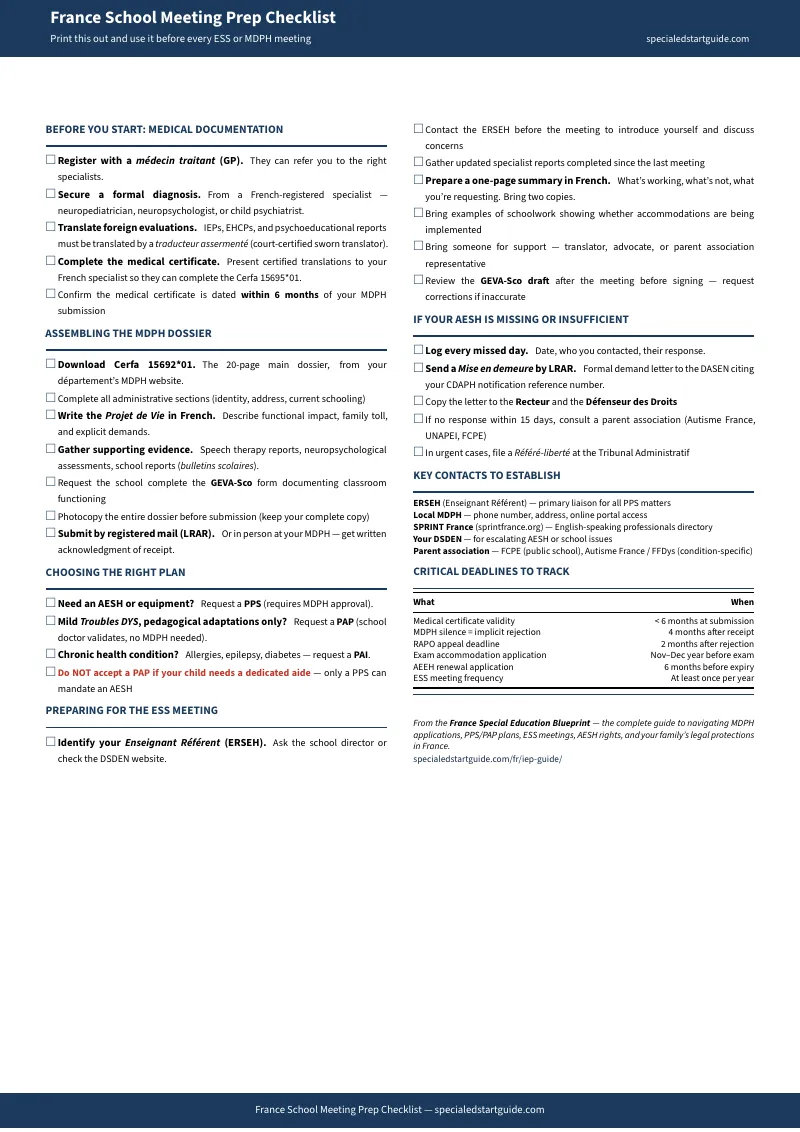
- France School Meeting Prep Checklist (checklist.pdf) — printable quick-reference covering MDPH dossier assembly, accommodation plan selection, ESS meeting preparation, AESH escalation protocol, key contacts to establish, and critical deadlines to track
- French-English Glossary (french-english-glossary.pdf) — every MDPH, CDAPH, and ESS term you will encounter, organised by category with operational meaning — print it and bring it to every school meeting
- ESS Meeting Preparation Worksheet (ess-meeting-prep.pdf) — pre-meeting checklist, parent statement writing prompts, bilingual key questions to ask, and post-meeting follow-up steps
- Accommodation Plan Decision Guide (accommodation-plan-selector.pdf) — PPS vs. PAP vs. PPRE vs. PAI comparison with decision checklist so you request the right plan from the start
- AESH Escalation Pathway (aesh-escalation-pathway.pdf) — the five-level escalation from school director to Tribunal Administratif, with key contacts and timing guidance
- Key Contacts & Support Networks (key-contacts.pdf) — English-speaking family resources, national advocacy organisations, government contacts, and how to find bilingual medical specialists
Instant PDF download. Print the standalone tools tonight and bring them to your next school meeting.
Money-back guarantee, no time limit. If the Blueprint doesn't change how you navigate your child's education in France, email us for a full refund. No questions asked.
Not ready for the full Blueprint? Download the free France School Meeting Prep Checklist — a structured action plan covering medical documentation, MDPH dossier assembly, accommodation plan selection, ESS meeting preparation, and AESH escalation. It's enough to walk into your next meeting prepared, and it's free.
Your child has a legal right to special education support in France. The MDPH knows the process. After tonight, so will you.