
Your Child's IEP Was Filed in a Drawer. The Spanish School Has No Idea What to Do With It.
You arrived in Madrid, Barcelona, or the Costa del Sol with an IEP that took years to build — evaluations, classroom observations, therapy reports, hard-won accommodations. You presented it to the orientador at your child's new school, expecting professional recognition of documented special educational needs. Instead, you got a polite nod and a drawer. Your child's American IEP, British EHCP, or Australian learning plan carries zero legal weight in Spain. The orientador cannot use it. The school cannot act on it. Your child is functionally undiagnosed in the eyes of the Spanish system — and the clock is ticking while they sit in a classroom operating in a language they may not speak, under a curriculum framework no one has explained to you.
Meanwhile, you Googled "special education Spain expat" and found a Reddit thread from 2022, a Spanish government website in dense legal prose, and an educational consultancy in Madrid quoting €225 for a single one-hour introductory call.
The Spain Special Education Blueprint is the LOMLOE Navigation System — the plain-English operational playbook that translates Spain's LOMLOE education law, the NEAE/NEE classification system, the EOEP psychopedagogical evaluation process, the ACI accommodation framework, and 17 autonomous communities' regional variations into the specific, sequential action plan that puts you on equal footing at the school table. Without hiring a consultant at €225–€325 per hour to explain what the orientador just said.
What's Inside the Blueprint
The LOMLOE — Spain's Education Law Decoded from Legal Spanish into Parental Leverage
The LOMLOE (Ley Orgánica 3/2020) mandates early identification of learning needs, reduced class ratios for students with disabilities, mainstreaming as the default placement, and restricted grade repetition. It also contains a provision most expat families never discover: "not speaking Spanish" is legally classified as a Specific Educational Support Need, triggering formal protections from the first day of enrollment. When the school tells you to "wait and see if the language comes," this chapter tells you exactly which article entitles your child to immediate adapted support — and gives you the formal Spanish letter to activate it.
The NEAE Umbrella and the NEE Distinction That Determines Everything
Spain groups all students requiring support under NEAE (Necesidades Específicas de Apoyo Educativo). Within that umbrella, NEE (Necesidades Educativas Especiales) is the protected subcategory for recognized disabilities, autism, and severe communication disorders — it unlocks the strongest legal protections, dedicated specialist staff, and smaller class ratios. Students outside NEE receive testing accommodations and methodological support, but without the same level of dedicated personnel. The difference between NEAE and NEE is the difference between a school noting your child's challenges and the school being legally obligated to assign specialized staff. This chapter maps every sub-category — disability, ASD, ADHD, dyslexia, giftedness, late entry, and socio-educational vulnerability — and explains the precise resources each tier triggers.
The "Late Entry" Right That Changes Everything for Expat Families
Under the LOMLOE, a child entering the Spanish school system without proficiency in the language of instruction — Spanish, Catalan, Basque, or Valencian — is formally categorized as "incorporación tardía" under the NEAE umbrella. This triggers legal access to linguistic immersion classrooms (Aulas de Enlace in Madrid, Aulas de Acogida in Catalonia, ATAL in Andalusia), modified grading, and adapted educational materials. Most expat families never learn this right exists — and the school is not required to tell you. This chapter explains how to activate the protection from day one, how it interacts with pre-existing learning disabilities, and what to do when the school attributes academic struggles entirely to the language barrier to avoid the deeper evaluation your child actually needs.
The EOEP Assessment Process — From First Suspicion to the Dictamen
The EOEP (Equipos de Orientación Educativa y Psicopedagógica) is the state assessment team that evaluates your child and issues the Dictamen de Escolarización — the single most important document in Spanish special education. The Dictamen establishes the diagnosis, identifies needs, and proposes the schooling modality. This chapter maps the complete process: how to formally request an evaluation in writing, the expected timeline, what happens during the psychopedagogical assessment, how to contest a Dictamen that recommends segregated placement, and the one-month appeal deadline that, if missed, makes the decision final. Includes the copy-paste formal Spanish letter to trigger the process.
Private Assessments — How to Use Them Without Wasting €600
This is the most expensive mistake expat families make. You pay €400–€800 for an English-speaking psychologist's evaluation, bring the report to the school, and learn that a private diagnosis does not legally compel the school to provide state-funded PT or AL support. Only the EOEP evaluation can unlock those resources. But a well-prepared private assessment is not wasted money — used strategically, it forces a faster and more favorable EOEP outcome. This chapter explains the exact strategy: when to get a private evaluation, what to tell the psychologist to include, the apostille and sworn translation requirements for foreign reports, and how to present private evidence so the EOEP incorporates it rather than filing it alongside your ignored IEP.
The ACI System — Spain's Answer to the IEP
The ACI (Adaptación Curricular Individualizada) is the closest Spanish equivalent to your IEP. But the enforcement mechanisms are fundamentally different — there are no due process hearings, no administrative law judges, no legally binding therapy minutes. Advocacy in Spain works through persistent documentation, collaborative relationship-building, and formal bureaucratic escalation. This chapter maps the complete accommodation hierarchy: ordinary measures (flexible grouping, differentiated instruction), non-significant adaptations or ACNS (testing accommodations, extended time, modified presentation), and significant adaptations or ACS (modified curriculum objectives, altered grading criteria). It explains what each tier provides, what each tier removes, and how to ensure your child's ACI contains measurable, time-bound objectives rather than the vague pedagogical language schools default to.
Region-by-Region Guide for the Communities Where Expats Actually Live
Spain has 17 autonomous communities, each implementing the LOMLOE through its own regional decrees, assessment teams, terminology, and timelines. The evaluation team in Madrid (EOEP) operates under different procedures than Barcelona (EAP), Andalusia (EOE), or Valencia (SPE). This chapter covers each major expat region: Madrid's EOEP and Aulas de Enlace system, Catalonia's EAP and the Catalan immersion double-language barrier, Andalusia's EOE and ATAL classrooms across the Costa del Sol, Valencia's SPE and recent decree changes, the Basque Country's Berritzegune advisory network, and the Balearic and Canary Islands. If you are moving to Spain with a special needs child, you need the chapter for your specific region — not generic national-level advice that may not apply.
Dispute Resolution — When the System Fails Your Child
The school never scheduled the evaluation you requested. The Dictamen recommends a segregated Special Education Centre and you disagree. The PT is shared across three schools and shows up four hours per week. The ACI reads like a photocopy with your child's name at the top. This chapter covers every formal escalation pathway: written complaints to the Inspección Educativa, formal objections to the Dictamen via Recurso de Alzada, complaints to the Defensor del Pueblo (national ombudsman), escalation to regional education authorities, and the specific rights parents hold under Spanish administrative law. Every step includes the copy-paste formal Spanish template with line-by-line English translation — because the orientador who stalled your informal request cannot stall a letter citing specific articles of the LOMLOE addressed to the Inspector Educativo.
The IEP-to-ACI Translation Matrix
A comprehensive glossary mapping US, UK, and Australian special education concepts to their Spanish legal and procedural equivalents. Not dictionary translations — operational definitions. "Accommodations" maps to ACNS (Adaptaciones Curriculares No Significativas). "Modifications" maps to ACS (Adaptaciones Curriculares Significativas). "School psychologist" maps to Orientador/a. "Speech therapist" maps to Maestro de Audición y Lenguaje (AL). Organised by category: documents, professionals, support tiers, assessment terminology, and classroom accommodations. Print it and bring it to every meeting — it shifts the power dynamic from guessing to advocating in the system's own language.
Who This Blueprint Is For
- Corporate expat families in Madrid and Barcelona whose relocation packages cover housing and schooling but not the bureaucratic minefield of advocating for a neurodivergent child in a system that operates on acronyms, regional decrees, and administrative pathways no English-language resource has ever mapped
- British post-Brexit families on the Costa del Sol and in the Balearic Islands who understood EHCP law instinctively and now face a decentralized system where the assessment team, the terminology, and the dispute resolution pathway are entirely different — and entirely in Spanish
- American families who expected IDEA-style due process protections and instead discovered a system where advocacy runs through persistent bureaucratic documentation and collaborative relationship-building, not courtroom enforcement
- Parents whose international school just informed them their child's needs exceed "mild to moderate" learning support — the contract is not being renewed, the concertado or public system is the only realistic option, and nothing about NEAE, EOEP, or ACI is available in English
- Families in Catalonia navigating a double-language barrier — their child must simultaneously acquire Spanish and Catalan while managing a learning disability, because the school operates on a Catalan immersion model and no one warned them
- Parents who paid €600 for a private English-speaking psychologist's evaluation, brought the report to the school, and were told it changes nothing — because only the state EOEP assessment can unlock formal resources, and now they need to understand how to strategically leverage that private report
- Digital nomad families and lifestyle relocators on tighter budgets who cannot afford €225–€325 per consultation and need to self-navigate the system with the same systemic knowledge consultants charge premium rates to explain
- Parents whose child is approaching EBAU (university entrance exams) and just learned that formal accommodations must be requested through an administrative process that begins years before exam season
Why Not Just Use the Free Resources?
The Ministry of Education publishes the LOMLOE text — in dense Spanish legal vernacular, hundreds of pages long, with zero parent-level guidance. The Eurydice European database summarises the national framework in English at a policy level that is useful to researchers and useless to a parent preparing for an EOEP meeting next Thursday. Regional Consejerías de Educación each publish their own implementing decrees — exclusively in Spanish, in different formats, using legal and pedagogical vocabulary that even many Spanish parents struggle to parse. Reddit and Facebook expat groups trade anecdotal, region-specific, frequently contradictory advice with no legal citations — and the most useful threads are monitored by educational consultants who answer just enough to drive leads toward their €225+ paid consultations.
- Government websites describe the system in institutional Spanish. They do not explain how to activate it as an English-speaking outsider, how regional differences change every procedure, or how to write the formal Spanish letter that actually triggers an evaluation.
- Expat forums provide emotional support and outdated anecdotes. Well-meaning advice from a parent in Barcelona's Catalan immersion system is legally inapplicable to a family in the Valencian Community's public schools. Spain's 17 autonomous communities each run their own special education implementation. Generic "Spain" advice from a random region can lead to irreversible missteps.
- Consultants charge €225–€325 per introductory hour. For families who need complex legal representation or school placement management, that investment makes sense. For the majority of expat families who need to understand the system, the terminology, the regional variations, and the advocacy strategies — a €300 call to learn what NEAE stands for and how to request an EOEP evaluation is an expensive way to get information this guide provides in fifteen minutes.
Free resources describe the system. Consultants navigate it for you at premium rates. This Blueprint teaches you to navigate it yourself.
— Less Than a Single Menú del Día
A single introductory call with an educational consultant in Madrid costs €225–€325. A comprehensive school placement package runs €900–€1,500. A private English-speaking psychopedagogical evaluation costs €400–€800 — and the results alone cannot compel the school to provide state-funded support. International school tuition runs €15,000–€25,000 per year and still cannot guarantee your child a place if their needs exceed "mild to moderate." Missing the one-month window to appeal a Dictamen de Escolarización makes the placement decision final. Not knowing the difference between an ACNS and an ACS can lock your child into a support tier that doesn't match their actual needs.
Your download includes the complete guide, a printable checklist, and 4 standalone printable tools — 6 PDF files:
- Complete Blueprint Guide (guide.pdf) — 16 chapters plus 2 appendices covering the LOMLOE framework, the NEAE/NEE classification system, the "late entry" right (incorporación tardía), the EOEP psychopedagogical evaluation process, private assessment strategy, the ACI accommodation hierarchy, region-by-region guides for Madrid, Catalonia, Andalusia, Valencia, the Basque Country, and the Islands, school type analysis (public, concertado, international), dispute resolution with copy-paste formal Spanish templates, document preparation and advocacy letters, early intervention, EBAU university entrance accommodations, the IEP-to-ACI translation matrix, meeting preparation, and support network resources
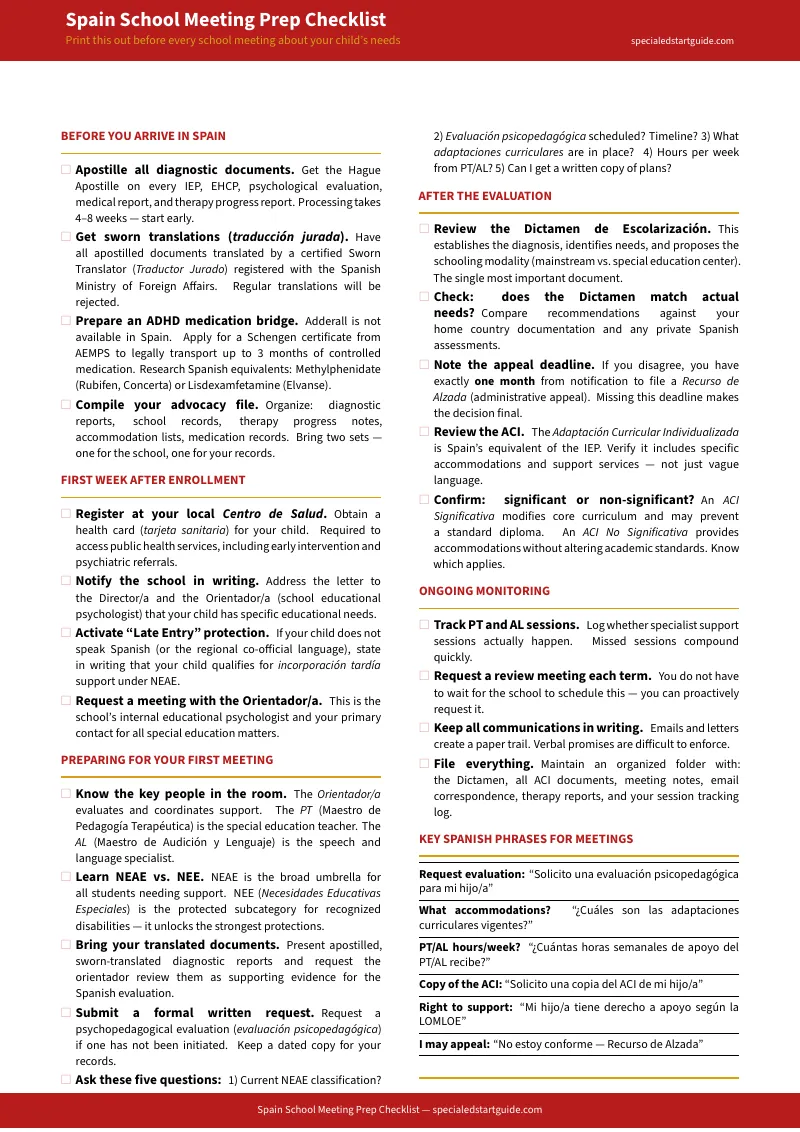
- Spain School Meeting Prep Checklist (checklist.pdf) — printable quick-reference covering pre-arrival document preparation (apostilles, sworn translations, ADHD medication bridging), first-week enrollment actions, meeting preparation with the five critical questions to ask the orientador, post-evaluation follow-up steps, ongoing monitoring, key Spanish phrases for school meetings, and red flags that signal the school is stalling or deflecting
- IEP-to-ACI Translation Matrix (iep-to-aci-matrix.pdf) — landscape reference card mapping US, UK, and Australian special education terminology to Spanish legal equivalents across four tables: core documents, disability terms, support staff, and process terms. Print it and bring it to every school meeting.
- Advocacy Letter Templates (advocacy-letter-templates.pdf) — bilingual fill-in letters for requesting a psychopedagogical evaluation and filing a Recurso de Alzada (administrative appeal), with line-by-line English translations and legal citations. Copy, customise, submit.
- Acronym & Phrase Quick Reference (acronym-phrase-reference.pdf) — two-sided meeting pocket card with all 18 key Spanish special education acronyms on one side and 8 essential Spanish phrases for school meetings on the other
- 90-Day Action Plan (90-day-action-plan.pdf) — single-page printable timeline covering Week 1 administrative foundations, Weeks 2–4 building the case, Months 2–3 securing the plan, and ongoing monitoring actions
Instant PDF download. Print the checklist and the translation matrix tonight — bring them to your next meeting with the orientador and know exactly what to ask, what the acronyms mean, and what "we'll look into it" actually signals.
Money-back guarantee, no time limit. If the Blueprint doesn't change how you navigate your child's education in Spain, email us for a full refund. No questions asked.
Not ready for the full Blueprint? Download the free Spain School Meeting Prep Checklist — a structured quick-reference covering pre-arrival document preparation, first-week enrollment actions, meeting prep with the critical questions, post-evaluation follow-up, key Spanish phrases, and red flags that require immediate action. It's enough to walk into your next meeting prepared, and it's free. The full Blueprint adds the complete LOMLOE legal framework, the step-by-step EOEP evaluation process, region-by-region guidance, the ACI accommodation system, dispute resolution with formal Spanish templates, the IEP-to-ACI translation matrix, an acronym pocket reference, advocacy letter templates, and a 90-day action plan.
Your child's foreign IEP doesn't work here. The Spanish system has its own pathway — and the legal protections are stronger than most expats realise. After tonight, you'll know exactly how to activate them.