
The PPR Psychologist Just Recommended Specialundervisning. The Report Is in Danish. You Have Four Weeks to Appeal.
You moved to Denmark for the job — Novo Nordisk, Genmab, Vestas, a university posting, your Danish partner's career. You enrolled your child in the local folkeskole because the international school waitlist was eighteen months and the tuition was 150,000 DKK a year before learning support surcharges. The school seemed fine. Then a meeting happened. The klasselærer sat down with someone from the PPR — the Pædagogisk Psykologisk Rådgivning — and used a phrase you'd never heard before: specialundervisning. They produced a document called a Pædagogisk-Psykologisk Vurdering. They mentioned a Visitationsudvalg and a possible specialklasse. They said your child's trivsel was a concern. They did not explain what any of this meant in practice.
You went home and opened Google Translate. You typed in specialundervisning. It gave you "special education." You typed in Pædagogisk-Psykologisk Vurdering. It gave you "pedagogical-psychological assessment." You typed in Visitationsudvalg. It gave you nothing useful. None of these translations told you that a PPV is a recommendation, not a legal mandate — and that the school headteacher can choose to ignore it. None of them told you that Denmark has no legally binding IEP and no direct equivalent to the UK's EHCP. None of them told you that the 9-hour rule that used to define the boundary between school-level support and formal special education has been abolished as of 2024/2025 — rendering most of the English-language advice you found online dangerously obsolete. And none of them told you that the four-week deadline to appeal a municipality's special education decision to the Klagenævnet is absolute.
You searched for "special education Denmark English." You found a four-paragraph summary on the Ministry of Education website confirming the system exists. You found Reddit threads from Americans whose IDEA-based advice does not apply. You found an expat Facebook group where a parent in Copenhagen recommended a strategy that is illegal in Aarhus Kommune. You found a private bisidder (advocate) who charges 1,650 DKK per hour and has a three-week waitlist. You found nothing that explained how Denmark's system actually works, step by step, in English, for a parent who needs to prepare for a school meeting next week.
The problem is not that Denmark's special education system is broken. It has genuine protections — including the right to bring a bisidder to any meeting and the right to appeal municipal decisions to an independent national board. The problem is that the entire system is documented in specialized pedagogical Danish, administered by 98 autonomous municipalities with wildly different practices, and operates on cultural assumptions about consensus, collective equality, and Janteloven that no expatriate family could reasonably anticipate.
The Denmark Special Education Blueprint is the Kommune Navigation System that translates Denmark's PPR assessment process, Handleplan advocacy, and Klagenævnet appeals from institutional Danish into the plain-English roadmap, meeting preparation tools, and bilingual question templates that give you equal footing at the school table — without paying a bisidder 1,650 DKK per hour to explain what the PPR psychologist just recommended.
What's Inside the Blueprint
The Legal Foundation — What the Folkeskoleloven Actually Guarantees You
The Folkeskoleloven, the municipal decentralization model, and the 98 autonomous kommune systems — translated from legislative Danish into plain-language leverage. When the school tells you "the municipality recommends a specialklasse," this chapter tells you exactly which sections of § 3, § 5, and § 51 define your right to challenge the decision. When you arrive from the US expecting your IEP to transfer, or from the UK expecting your EHCP to carry legal weight, this chapter explains precisely why neither applies in Denmark — and what replaces them. It covers the inclusion agenda that tried to keep 96% of students in mainstream classrooms, why that target failed, and what the institutional residue of that policy means for your child's support today.
The Nine-Hour Rule — What Changed and Why Every Free Resource Is Now Wrong
The historic 9-timer-grænsen (9-hour threshold) that divided Danish special education into two funding tiers has been abolished as of 2024/2025. Every Reddit thread, every expat Facebook post, every blog article written before 2024 that advises you to "fight to cross the 9-hour line" is using a framework that no longer exists in law. This chapter explains what the old rule did, why it created perverse incentives for schools to cap support at 8.5 hours, what the new decentralized funding model looks like, and how to advocate effectively in the post-reform landscape where flexible, school-level support replaces rigid bureaucratic thresholds.
The PPR Assessment — From Referral to the PPV Report
How the PPR (Pædagogisk Psykologisk Rådgivning) works in practice. Who can initiate a referral. What the PPR psychologist evaluates. What the PPV (Pædagogisk-Psykologisk Vurdering) report contains — and the critical fact that the PPV is a set of professional recommendations, not a legal mandate. How standardized PPV reports routinely suggest "increased structure" rather than individualized clinical interventions. How wait times vary from weeks to months depending on your kommune. And how to push for interim school-level accommodations from the headteacher while the formal assessment grinds through the municipal system.
The Handleplan — Denmark's Support Plan and Why It Is Not a Legal Contract
In the US, an IEP is a legally binding document. In the UK, an EHCP mandates specific provision. In Denmark, the Handleplan is a pedagogical working document drafted by teachers and reviewed periodically — and the school can modify it unilaterally. This chapter explains what the Handleplan contains, what it does not guarantee, and how to make it work as an accountability tool despite its non-binding status — including how to document verbal commitments, how to request measurable goals instead of vague "improve trivsel" targets, and how to use your written records as leverage when the school fails to deliver.
School Meetings — The Advocacy Moment That Determines Everything
Danish school culture operates on consensus, not confrontation. The adversarial advocacy tactics that work in American IEP meetings will actively damage the collaborative relationship you need in Denmark. This chapter explains the unwritten cultural rules of engagement — including why aggressive demands trigger institutional resistance rooted in Janteloven — and provides the specific preparation strategy that works: what documents to translate and bring, which Danish phrases to use, how to exercise your legal right to a bisidder, and the exact questions to ask at every stage of the process, provided in both Danish and English.
The Clinical Track — PPR vs. BUP and the Private Assessment Workaround
When your child needs a formal clinical diagnosis — ADHD, autism spectrum, severe anxiety — the PPR cannot provide it. The regional Børne- og Ungdomspsykiatri (BUP) handles clinical diagnoses, but waitlists can stretch for years. This chapter explains how to navigate both tracks simultaneously, how to use private English-speaking neuropsychologists as a workaround while waiting for the BUP, and why securing a formal Danish-system diagnosis before the transition to Gymnasium is essential for accessing SPS support in upper secondary.
The Klagenævnet — How to Appeal When the Municipality Gets It Wrong
When a PPR assessment is denied, a placement is inadequate, or a municipality refuses to provide the support your child needs, you have the right to file a formal complaint with the Klagenævnet for Specialundervisning — Denmark's national special education appeals board. The deadline is four weeks from the municipality's decision. The entire process operates in formal legal Danish. This chapter provides the exact procedure, the required documentation, and bilingual question templates to ensure your complaint is registered, legally sound, and reviewed accurately — without paying a lawyer to translate basic procedural requirements.
The Gymnasium Transition — From PPR to SPS
When your child moves from Folkeskole to Gymnasium, HF, or EUD (around age 16), the support system changes entirely. Municipal PPR support ends. National SPS (Specialpædagogisk Støtte) begins — but only with a formal clinical diagnosis in the Danish medical records system. A letter from your previous international school will not suffice. This chapter covers what changes, how to prepare before the transition, and why waiting until Gymnasium to seek a diagnosis can leave your child without support for their entire upper secondary education.
The Complete Danish-English Glossary — Every Term You'll Encounter, Explained
Not just translated — functionally explained. The glossary doesn't just tell you that Visitationsudvalg means "visitation committee." It tells you that the Visitationsudvalg is the municipal body that approves or denies placements in special classes and special schools, that its decisions are based on the PPV recommendation and the school's capacity assessment, and that an unfavourable decision can be appealed to the Klagenævnet within four weeks. Every term includes its operational meaning, its institutional weight, and what it means for your child in practice.
Who This Blueprint Is For
- Pharmaceutical, biotech, and engineering professionals at Novo Nordisk, Genmab, Vestas, and Lego whose child has been referred for a PPR assessment — and who received Danish-language documentation they cannot fully understand
- EU knowledge workers, postdoctoral researchers, and university faculty who rely on the free folkeskole system and need rigorously cited, actionable guidance rather than anecdotal forum advice
- Trailing spouses and partners managing the family's educational integration while the primary earner works — and who bear the full weight of navigating kommune bureaucracy in a language they are still learning
- Partners of Danish nationals who have a built-in cultural translator at home but need independent understanding of the system — because relying entirely on a Danish spouse who trusts the state creates conflict when the state falls short
- Parents who arrived from the US, UK, Australia, or Canada expecting their existing IEP, EHCP, or equivalent to transfer — and discovered that Denmark's system operates on entirely different legal and cultural principles
- Parents whose child struggles in school primarily because they are still acquiring Danish — and who need to ensure the school distinguishes a language acquisition issue from a learning disability before the PPR assessment leads to a restrictive placement
- International school families paying 150,000+ DKK annually who discovered that the school charges uncapped surcharges for learning support, or who have been told the school cannot accommodate their child's needs and must transition to the public folkeskole system
Why Not Just Use the Free Resources?
The Danish government publishes special education policy. The PPR is free. The Klagenævnet charges no filing fee. Here's why expatriate parents still arrive at meetings unable to advocate effectively:
- Government resources state the law — they don't teach you how to use it. The Ministry of Children and Education (UVM.dk) provides high-level English-language descriptions of the folkeskole system. It does not provide English-language guidance on the PPR referral process, the PPV assessment criteria, or the Klagenævnet appeal procedure. The deep regulatory frameworks are published exclusively in specialized Danish legal language on retsinformation.dk. The law exists. The operational instructions for using it do not — at least not in English.
- PPR psychologists work for the municipality. The PPR provides free educational-psychological assessments. The PPR also works for the same municipality that controls the budget. Research shows that PPR psychologists frequently write standardized recommendations pushing for "increased structure" rather than individualized clinical interventions. Relying on a municipal employee to advocate aggressively against the municipality's own budget constraints is not a viable strategy.
- Borger.dk is a citizen portal, not an advocacy tool. Borger.dk offers a "Top 25 dictionary" of tricky Danish terms translated to English — focused on work permits and basic immigration. It provides zero guidance on specialized educational terminology, PPR assessment procedures, or your rights under the Folkeskoleloven.
- Expat forums mix advice from different municipalities — and different decades. Reddit and Facebook threads regularly apply Copenhagen-specific advice to families in Aarhus, Odense, or smaller kommuner where different rules and resources apply. Worse, the most-referenced advice about the 9-hour rule is based on legislation that has been abolished. Outdated legal advice is more dangerous than no advice at all.
- The Klagenævnet provides zero English-language procedural guidance. Denmark's national special education appeals board operates entirely in formal legal Danish. Its "Practice Notices" (K-meddelelser) that explain how cases are decided are published only in Danish. A procedural error or missed four-week deadline results in summary dismissal.
The government publishes the regulations. The PPR provides the assessment. The Blueprint gives you the operational playbook for making both work in your child's favour.
— Less Than Fifteen Minutes of a 1,650 DKK/Hour Bisidder
A single session with a private bisidder (professional advocate) in Denmark costs upwards of 1,650 DKK per hour. Copenhagen International School tuition starts at 151,000 DKK annually — and the school explicitly reserves the right to reject students whose needs exceed internal capacity. Even if you eventually need a bisidder for a specific dispute, the systemic preparation you build with this Blueprint saves thousands of kroner — because you arrive understanding the PPR framework, speaking the right terminology, and asking specific questions instead of paying someone to explain what Pædagogisk-Psykologisk Vurdering means.
Your download includes 6 PDFs:
- Complete Blueprint Guide (guide.pdf) — 11 chapters covering the legal foundation (Folkeskoleloven and municipal decentralization), the nine-hour rule and its abolition, the PPR assessment process and PPV report, the Handleplan and why it is not a legal contract, school meeting culture and advocacy strategy, the clinical diagnostic track (PPR vs. BUP), common expat scenarios (arriving with an existing IEP, language vs. learning disability, school choice), the SFO gap and STU pathway, the Gymnasium transition to SPS, the Klagenævnet appeals process, support networks and professional resources, and a complete Danish-English special education glossary
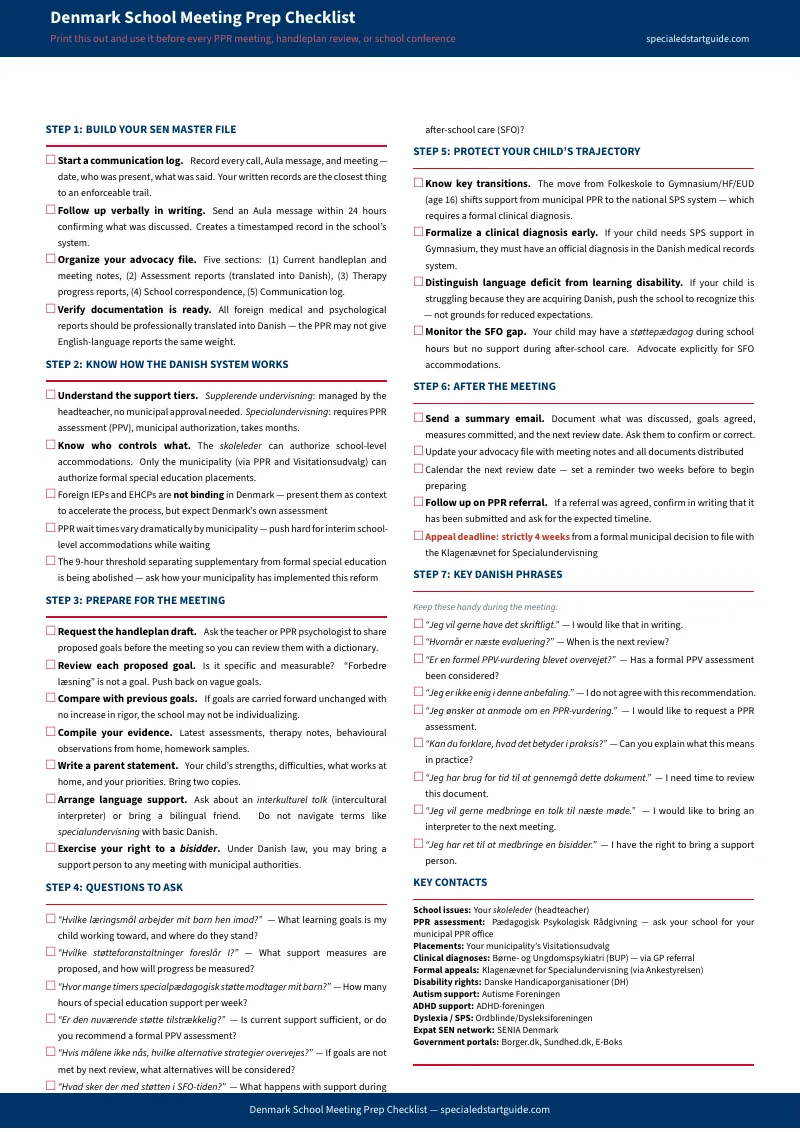
- Denmark School Meeting Prep Checklist (checklist.pdf) — printable 7-step quick-reference covering SEN Master File setup, system orientation, meeting preparation, essential questions in Danish with English translations, trajectory protection, post-meeting documentation, and key Danish phrases for real-time use during meetings
- School Meeting Questions (meeting-questions.pdf) — printable bilingual Danish-English question cards covering learning goals, support measures, PPV assessment triggers, alternative strategies, SFO support, and handleplan status — plus a follow-up email template for locking verbal commitments into the written record
- Danish-English Special Education Glossary (danish-english-glossary.pdf) — 38-term quick-reference organised by category: core system terms, assessment and support, placement types, post-compulsory pathways, institutions and appeals, condition-specific roles, and digital administration — not just translated but functionally explained
- Klagenævnet Appeal Template (klagenaevnet-appeal-template.pdf) — fill-in complaint letter template in Danish with English translation, documentation checklist, the 4-week deadline warning, and the 3-step process for filing a formal complaint with Denmark's national special education appeals board
- PPR Assessment Roadmap (ppr-assessment-roadmap.pdf) — single-page visual flowchart showing the 4-step PPR process from referral through decision, possible placement outcomes from least to most restrictive, and a key people reference table with Danish professional titles and their roles
Instant PDF download. Print the checklist and meeting questions tonight and bring them to your next school meeting.
Money-back guarantee, no time limit. If the Blueprint doesn't change how you navigate your child's education in Denmark, email us for a full refund. No questions asked.
Not ready for the full Blueprint? Download the free Denmark School Meeting Prep Checklist — a structured quick-reference covering the PPR process, meeting preparation, essential questions in Danish, key phrases for meetings, and post-meeting documentation. It's enough to walk into your next meeting prepared, and it's free.
Your child has a right to special education support in Denmark. The kommune knows the system. After tonight, so will you.