
The School Said Your Child Needs a CLB Assessment. The Letter Is in Dutch. The CPMS Version Is in French. You Don't Speak Either Language.
You moved to Brussels for the posting — European Commission, NATO, a corporate rotation, your Belgian partner's career. You enrolled your child in the local school because the relocation agent handled the paperwork. Things seemed manageable. Then a meeting happened. The school psychologist sat down with the care coordinator and used phrases you'd never heard before: Centrum voor Leerlingenbegeleiding. Buitengewoon onderwijs. They produced a consent form — in Dutch. They mentioned something about a "verslag" and "Types" of special education and a possible transfer. They said you have options. They did not explain what those options are.
You went home and opened Google Translate. You typed in buitengewoon onderwijs. It gave you "extraordinary education." You typed in redelijke aanpassingen. It gave you "reasonable adjustments." You typed in individueel aangepast curriculum. It gave you "individually adapted curriculum." None of these translations told you that Belgium has three completely separate education systems — Flemish, French, and German-speaking — each with its own legislation, its own assessment body, and its own set of SEN categories. None of them told you that Flanders has a Type 9 autism category that doesn't exist in the French system — and that choosing the wrong community's school for your child's specific diagnosis can cost years of appropriate support. None of them told you that accepting an adapted curriculum instead of reasonable accommodations means your child follows individualized goals and receives a certificate of completion, not a mainstream diploma.
You searched for "special education Belgium English." You found a four-paragraph summary on an expat lifestyle site that acknowledged the system exists. You found Reddit threads from parents in the Netherlands whose advice does not apply. You found an educational consultant who charges €80 per hour just to explain what the CLB letter says — and has a three-week waiting list. You found a relocation agent who handles apartment leases but goes silent when you mention buitengewoon onderwijs. You found nothing that compared the Flemish and French systems side by side, explained how the European Schools' SEN policies actually work in practice, or told you what to do when the school says they "cannot meet your child's needs."
The problem is not that Belgium's special education system is broken. The Flemish system has genuine legal protections — including a legally guaranteed right to reasonable accommodations. The French Community is implementing sweeping reforms through the Pacte pour un Enseignement d'Excellence. The problem is that these three parallel systems are documented in dense administrative Dutch, French, and German, designed for native speakers who grew up inside the bureaucracy, and operate on assumptions about parental knowledge that no expatriate family could reasonably meet.
The Belgium Special Education Blueprint is the Tri-System Navigation Kit that translates Belgium's three parallel special education frameworks — the Flemish Leersteundecreet, the French Community's Pacte reforms, and the European Schools' SEN policies — from institutional Dutch, French, and German into the plain-English roadmap, meeting preparation tools, and trilingual glossary that give you equal footing at the school table — without paying a consultant €80 to €167 per hour to explain what the teacher just said.
What's Inside the Blueprint
The Three Systems Decoded — Flemish, French, and German-Speaking
Belgium does not have a federal ministry of education. It has three independent community systems, each with its own legislation, terminology, assessment bodies, and funding streams. The Flemish Leersteundecreet replaced the failed M-Decree in 2023. The French Community's Pacte pour un Enseignement d'Excellence is restructuring inclusion through Pôles territoriaux. The German-speaking Community centralises everything through the Zentrum für Förderpädagogik. This guide walks you through all three — so when the school says "Type 3" or "BasisAanbod" or "enseignement spécialisé," you know exactly what they mean, what it implies for your child's trajectory, and whether the recommendation is legally sound.
The Brussels Crossroads — Why Your System Choice Matters More Than Your Address
In Brussels, you have the constitutional right to choose between the Flemish and French education systems. For a child with special educational needs, this is the single most consequential decision you will make — and no one will explain it to you unless you ask. Flanders has a dedicated Type 9 category for autism without intellectual disability. The French system does not. Flanders uses CLB assessments; the French system uses CPMS. The terminology, the categories, the appeal mechanisms, and the funding structures are all different. This chapter provides the direct, unbiased side-by-side comparison that no government website offers, helping you align your child's specific diagnosis with the system that funds and supports it best.
The European School Reality Check — When the "Protected" System Fails
Thousands of EU institution families arrive in Brussels believing their children's education is secured by the European School system. Human Rights Watch documented a "sink or swim" environment where schools actively pressure parents to withdraw children with complex needs, accommodations depend on staff goodwill rather than systematic policy, and the rigid curriculum leads only to the European Baccalaureate. When the school declares itself "unable to meet the needs of the pupil," your family is abruptly thrust into the Belgian public system. This chapter explains the European Schools' actual SEN support tiers — General, Moderate, and Intensive Support A/B — alongside the documented gaps, and provides a concrete transition strategy for pivoting into the Belgian system without losing academic momentum.
The CLB and CPMS Assessment Process — From Referral to Verslag
How the Flemish CLB and French CPMS assessments work in practice. What the Zorgcontinuüm's four phases mean for your child's pathway. What the HGD-traject diagnostic assessment involves. What the CLB's "verslag" or "gemotiveerd verslag" contains and what it legally authorises. How to prepare your child for evaluation — especially when every standardised tool is calibrated for Dutch- or French-speaking children. And the critical distinction most expat families never learn: that the CLB acts in an advisory capacity, and you can challenge its conclusions.
Reasonable Accommodations vs. Adapted Curriculum — The Decision That Determines Everything
This is the single most important distinction in Belgian special education — and the one most expat families discover too late. Reasonable accommodations (redelijke aanpassingen / aménagements raisonnables) keep your child on the standard curriculum with supports like extra time, assistive technology, and modified presentation. An adapted curriculum (individueel aangepast curriculum / plan individuel d'apprentissage) changes the learning objectives themselves. A child on accommodations earns a mainstream diploma. A child on an adapted curriculum receives a certificate of completion. This chapter explains when each applies, how to push for accommodations before the school proposes an adapted curriculum, and how to protect your child's post-secondary options.
Document Transfer — Why Your Foreign IEP Carries Zero Legal Weight
Your US IEP, UK EHCP, Australian support plan, or Canadian IPP has no legal force the moment you cross the Belgian border. Belgium requires a local assessment through the CLB or CPMS. This chapter provides the exact process for converting your foreign documentation into Belgian equivalents — including which documents to translate, which certification standards Belgian authorities accept, and how to present your child's history so the assessment body doesn't start from zero.
Diagnostic Bottlenecks — Navigating 12-to-24-Month Waiting Lists
Public diagnostic pathways for autism and ADHD in Belgium routinely face waiting lists of one to two years. Families needing immediate documentation for school enrollment must navigate the private medical sector, where comprehensive assessments run €1,000 or more. This chapter maps the diagnostic landscape — public university hospital centres, private practitioners, and English-speaking specialists — and explains how to use interim documentation from your home country's professionals while awaiting Belgian assessment.
Parents' Rights and Dispute Resolution — What to Do When the School Says No
The school refuses enrollment. The CLB recommends special education without exhausting the Zorgcontinuüm. The CPMS insists on a placement you disagree with. This chapter covers the full arsenal: Flemish mediation committees, French Community appeal processes, the Commissie inzake Leerlingenrechten, Unia discrimination complaints, and the legal requirements schools must meet before claiming "insufficient capacity." It explains the appeal deadlines — 30 calendar days for Flemish enrollment refusals, 10 working days for French Community decisions — and what to include in your written objection.
The Trilingual Terminology Matrix — Every Term You'll Encounter, in Three Languages
Not just translated — functionally explained. The matrix doesn't just tell you that verslag means "report." It tells you that the verslag is the CLB's formal diagnostic document that legally authorises access to special education, that the gemotiveerd verslag unlocks support from a Leersteuncentrum while keeping your child in mainstream education, and that losing the distinction between these two documents can permanently alter your child's educational track. Every term includes its Dutch form, French equivalent, English operational meaning, and practical implications.
Who This Blueprint Is For
- EU institution families — European Commission, Parliament, Council, EIB, EIF — whose child has been flagged for assessment by the CLB or CPMS, or whose European School has declared itself unable to accommodate their child
- NATO staff and military families on three-to-four-year rotations who need immediate, structured intelligence on Belgium's SEN systems rather than years of trial-and-error navigation
- Corporate assignees and trailing spouses who discovered that the relocation agent's expertise ends exactly where special education begins
- Partners of Belgian nationals who need to co-manage the system in English while their partner navigates in Dutch or French
- Parents in Brussels who must choose between the Flemish and French education systems and need hard data — not Facebook group anecdotes — to make the right call for their child's specific diagnosis
- Parents whose European School has just invoked the "unable to meet needs" policy and who need a transition strategy into the Belgian public system before the next school year
- Parents arriving from the US, UK, Australia, or Canada expecting their existing IEP, EHCP, or equivalent to transfer — and discovering that Belgium operates on entirely different legal and pedagogical principles
Why Not Just Use the Free Resources?
The Belgian regional governments publish special education policy documents. The CLB and CPMS provide free assessments. Expat media covers the basics. Here's why expatriate parents still arrive at meetings unable to advocate effectively:
- Government resources are locked behind language walls. The Flemish Ministry of Education (Onderwijs Vlaanderen) publishes definitive legal guidelines — in Dutch. The French Community's portals detail the Pacte reforms and the DAccE tracking tool — in French. Crucial policy shifts, like the Flemish government's explicit retreat from the M-Decree's inclusion mandate, are documented in administrative language that machine translation cannot accurately render. An English-speaking parent relying on Google Translate will miss the legal implications of every document they receive.
- The CLB and CPMS work for the education system, not for you. These assessment bodies are free and genuinely helpful. They are also staffed by professionals embedded within the same system that makes placement decisions. Relying on a CLB counsellor to aggressively advocate against a segregation recommendation made by the school where they operate is not a reliable strategy.
- No free resource compares the three systems. Flemish government websites do not explain the French system. French Community portals do not explain the Flemish system. European School policy documents do not explain what happens when your child leaves the European system. There is no publicly available English-language resource that places all three systems side by side and helps you evaluate which one serves your child's specific diagnosis best.
- Expat media gives you a 500-word overview, not a crisis playbook. The Bulletin, Expatica, and Brussels Expats articles accurately summarise that Belgium segregates children at a higher rate than most Western European countries. They do not explain how to fight a segregation recommendation, how to file a complaint with the Commissie inzake Leerlingenrechten, or how to leverage the Zorgcontinuüm requirement to demonstrate that the school skipped mandatory support phases before referring your child.
- International education consultants don't know Belgian law. US-based special education advocates operate under IDEA and are experts in 504 plans. They have never navigated a CLB assessment, decoded a verslag, or filed a complaint with Unia. At €80 to €167 per hour, you're paying for expertise in the wrong jurisdiction.
The government publishes the regulations in three languages. NGOs campaign for policy reform. The Blueprint gives you the operational playbook in the one language you actually speak.
— Less Than One Hour of an €80/Hour Consultant
A single session with an educational consultant in Brussels costs €80 to €167. An American special education advocate charges $100 just to review one report — and cannot advise on Belgian law. International school tuition — the escape route many families consider when the public system feels impenetrable — starts at €14,200 and runs up to €44,600 per year. Even the EU's own subsidy for private school placement when the European School fails averages over €20,000 per child. If you eventually need a consultant for a specific dispute, the systemic preparation you build with this Blueprint saves hundreds — because you arrive understanding the three-community framework, speaking the right terminology, and asking specific questions instead of paying someone to explain basics.
Your download includes 9 PDFs — the complete guide, a meeting prep checklist, and 7 standalone printable tools:
- Complete Blueprint Guide (guide.pdf) — 12 chapters covering all three community systems (Flemish Leersteundecreet, French Pacte reforms, German-speaking ZFP), the Brussels bilingual crossroads, European School SEN realities, document transfer and foreign IEP conversion, diagnostic bottlenecks and waiting lists, parents' rights and dispute resolution across all communities, healthcare and therapy funding, practical navigation strategies, a complete trilingual terminology matrix (Dutch-French-English), and English-speaking support networks
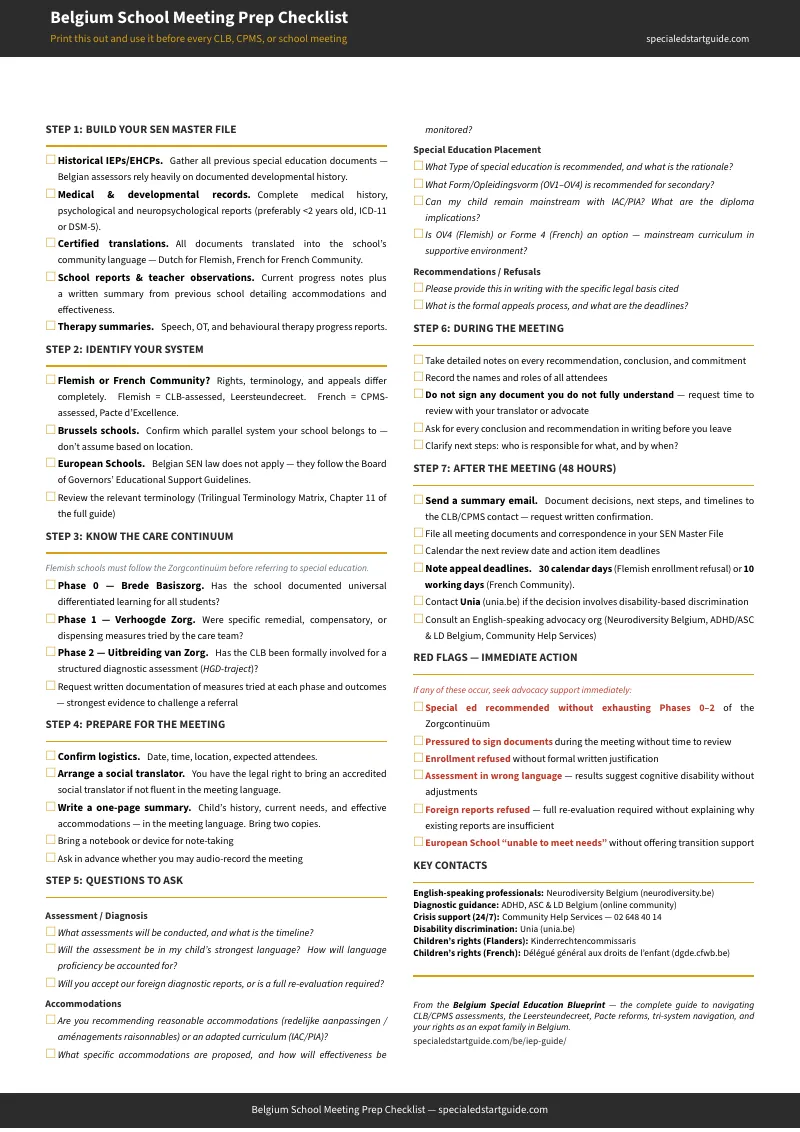
- Belgium School Meeting Prep Checklist (checklist.pdf) — printable 7-step quick-reference covering SEN Master File setup, system identification, Zorgcontinuüm phase verification, meeting preparation, and essential questions — plus appeal deadlines, red flags, and a key contacts directory
- Trilingual Terminology Cheat Sheet (terminology-cheat-sheet.pdf) — every Dutch, French, German, and English term you'll encounter, grouped by category with operational definitions
- Brussels Decision Matrix (brussels-decision-matrix.pdf) — side-by-side Flemish vs. French system comparison by diagnosis, with system feature comparison and decision guidance
- Dispute Resolution Roadmap (dispute-resolution-roadmap.pdf) — appeal pathways across all three communities with deadlines, escalation contacts, and filing strategy
- Meeting Scripts (meeting-scripts.pdf) — 16 scripted questions organised by scenario: assessment, accommodations, placement, and refusal — print and bring to every CLB or CPMS meeting
- Communication Log (communication-log.pdf) — fillable worksheet for tracking every school conversation, meeting, and email with follow-up status
- Advocacy Letter Templates (advocacy-letters.pdf) — 5 ready-to-customise letters: accommodation requests, enrollment refusal challenges, Zorgcontinuüm documentation requests, assessment language rights, and 48-hour meeting follow-ups
- Document Transfer Checklist (document-transfer-checklist.pdf) — step-by-step process for converting your foreign IEP, EHCP, or support plan into Belgian equivalents before and after arrival
Instant PDF download. Print the checklist and meeting scripts tonight and bring them to your next school meeting.
Money-back guarantee, no time limit. If the Blueprint doesn't change how you navigate your child's education in Belgium, email us for a full refund. No questions asked.
Not ready for the full Blueprint? Download the free Belgium School Meeting Prep Checklist — a structured quick-reference covering the CLB/CPMS assessment process, meeting preparation, essential questions in Dutch and French, Zorgcontinuüm verification, appeal deadlines, and red flags. It's enough to walk into your next meeting prepared, and it's free.
Your child has a right to special education support in Belgium. The school knows the system — in Dutch, French, or German. After tonight, so will you.