
Your Child's School Just Said No. Now What?
You requested an evaluation. The special education director said they'd "look into it." You asked why speech therapy stopped when the therapist quit in October. The IEP team said staffing doesn't allow a replacement right now. You questioned why your child's aide was pulled to cover another classroom. The principal — the same person you see at church every Sunday — told you "we're doing our best with what we have." Every denial came verbally. Nothing in writing. Nothing you can challenge. Nothing that creates accountability.
This is how West Virginia's special education system fails families — not through malice, but through a staffing crisis so severe that 20% of beginning teachers leave after their first year and 32% leave within four years. Policy 2419 says your child is entitled to a Free Appropriate Public Education. The district says it can't find anyone to deliver it. Both statements are true — and only one of them is a legal defense. (Hint: it's not the district's.)
The West Virginia IEP & 504 Advocacy Playbook is the Dispute Documentation System — the tactical toolkit that turns verbal denials into written records, missed service hours into compensatory education demands, and vague promises into enforceable obligations, with every template anchored in West Virginia Board of Education Policy 2419 and WV Code Chapter 18 Article 20.
What's Inside the Playbook
The Prior Written Notice Enforcement Kit
Prior Written Notice under Policy 2419, Chapter 10, Section 1 is the single most powerful procedural tool available to West Virginia parents — and the one districts work hardest to avoid issuing. When a school verbally denies your request for an evaluation, a service, a placement change, or an IEE, the PWN demand letter forces them to put the refusal in writing: what was refused, why, what data they relied on, and what alternatives they considered. Districts avoid PWN requests because they create the exact paper trail that wins state complaints. The Playbook gives you the copy-paste template that triggers this obligation — fill in the blanks, attach to an email, and the district's legal clock starts ticking.
The WVDE State Complaint Filing Guide
State Complaints to the WVDE Office of Special Education are free, don't require an attorney, and frequently produce faster results than due process hearings. In 2022–2023, 52% of WVDE complaints resulted in findings of noncompliance — meaning parents who file with proper documentation win more than half the time. The Playbook provides the complaint template with the exact format WVDE investigators expect — chronological timeline of events, specific Policy 2419 regulations violated, supporting documentation references, and proposed corrective actions including compensatory education hours. WVDE has 60 days to investigate and issue a Letter of Findings.
The Compensatory Education Demand System
When your child's IEP services weren't delivered — the speech therapist quit and the district used a long-term substitute with no special education certification, the aide was pulled to cover a staffing gap in another classroom, the behavioral support hours were cut without an IEP meeting — you are entitled to compensatory education. Not "make-up" sessions at the district's convenience, but additional services designed to put your child back where they would have been if the IEP had been implemented. West Virginia's chronic teacher shortage makes this the most common advocacy need in the state. The Playbook shows you how to document the service gap, cite the specific Policy 2419 obligation, and submit the formal demand that districts cannot deflect with staffing excuses.
The 80-Calendar-Day Evaluation Timeline Defense
Federal IDEA gives districts 60 days to complete evaluations. West Virginia Policy 2419 extends that to 80 calendar days — a generous timeline that districts still routinely miss. When the school psychologist position sits vacant for months, when the district insists your child complete more MTSS tiers before processing your evaluation request, when consent forms disappear into administrative limbo — the 80-day clock is your leverage. The Playbook teaches you how to track it from the date you sign consent, how to stop SAT/MTSS stalling tactics, and how to force compliance when the district blows the deadline.
The Small-Town Advocacy Protocol
In many West Virginia counties, the school system is the largest employer. The principal who runs your child's IEP meeting is the person you sit behind at church. The special education director who denied your request coaches your child's team. Challenging the school system in these communities is not just bureaucratically complex — it is socially dangerous. Every template in this Playbook is designed to "blame the law" — citing specific Policy 2419 regulations and requesting specific actions without personal accusations or emotional escalation. You can be legally bulletproof without burning bridges you cannot afford to lose.
The One-Party Consent Recording Advantage
West Virginia is a one-party consent state under WV Code §62-1D-3. You can legally record any IEP meeting — in person, by phone, or electronically — without the district's permission, as long as you are a participant. Most parents don't know this. The Playbook explains how to use this advantage strategically: when recording is most valuable, how to store recordings securely, and how a timestamped audio record changes the dynamic when the district later claims "that's not what we said."
Who This Playbook Is For
- Parents whose IEP requests have been denied verbally and who need to force the district to put refusals in writing — creating the paper trail that wins state complaints with the WVDE
- Parents whose child's IEP services are not being delivered due to West Virginia's special education teacher shortage — and who need to document the gap and demand compensatory education for every missed session
- Parents in Kanawha County where advocacy groups have filed class-action complaints alleging the unlawful removal of over 1,000 students with disabilities — and your child is one of them
- Parents in Berkeley County watching special education identification surge while the district struggles to scale services and faces WVDE special circumstance reviews for noncompliance
- Parents in rural Southern Coalfield counties where one person fills every special education role, the nearest advocate is hours away, and the school system is the only employer in town
- Parents navigating discipline disputes — suspensions, restraint, seclusion, informal removals, manifestation determination reviews — who need to understand the 10-day rule and MDR process under Policy 2419
- Parents whose child was evaluated and declared ineligible, and the evaluation feels thin — and who need to demand an Independent Educational Evaluation at public expense under Policy 2419, Chapter 10, Section 3
- Parents who have already used the West Virginia IEP & 504 Blueprint and now need the advanced dispute resolution and advocacy tools
Why Free Resources Won't Get You Through a Dispute
West Virginia has genuinely dedicated free advocacy organizations. WV PTI provides excellent training. Disability Rights of West Virginia publishes the thorough "Parent's Advocacy Guide to Special Education." Legal Aid of WV's FAST program offers legal support for eligible families. Here's why parents still lose disputes after using all of them:
- WV PTI has four regional coordinators covering 55 mountainous counties. During fall and spring IEP seasons, waitlists and scheduling bottlenecks are inevitable. When your child's expulsion hearing is next Tuesday, you cannot wait three weeks for a callback. WV PTI teaches the process — this Playbook gives you the documents to fight back tonight.
- DRWV's Parent's Advocacy Guide is 159 pages of accurate legal reference — not operational tools. The sample letters in the appendix are embedded in a static PDF and must be retyped from scratch. A parent in crisis needs to fill in a bracket and press send, not retype four paragraphs of legal citations at midnight. This Playbook's templates are designed for copy-paste with Policy 2419 citations pre-loaded.
- Legal Aid of WV's FAST program has strict eligibility criteria. FAST prioritizes children with mental health or co-existing diagnoses in specific wraparound programs. A standard IEP service violation for a child with a specific learning disability may not meet the threshold for immediate FAST intervention.
- Wrightslaw is federal law — not Policy 2419. Wrightslaw is the gold standard for understanding IDEA theory. It does not cover West Virginia's 80-calendar-day evaluation timeline, WVDE-specific complaint procedures, the state's unique transition planning requirement starting at age 14, or the one-party consent statute that gives you recording rights the district doesn't want you to know about.
- Private advocates cost $100–$200 per hour. Attorneys run $250–$450. A due process case in West Virginia can exceed $30,000. And the Buckhannon ruling — a Supreme Court case that originated right here in West Virginia — means the district can stall, settle voluntarily, and leave you unable to recover attorney fees because you're not a "prevailing party."
The free resources explain what West Virginia law says. The Playbook gives you the enforcement tools to make the district follow it — or document their refusal so WVDE has no choice but to act.
— Less Than 15 Minutes of a Special Education Attorney
Special education attorneys in West Virginia charge $250 to $450 per hour. Even a brief phone call can cost more than this entire Playbook. Private advocates charge $100 to $200 per hour — and the first thing they do is ask for your paper trail. If you don't have one, you're paying them to build what the Playbook teaches you to build yourself.
Your download includes the complete Advocacy Playbook guide plus 6 standalone printable PDFs — every dispute template, demand letter, complaint form, and reference card, ready to print and send tonight.
- Complete Advocacy Playbook Guide (guide.pdf) — 13 chapters covering procedural safeguards, Prior Written Notice enforcement, the 80-calendar-day timeline defense, IEE demands, compensatory education for teacher shortages, manifestation determination reviews, discipline and restraint protections under Policy 4373, small-town advocacy strategies, WVDE state complaints, mediation, due process preparation, one-party consent recording guidance, transition planning from age 14, and West Virginia advocacy resources
- Advocacy Letter Templates (advocacy-letters.pdf) — 7 ready-to-send letters citing Policy 2419: evaluation requests, PWN demands, IEE requests, compensatory education demands, WVDE state complaints, IEP meeting follow-ups, and conversation confirmations
- Dispute Resolution Roadmap (dispute-roadmap.pdf) — side-by-side comparison of Facilitated IEP meetings, State Complaints, mediation, and due process with West Virginia-specific timelines, filing procedures, key contacts, and the 52% complaint noncompliance finding rate
- West Virginia Timeline Cheat Sheet (timeline-cheat-sheet.pdf) — every legal deadline on one printable page: the 80-calendar-day evaluation clock, 30-day IEP development window, MDR triggers, dispute filing windows, and records request timelines
- Compensatory Services Worksheet (compensatory-services-worksheet.pdf) — fillable tracker for documenting missed IEP services due to staffing shortages, calculating hours owed, and building the formal demand that forces the district to make your child whole
- Manifestation Determination Prep Sheet (mdr-prep-sheet.pdf) — evidence checklist and challenge strategy for MDR meetings, including the two questions the team must answer and your options if the finding goes against you
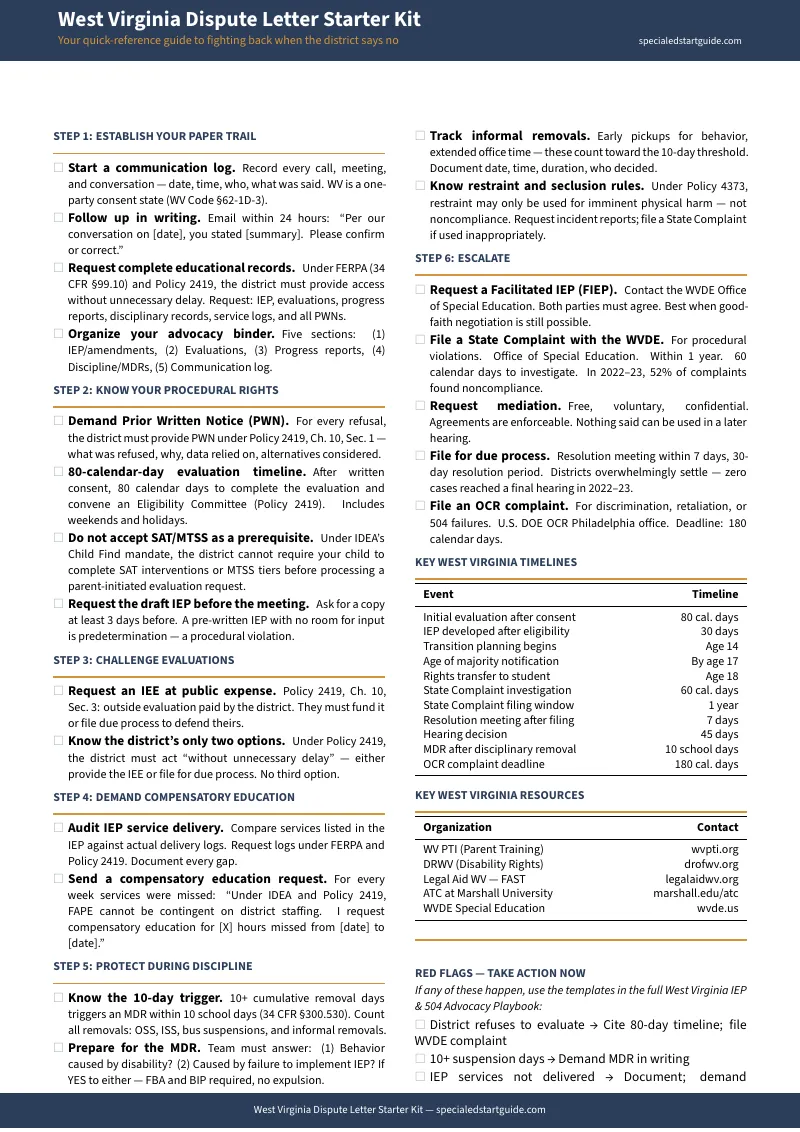
- Dispute Letter Starter Kit (checklist.pdf) — step-by-step checklist for establishing your paper trail, knowing your procedural rights under Policy 2419, challenging evaluations, protecting your child during discipline, and escalating disputes through WVDE
Instant PDF download. Print the demand letter that matches your situation tonight. Send it tomorrow morning.
Money-back guarantee, no time limit. If the Playbook doesn't change how you handle IEP disputes in West Virginia, email us for a full refund. No questions asked.
Not ready for the full Playbook? Download the free West Virginia Dispute Letter Starter Kit — a printable checklist covering paper trail basics, core procedural rights under Policy 2419, one-party consent guidance, and the essential steps for challenging denials. It's enough to start documenting tonight, and it's free.
The district has administrators, budget constraints, and legal precedent on their side. After tonight, you'll have the same Policy 2419 citations they're bound by — and the paper trail to prove they ignored them.