
The Cooperative Is Banking on You Not Knowing ARSD 24:05.
You sat down at the IEP meeting — across from the special education coordinator, a general education teacher you've barely met, and a school psychologist who works for a regional cooperative based three towns away. They used acronyms nobody explained — PLAAFP, LRE, SDI, ESY, FBA. They told you the goals were "measurable" and the services were "appropriate." They slid the IEP across the table and told you where to sign. You left feeling like everything had been decided before you walked in.
You were right. In South Dakota, over 24,000 students — 17.3% of public school enrollment — receive special education services. Most of the state's school districts serve fewer than 200 students total. They can't afford full-time therapists, so they pool resources into Educational Cooperatives — entities like the Black Hills Special Services Cooperative, the North Central Special Education Cooperative, and the Northeast Educational Services Cooperative. The therapist writing your child's IEP goals may serve two dozen other districts, spending more time driving between towns than delivering services. When your child's speech pathologist is a cooperative employee who visits once every two weeks — or delivers therapy through a laptop screen — accountability vanishes. Your local principal points to the cooperative. The cooperative points to staffing shortages. Nobody points to ARSD 24:05, which says your child's right to a Free Appropriate Public Education does not bend because the district can't hire enough therapists.
Private special education advocates in South Dakota charge an average of $150 per hour — a typical case runs $1,500 to $2,250 or more. And they're almost impossible to find in the state. South Dakota Parent Connection offers free navigators, but they're federally funded and legally required to remain "objective and neutral." When the district is ignoring your child's IEP, you don't need neutrality. You need the exact legal citations and enforcement templates that force a response.
The South Dakota IEP & 504 Blueprint is the Cooperative Accountability System — the tactical toolkit that bridges the gap between knowing your rights under South Dakota law and actually exercising them at the IEP table, with every template, script, and checklist grounded in the Administrative Rules of South Dakota (ARSD 24:05), South Dakota Codified Law (SDCL) Chapter 13-37, and IDEA.
What's Inside the Blueprint
The Educational Cooperative Accountability Guide
South Dakota's 13 Special Education Cooperatives supply itinerant therapists, school psychologists, and special education directors to small rural districts. The result: your child's key service providers don't work for your school. They work for a regional entity serving up to two dozen districts simultaneously. The Blueprint maps out how the cooperative system works, who the itinerant staff answer to, and — critically — how to hold your local principal legally accountable for FAPE violations when the therapist failing to deliver services is a cooperative employee based in another town. The cooperative structure is designed for administrative efficiency, not parent transparency. This guide makes it transparent.
The 25-School-Day Timeline Tracker
The moment you consent to an evaluation, South Dakota gives the district exactly 25 school days — not calendar days — to complete it. In districts running four-day school weeks, those 25 days stretch across a much longer calendar window. Districts exploit this ambiguity. The Blueprint maps every milestone from initial referral through eligibility determination, IEP development, annual reviews, and triennial reevaluations. It gives you the follow-up language at each checkpoint and the escalation template when deadlines pass.
The Teletherapy Defense Protocol
South Dakota's staffing crisis has pushed districts to replace in-person therapy with teletherapy delivered through a screen. Speech-language pathologists themselves report that teletherapy is ineffective for children with attentional or behavioral concerns — children who need hand-over-hand prompting, physical redirection, or consistent eye contact that a laptop cannot provide. The Blueprint gives you the step-by-step documentation protocol to prove teletherapy is failing your child, the template to demand an IEP team reconvene, and the legal basis to request compensatory services for therapy minutes lost to ineffective virtual delivery. A staffing shortage is not a legal excuse for failing to provide FAPE.
The Copy-Paste Advocacy Letter Library
Every letter cites the exact South Dakota regulation. Request a formal evaluation and start the district's 25-school-day clock. Demand an Independent Educational Evaluation at public expense using the specific legal phrase that triggers the district's obligation to either pay or file for due process. Request a Functional Behavioral Assessment. Document service non-delivery. Formally disagree with an IEP proposal and demand Prior Written Notice under ARSD 24:05. These aren't generic federal templates — they're South Dakota enforcement tools that create a legally binding paper trail the moment you hit send.
IEP Meeting Scripts and Checklists
What to say when the team tells you your child doesn't qualify because their grades are passing. What to say when they push a 504 instead of an IEP. What to say when the cooperative representative claims they can't add service minutes "because of staffing." Each script cites the ARSD 24:05 regulation that proves them wrong — so you're not arguing opinions at the table, you're citing South Dakota law. The pre-meeting checklist covers one-party consent recording rules under SDCL 23A-35A-20, required IEP team composition, and the specific documents to bring.
BIE vs. State School Navigation
South Dakota has nine reservations and a significant Native American student population navigating overlapping jurisdictions. The Bureau of Indian Education operates as its own State Education Agency with different evaluation timelines — 60 calendar days instead of 25 school days. Section 504 complaints in BIE schools go to the federal Office for Civil Rights, not the SD DOE. The Blueprint maps which entity is responsible for Child Find, evaluations, and FAPE at every age, and provides targeted advocacy for families transitioning between tribal and state systems.
Goal-Tracking Worksheets
IEP goals are legally required to be measurable — with baselines, targets, and mastery criteria that meet the Endrew F. standard. But many goals in South Dakota IEPs are written so vaguely that progress is impossible to track. The worksheets give you a structured format to log data between meetings, compare school-reported progress against your own observations, and arrive at the annual review with documentation that either confirms the program is working or proves it isn't.
The Dispute Resolution Roadmap
When informal advocacy fails, South Dakota offers formal options: State Complaints to the SD DOE Office of Special Education Programs (triggering a 60-day investigation), mediation, and due process hearings before an impartial hearing officer. The Blueprint explains when each option is appropriate, the timeline and costs involved, and how to build the paper trail that wins — including the fact that State Complaints are free, don't require an attorney, and have a documented track record of finding South Dakota districts non-compliant for IEP implementation failures.
Who This Blueprint Is For
- Parents preparing for their first IEP meeting who don't want to walk in blind against a team that does this every day — and who need to understand South Dakota's cooperative-driven system before the meeting starts
- Parents whose child has been pushed into a 504 Plan when they should be receiving Specially Designed Instruction under an IEP — especially in districts trying to avoid the costlier, more enforceable IEP process
- Parents in Sioux Falls, Rapid City, Aberdeen, or Brookings navigating large districts that pressure parents to sign at the table
- Parents in frontier counties where the school psychologist is a cooperative employee who visits monthly, services are delivered via teletherapy, and the nearest developmental evaluation is two hours away
- Parents whose child has ADHD, autism, dyslexia, or anxiety and was told they're "too smart for special education" or "grades are too high" — and who need to understand that academic performance is not the legal standard
- Military families PCSing to Ellsworth AFB who need to understand how South Dakota handles IEP transfers from other states
- Parents on reservations navigating the jurisdictional overlap between BIE schools and state public schools — and who need to know which agency is legally responsible for their child's services
- Parents whose child is turning three and Birth to Three early intervention services are ending, but the school district says they "don't qualify" for preschool special education
Why Not Just Use the Free Resources?
South Dakota has dedicated free special education resources. South Dakota Parent Connection provides navigators and workshops. Disability Rights South Dakota publishes legal guides. The SD DOE distributes the Parental Rights and Procedural Safeguards Handbook. Here's why parents still struggle after consulting all of them:
- SD Parent Connection's navigators are mandated to stay neutral. Their funding requires them to remain "objective and neutral" — helping both parents and school personnel. When the district is blatantly violating your child's IEP, you don't need someone keeping the peace. You need the exact confrontational scripts and legal leverage the state-funded organizations are not permitted to hand you.
- Disability Rights South Dakota is reactive, not proactive. DRSD is an excellent legal safety net — for severe, systemic cases. They operate as a non-profit law firm with limited capacity, typically engaging only after a child is already suspended or facing extreme disciplinary action. They are not a daily navigational tool for the parent struggling with IEP goal formulation or teletherapy pushback.
- The DOE handbook is 30+ pages of legal jargon designed for compliance officers. It constantly cross-references ARSD 24:05 and 34 CFR Part 300 without explaining what any of it means in plain English. It was written to protect the state from liability, not to teach you how to draft a state complaint that actually wins an investigation.
- Wrightslaw covers federal law — not ARSD 24:05. Wrightslaw is the gold standard for IDEA. It does not address South Dakota's cooperative system, the 25-school-day evaluation timeline, four-day school week complications, or BIE jurisdiction. There are no Wrightslaw training events scheduled in South Dakota. If you use national terminology without understanding South Dakota's implementation, the district knows.
- Etsy and TPT planners organize paperwork — they don't enforce rights. A pastel IEP binder helps you keep documents in order. It won't explain who at the cooperative is legally responsible for your child's therapy, how to cite ARSD 24:05 to demand Prior Written Notice, or how to file a state complaint that triggers an investigation.
- Private advocates charge $150 per hour — and barely exist in South Dakota. The Wrightslaw Yellow Pages lists an extremely limited number of private consultants in the state. Most rural families can't access one even if they could afford the $1,500+ typical engagement cost. The Blueprint teaches you how to build the paper trail that either makes an advocate unnecessary or saves hundreds in billable hours if you do hire one.
The free resources explain what South Dakota law says. The Blueprint gives you the tools to make the district follow it.
— Less Than One Hour of a Special Education Advocate
Private advocates in South Dakota charge an average of $150 per hour. If you hand an advocate a disorganized pile of papers, you'll spend hundreds just for them to review the file and formulate a strategy — assuming you can find one in the state. The Blueprint teaches you how to organize the documentation, decode the IEP, understand the cooperative accountability chain, and draft the initial requests — either empowering you to advocate effectively without an advocate, or saving hundreds in billable hours if you do hire one.
Your download includes the complete Blueprint guide plus standalone printable PDFs — every template, worksheet, script, and reference card, ready to print and bring to your next IEP meeting.
- Complete Blueprint Guide — 17 chapters covering the South Dakota special education landscape, IEP vs. 504, referral and evaluation timelines (25-school-day evaluation + eligibility determination + IEP development), IEP meeting strategies, the cooperative system, goals and progress monitoring, Independent Educational Evaluations, related services and teletherapy, ESY, the 504 Plan process, school discipline protections, Birth to Three transition, BIE school jurisdiction, transition planning, Ellsworth AFB transfers, private schools and homeschool, dispute resolution, and South Dakota advocacy resources
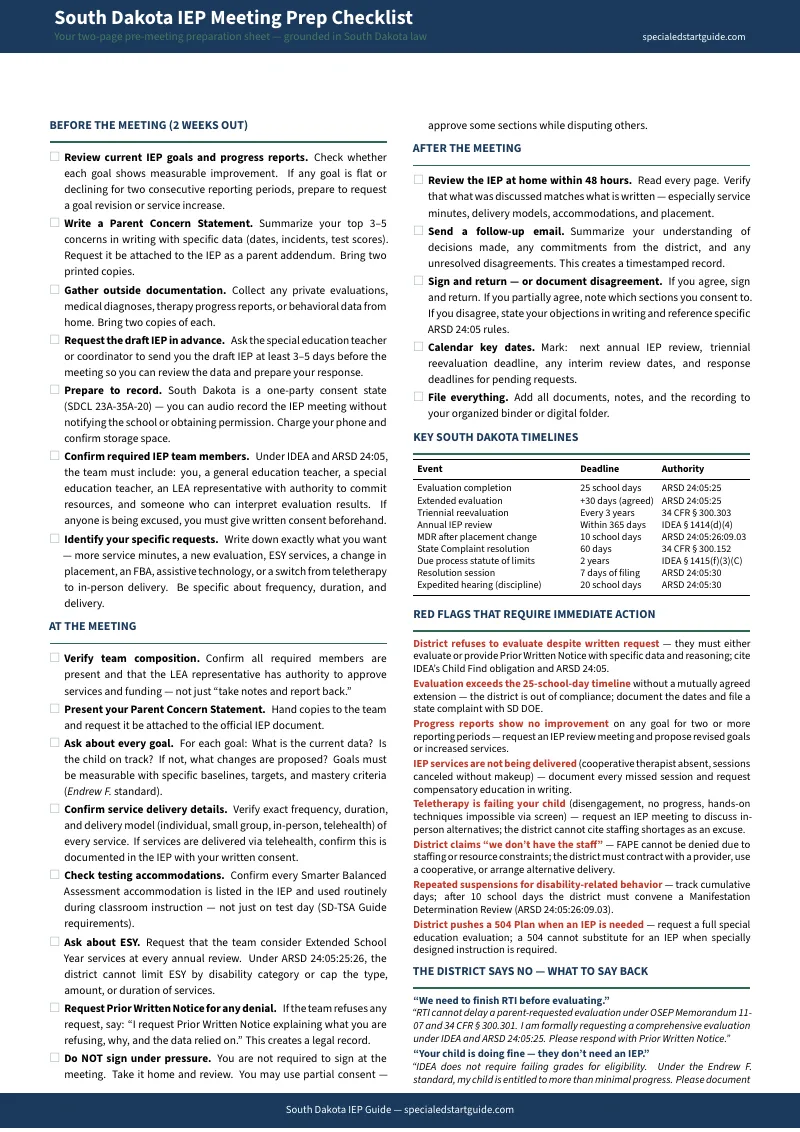
- IEP Meeting Prep Checklist — the before/during/after checklist with South Dakota timelines, ARSD 24:05 citations, and one-party consent recording rules under SDCL 23A-35A-20
- Advocacy Letter Templates — copy-paste letters citing exact ARSD 24:05 regulations for evaluation requests, IEEs, FBA demands, service non-delivery, teletherapy objections, and formal disagreements
- Goal-Tracking Worksheet — structured fillable worksheet for measurable progress monitoring between annual IEP reviews
- South Dakota Timeline Cheat Sheet — every legal deadline on one page: 25-school-day evaluation, eligibility, IEP development, annual reviews, triennial reevaluations, and Part C to Part B transition
- IEP Meeting Scripts — word-for-word responses to common IEP team pushback tactics, each citing the specific South Dakota regulation
- Cooperative Accountability Guide — directory of South Dakota's Educational Cooperatives with a plain-English explanation of how to hold your local district responsible when cooperative staff fail to deliver services
- Dispute Resolution Roadmap — your formal options: SD DOE State Complaint, mediation, and due process — with South Dakota-specific filing procedures
- 504 vs. IEP Decision Matrix — side-by-side comparison of protections with South Dakota-specific qualification criteria and enforcement mechanisms
Instant PDF download. Print the templates tonight. Walk into tomorrow's IEP meeting with the law on your side.
Money-back guarantee, no time limit. If the Blueprint doesn't change how you approach IEP meetings in South Dakota, email us for a full refund. No questions asked.
Not ready for the full Blueprint? Download the free South Dakota IEP Meeting Prep Checklist — a printable pre-meeting checklist with South Dakota timelines, IEP team composition requirements, one-party consent recording rules under SDCL 23A-35A-20, and red flags that require immediate action. It's enough to walk into your next meeting prepared, and it's free.
Your child's education is a legal right, not a favor. The district knows ARSD 24:05. After tonight, so will you.