
The District Is Counting on You Not Filing a State Complaint.
You already know your child's IEP is being violated. The speech therapy sessions keep getting canceled. The aide that was written into the IEP never showed up. The cooperative's itinerant therapist visits once every two weeks — when she visits at all. You raised it at the last IEP meeting and the team nodded sympathetically, wrote nothing down, and changed nothing. You called South Dakota Parent Connection and they told you to try collaboration. You've been collaborating. The district has been ignoring.
Now you're sitting at your kitchen table at midnight trying to figure out how to file a state complaint with the SD DOE — and the only resource you can find is a 173-page legal manual from Disability Rights South Dakota that reads like a law textbook. You don't need a textbook. You need the exact letter to send tomorrow morning that forces the district to respond in writing, creates a binding legal paper trail, and starts the clock on formal accountability.
That's the gap this playbook fills. South Dakota Parent Connection teaches you how to collaborate. Disability Rights South Dakota explains what the law says. The South Dakota IEP & 504 Advocacy Playbook is the Dispute Enforcement System — the tactical toolkit that gives you the copy-paste letters, state complaint strategies, and cooperative escalation sequences you need when collaboration has already failed and you need the district to comply with ARSD 24:05, not just discuss it.
What's Inside the Playbook
The Copy-Paste Dispute Letter Library
Every letter cites the exact South Dakota regulation. Demand Prior Written Notice under ARSD 24:05:30:04 and start the district's 5-day compliance clock. Request an Independent Educational Evaluation at public expense using the specific legal phrase that forces the district to either pay or file for due process. Escalate service non-delivery to the Educational Cooperative's executive director with a 10-day resolution deadline backed by the threat of an SD DOE audit. Document informal removals that the district is hiding from the 10-day cumulative suspension count. These are enforcement tools — not polite request templates.
The 5-Day PWN Weaponization Guide
South Dakota's Prior Written Notice rule is unlike any other state's. Under ARSD 24:05:30:04, the district must provide written notice five calendar days before implementing any proposed change or refusal. Most parents don't know this rule exists. The ones who do don't know how to use it offensively. This guide teaches you how to demand PWN after every verbal refusal, forcing the district to document — in writing — exactly why it's denying your child's services, what data it relied on, and what alternatives it considered. That documentation becomes the evidence that wins state complaints. The district creates its own paper trail of non-compliance. You just have to ask.
The Cooperative Escalation Ladder
In rural South Dakota, the principal who tells you "we don't have the staff" isn't the person who controls the staffing budget. The Educational Cooperative — Cornbelt, Black Hills Special Services, Northeast Educational Services — is the entity that allocates the therapists, psychologists, and special education directors across a dozen or more districts. When the local school board shrugs, you need to know who at the cooperative to contact, what legal obligation the cooperative has under SDCL 13:5:31, and how to frame the escalation so the cooperative treats your child's case as a FAPE violation, not a scheduling inconvenience.
The State Complaint Filing Guide
Filing a state complaint with the SD DOE is free, doesn't require an attorney, and triggers a 60-day investigation. It is the most powerful formal tool available to a South Dakota parent — and most parents either don't know it exists or are too intimidated to use it. The playbook walks you through exactly what to include, how to organize the evidence, what the investigator looks for, and how to frame the complaint so the violation is undeniable. State complaint data shows that poorly documented complaints are routinely dismissed. A well-documented complaint forces an investigation that the district cannot ignore.
The Due Process Hearing Roadmap
When state complaints and mediation aren't enough, due process is the formal hearing that produces a legally binding decision. The playbook explains when due process is the right option (and when it's premature), the timeline and procedural steps, how to prepare your evidence, the role of the impartial hearing officer, and the new HB 1220 civil court appeal pathway that gives you 30 days to challenge an unfavorable decision in state or federal court. You don't need a $287/hour attorney to understand how the process works.
BIE and Tribal School Advocacy
If your child attends a Bureau of Indian Education school or a tribally controlled grant school on Pine Ridge, Rosebud, or Cheyenne River, the dispute resolution process is fundamentally different. BIE operates as its own State Education Agency with a 60-calendar-day evaluation timeline instead of 25 school days. Section 504 complaints go to the federal Office for Civil Rights, not the SD DOE. GAO reports have confirmed that BIE schools failed to provide or account for 38% of required special education service time. The playbook maps which entity is responsible at each stage and provides targeted enforcement templates for BIE-specific violations.
Manifestation Determination Defense
When a child with a disability is suspended for more than 10 cumulative school days, the district must hold a Manifestation Determination Review (MDR) to determine whether the behavior was caused by the disability. South Dakota complaint data shows districts routinely skip this step — or conduct it as a rubber-stamp exercise. The playbook teaches you how to recognize when removals are being disguised as "shortened days" or "early dismissals" to avoid triggering the 10-day count, how to demand an MDR, and how to challenge a determination that ignores the relationship between your child's disability and their behavior.
The Documentation System
Every strategy in this playbook depends on one thing: a paper trail. The documentation system teaches you how to log every interaction, convert verbal statements into written confirmations, organize your evidence chronologically, and build the kind of case file that makes a state complaint investigator's job easy — and the district's defense impossible.
Who This Playbook Is For
- Parents who have already tried collaboration and it didn't work — the school promised changes at the IEP meeting and nothing happened, and now you need enforcement tools
- Parents whose child is being denied services because the Educational Cooperative claims it can't staff the position — and who need to escalate above the local school board
- Parents whose child has been suspended or removed from class repeatedly without a Manifestation Determination Review
- Parents preparing to file a state complaint with the SD DOE and who need to build the evidence file that wins investigations
- Parents on reservations navigating disputes at BIE schools where the state complaint process doesn't apply and the federal oversight is different
- Parents in extreme rural isolation — frontier counties where the nearest private advocate is a 200-mile drive and the cooperative controls everything
- Parents in Sioux Falls, Rapid City, or Aberdeen whose large district has a legal team and a pattern of pressuring parents to sign at the table
- Parents who already own the South Dakota IEP & 504 Blueprint and need the next level — dispute-ready templates and formal complaint strategies
Why Not Just Use the Free Resources?
South Dakota has dedicated free special education resources. South Dakota Parent Connection provides navigators. Disability Rights South Dakota publishes legal guides. The SD DOE distributes complaint forms. Here's why parents still lose disputes after consulting all of them:
- SD Parent Connection is mandated to stay neutral. Their federal funding requires them to remain "objective and neutral" — supporting both parents and school personnel. When the district has already chosen an adversarial posture, neutrality leaves you without the confrontational scripts and legal leverage that force compliance. Collaboration is ideal. It's not always possible.
- Disability Rights South Dakota handles severe cases, not daily advocacy. DRSD is a non-profit legal organization with limited capacity. They typically engage only after a child faces extreme disciplinary action or systemic discrimination. For the parent struggling with chronic service non-delivery or a cooperative that won't staff the IEP, DRSD is not a daily advocacy tool.
- The DOE complaint form tells you where to file — not how to win. The SD DOE provides the state complaint form and the procedural safeguards handbook. Neither document explains how to organize your evidence, what the investigator looks for, or how to frame the violation so it's impossible to dismiss on a technicality. A complaint form without a strategy is a complaint that gets closed.
- Wrightslaw covers federal law — not ARSD 24:05. Wrightslaw doesn't address South Dakota's 5-day PWN rule, the cooperative escalation chain, four-day school week complications, or BIE jurisdiction. If you cite federal timelines when South Dakota has state-specific ones, the district knows you're working from a generic guide.
- Private advocates charge $150+ per hour and barely exist in South Dakota. Comprehensive case management runs $1,500 to $2,250. Most rural families can't access a private advocate even if they could afford one. The playbook teaches you the enforcement strategy that either makes an advocate unnecessary or cuts hundreds from their billable hours if you do hire one.
The free resources explain what South Dakota law says. This playbook gives you the enforcement tools to make the district follow it.
— Less Than Six Minutes of an Attorney's Time
Education attorneys in South Dakota charge an average of $252 per hour. Private advocates bill $150 per hour for case management that typically runs 10 to 15 hours. For families in rural counties, just the fuel cost for a 200-mile round trip to Sioux Falls to meet with an advocate can exceed the price of this playbook. The playbook gives you the same dispute letters, escalation strategies, and state complaint methodology that advocates use — ready to deploy tonight from your kitchen table.
Your download includes the complete Advocacy Playbook guide plus 8 standalone printable PDFs — every template, flowchart, and reference card, ready to print and use immediately.
- Complete Advocacy Playbook Guide (guide.pdf) — 12 chapters covering the South Dakota advocacy landscape, your legal arsenal (ARSD 24:05, SDCL 13-37, HB 1220), the evaluation battle and 25-school-day timeline enforcement, IEP meeting advocacy strategies, the 5-day Prior Written Notice weaponization guide, discipline protections and manifestation determinations, the Educational Cooperative escalation ladder, BIE and tribal school advocacy, dispute resolution (state complaints, mediation, due process, civil court appeals), the documentation system, special situations (rural staffing shortages, Birth to Three, ESY, Section 504), and South Dakota resources
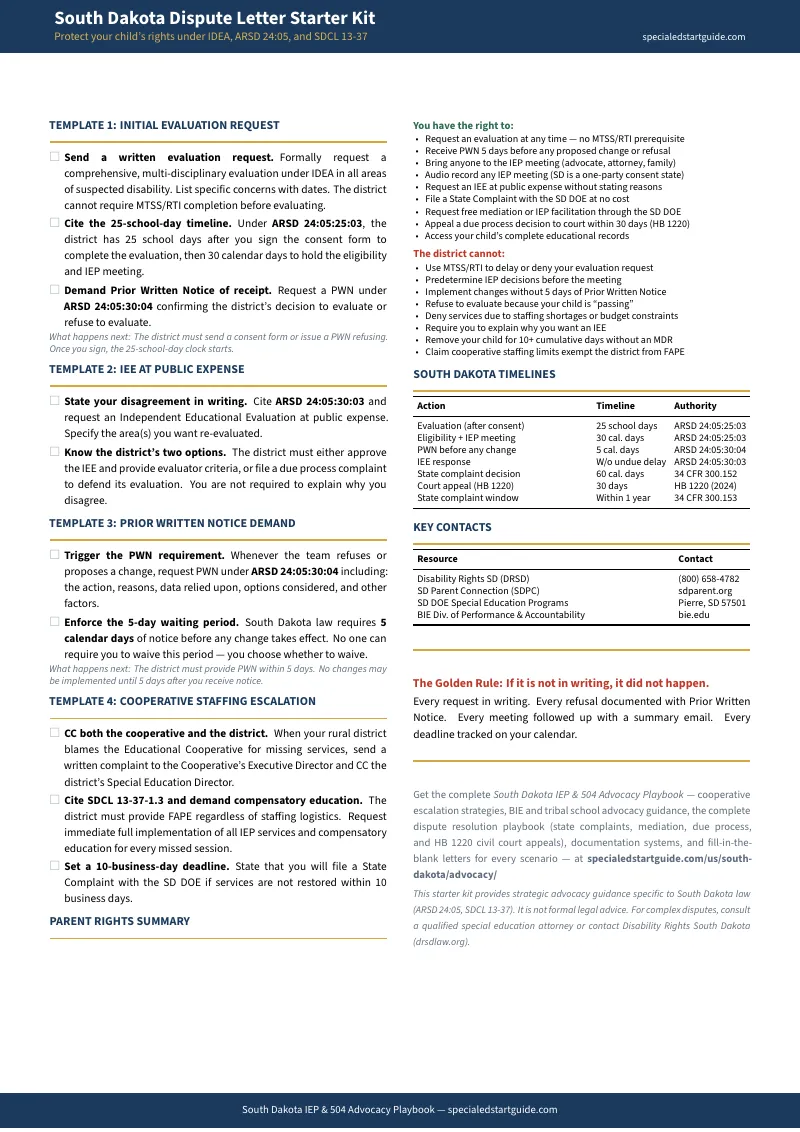
- Dispute Letter Starter Kit (checklist.pdf) — four copy-paste templates for evaluation requests, IEE demands, PWN demands, and cooperative staffing escalations, plus a timeline quick reference and parent rights summary
- Advocacy Letter Templates (dispute-letters.pdf) — six fill-in-the-blank enforcement letters citing exact ARSD 24:05 regulations: initial evaluation request, IEE demand, PWN demand, cooperative staffing escalation, service non-delivery documentation, and follow-up email after verbal conversation
- South Dakota Timelines Quick Reference (timelines-reference.pdf) — every legal deadline on one page: 25-school-day evaluation, 30-day eligibility, 5-day PWN, IEE response, state complaint investigation, due process timeline, and HB 1220 appeal window
- Parent Rights One-Pager (parent-rights-one-pager.pdf) — one-page fridge sheet listing everything the district must do and everything it cannot do under South Dakota law, plus key contacts
- Communication Log (communication-log.pdf) — printable two-page log for tracking every interaction with school staff, with the 24-hour follow-up rule
- Dispute Escalation Ladder (escalation-ladder.pdf) — the five-step path from informal advocacy through SD DOE state complaint, mediation, due process, and federal OCR complaint, with South Dakota-specific timelines
- MDR Preparation Checklist (mdr-prep-checklist.pdf) — everything to bring and argue at a Manifestation Determination Review, including the two legal questions and what to do after the determination
- SD DOE State Complaint Template (state-complaint-template.pdf) — fill-in-the-blank complaint form with sections for violations, facts, evidence, and proposed resolution, ready to mail to Pierre
Instant PDF download. Print the dispute letter that matches your situation tonight. Send it tomorrow morning.
Money-back guarantee, no time limit. If the playbook doesn't change how you handle special education disputes in South Dakota, email us for a full refund. No questions asked.
Not ready for the full Playbook? Download the free South Dakota Dispute Letter Starter Kit — four copy-paste templates for evaluation requests, IEE demands, Prior Written Notice demands, and cooperative staffing escalations, plus a quick-reference timeline card and parent rights summary. Enough to start building your paper trail tonight, and it's free.
The district is counting on you giving up. The paper trail you start tonight proves you won't.