
The District Knows SC Regulation 43-243. Now You Will Too.
You walked into that IEP meeting prepared — or you thought you did. You read the Procedural Safeguards Notice. You printed your child's progress reports. You wrote down your concerns. And then the special education teacher, the school psychologist, and the LEA representative smiled, used phrases you'd never heard before, and told you your child needed "more time" before they could even start evaluating.
You left the meeting with nothing. No evaluation referral. No Prior Written Notice explaining why they refused. No timeline. Just a vague promise to "keep monitoring" while your child falls further behind — because you didn't know that South Carolina law gives you the right to demand a formal evaluation regardless of what tier your child is in.
The problem isn't that you're uninformed. The problem is that South Carolina's special education system — 82 separate school districts, each implementing federal and state law on its own terms — is specifically designed to be navigated by professionals, not parents. The state serves roughly 15 percent of all public school students under IDEA, but more than 40 percent of its schools are classified as rural, where severe special education teacher shortages mean IEPs become documents that collect dust. Parents on local forums describe the process as a "fight" with "absolutely no accountability on follow through." Teachers openly describe 504 plans as "entitlements." And South Carolina has joined a 17-state lawsuit challenging Section 504 protections — creating real uncertainty about the future of accommodation plans statewide.
The South Carolina IEP & 504 Blueprint is the tactical enforcement toolkit that bridges the gap between knowing your rights and actually exercising them — with every template, script, and checklist grounded in South Carolina Regulation 43-243 and SCDE procedures.
What's Inside the Blueprint
The Copy-Paste Advocacy Letter Library
Every letter cites the exact SC regulation section. Request a formal evaluation and start the district's strict 60-day clock — a clock that begins when you provide written consent, not when the district gets around to scheduling. Demand an Independent Educational Evaluation at public expense using the specific legal phrase that triggers the district's obligation to either pay or file for due process. Formally disagree with an IEP and demand Prior Written Notice for every refusal. These aren't generic federal templates — they're South Carolina enforcement tools that create a legally binding paper trail the moment you hit send.
The Employability Credential Defense Playbook
The most consequential decision in South Carolina special education happens around 8th grade — and most parents don't realize it until it's too late. Under SC Code § 59-39-100 and Regulation 43-235, IEP teams decide whether a student pursues a standard 24-credit South Carolina High School Diploma or the SC Employability Credential. The Credential requires 360 work-based learning hours but is definitively not a high school diploma. Four-year colleges won't accept it. The military won't accept it. And teachers report that students who could pass with accommodations are being inappropriately routed onto this track. The Blueprint gives you the flowchart, the data demands, and the exact pushback script to keep your child on the diploma pathway — or reverse a credential decision that was made without your fully informed consent.
The 60-Day Timeline Tracker
The moment you submit written consent for an evaluation, the district has exactly 60 days to conduct all evaluations and determine eligibility. Then the IEP team must convene within 30 days to develop the initial IEP. If the district misses these deadlines — a common occurrence when caseloads are heavy and staff positions sit unfilled — you have grounds for a State Complaint to SCDE and potentially compensatory education. The Blueprint maps every milestone within these windows, gives you the specific follow-up language at each checkpoint, and provides the escalation template when the deadline passes.
Charleston, Greenville, Columbia, and Rural District Navigation
Advocating in Charleston County or Greenville County is fundamentally different from advocating in a rural district outside the metros. In the large urban districts, you're navigating overcrowded caseloads, bureaucratic delay, and systemic staff turnover. In rural districts — more than 40 percent of SC's schools — the challenges are isolation and severe staffing shortages: schools that can't hire a speech-language pathologist, virtual instruction that leads to regression, and no local advocacy infrastructure within an hour's drive. The Blueprint covers strategies for both environments because a one-size approach fails in a state this fragmented.
The Military Transfer Protocol
Fort Jackson, Joint Base Charleston, Shaw Air Force Base, Parris Island — South Carolina's nearly 12,000 military-connected students face unique bureaucratic hurdles when transferring existing out-of-state IEPs into the South Carolina system. Under the Interstate Compact on Educational Opportunity for Military Children (MIC3), the receiving district must initially provide comparable services based on the current IEP. The Blueprint provides the exact language to invoke these protections at enrollment — before the district has a chance to "reevaluate" your child's services downward.
IEP Meeting Scripts and Checklists
What to say when the team tells you your child needs "more time" before they'll evaluate. What to say when they offer a 504 instead of an IEP. What to say when the LEA representative claims they can't add service minutes "because of staffing." Each script cites the SC Regulation 43-243 section that proves them wrong — so you're not arguing opinions at the table, you're citing law. The pre-meeting checklist covers one-party consent recording rights under SC law, team composition verification, and the specific documents to bring.
Goal-Tracking Worksheets
IEP goals are legally required to be measurable — with baselines, targets, and mastery criteria that meet the Endrew F. standard. But many goals are written so vaguely that progress is impossible to track. The worksheets give you a structured format to log data between meetings, compare school-reported progress against your own observations, and arrive at the annual review with documentation that either confirms the program is working or proves it isn't.
The Dispute Resolution Roadmap
When informal advocacy fails, you have formal options in South Carolina: filing a State Complaint with the SCDE Office of Special Education Services (OSES), requesting mediation, or filing for a due process hearing. South Carolina operates a two-tier due process system — a local hearing first, then a state-level review — which creates additional procedural complexity. The Blueprint explains when each option is appropriate, the timelines and costs involved, and how the paper trail you've been building becomes the evidence that carries your case.
Who This Blueprint Is For
- Parents preparing for their first IEP meeting who don't want to walk in blind against a team that does this every day — and who need to understand the 60-day evaluation timeline before consent forms are pushed across the table
- Parents whose child has been stuck waiting while the school insists on "more data" before evaluating — and who need the legal citations to force a referral under IDEA's Child Find mandate
- Parents in Charleston, Greenville, or Richland County navigating overcrowded EC departments, high teacher turnover, and systemic service delivery gaps
- Parents in rural South Carolina districts where staffing shortages mean IEP meetings don't happen on schedule, services aren't delivered, and there's no local advocate to call
- Military families at Fort Jackson, Joint Base Charleston, or Shaw AFB who need to enforce their child's existing IEP during a South Carolina school transfer
- Parents whose child is approaching 8th grade and being steered toward the SC Employability Credential instead of a standard diploma — and who need the data demands and pushback scripts to keep the diploma pathway open
- Parents navigating the 504-to-IEP question — especially given South Carolina's participation in the multi-state Section 504 lawsuit — who need to understand whether an IEP provides more durable protections
- Parents whose child is being repeatedly suspended for behavior related to their disability — and who need to understand the 10-day rule and Manifestation Determination procedures
- Parents of children transitioning from South Carolina's BabyNet early intervention program into the public school system under IDEA Part B
Why Not Just Use the Free Resources?
South Carolina has solid free special education resources. Family Connection SC provides training and peer support. SCDE distributes Procedural Safeguards notices. Disability Rights SC publishes legal fact sheets. Here's why parents still struggle after consulting all of them:
- Family Connection SC can't triage your crisis overnight. Family Connection is the federally recognized Parent Training and Information Center for South Carolina. They provide excellent peer-to-peer support and bilingual outreach. But they are a grant-funded 501(c)(3) dependent on volunteer labor. You cannot wait two weeks for a volunteer match to process when your IEP meeting is on Tuesday. They explain what the law is — they cannot provide fill-in-the-blank enforcement templates for when the school actively ignores it.
- Disability Rights SC writes for people already in the legal process. DRSC handles systemic litigation, OCR complaints, and serious abuse investigations. Their fact sheets are legally accurate but written by lawyers, for individuals already deep in the disciplinary or due process pipeline. If you need a fill-in-the-blank letter to request an evaluation — not a treatise on federal case law — DRSC doesn't meet you where you are.
- The Procedural Safeguards handbook was written to protect the district. SCDE's official document tells you the district has 60 days to evaluate. It does not tell you what to say in the email to the special education director on Day 55 when nothing has happened. It relies on regulatory citations (R-43-243) rather than actionable advice. It is designed to document that your rights were "disclosed," not to teach you how to use them.
- Wrightslaw covers federal law — not South Carolina's regulations. Wrightslaw is the gold standard for IDEA. It does not address SC Regulation 43-243, the specific 60-day evaluation timeline, the SC Enrich IEP system, the two-tier due process hearing structure, or the Employability Credential graduation trap. Generic national advice leaves you vulnerable at a South Carolina IEP table.
- TPT and Etsy planners organize paperwork — they don't enforce rights. A pastel IEP binder helps you keep documents in order. It won't explain what the Employability Credential means for your child's future, why the district is delaying your evaluation, or how to cite SC Regulation 43-243 to force the referral.
- Private advocates cost $150–$300 per hour. Attorneys cost even more. A basic document review from Advocacy of the Carolinas runs $350. Full IEP meeting representation costs $800. Most families can't afford this. And attorneys prefer cases where a solid paper trail already exists — meaning you still need guidance on building the documentation that makes representation possible.
The free resources explain what the law says. The Blueprint gives you the tools to make the district follow it.
— Less Than 2 Minutes of a Special Education Advocate
Special education advocates in South Carolina charge $150–$300 per hour. A document review and written recommendations from Advocacy of the Carolinas costs $350. Even if you eventually need professional help, the meticulous paper trail you build with this Blueprint saves hundreds in billable hours — because you're handing your advocate an organized case, not a folder of unsigned IEP copies and half-remembered conversations.
Your download includes the complete Blueprint guide plus standalone printable PDFs — every template, worksheet, script, and reference card, ready to print and bring to your next meeting.
- Complete Blueprint Guide — 17 chapters covering the SC special education landscape, IEP vs. 504, evaluation timelines, IEP meeting strategies, BabyNet transitions, related services and ESY, behavior and discipline protections, Independent Educational Evaluations, SC READY and EOCEP testing accommodations, the Employability Credential vs. diploma decision, transition planning, military family transfers, assistive technology, consent and partial consent, dispute resolution, and the documentation system with SC resources directory
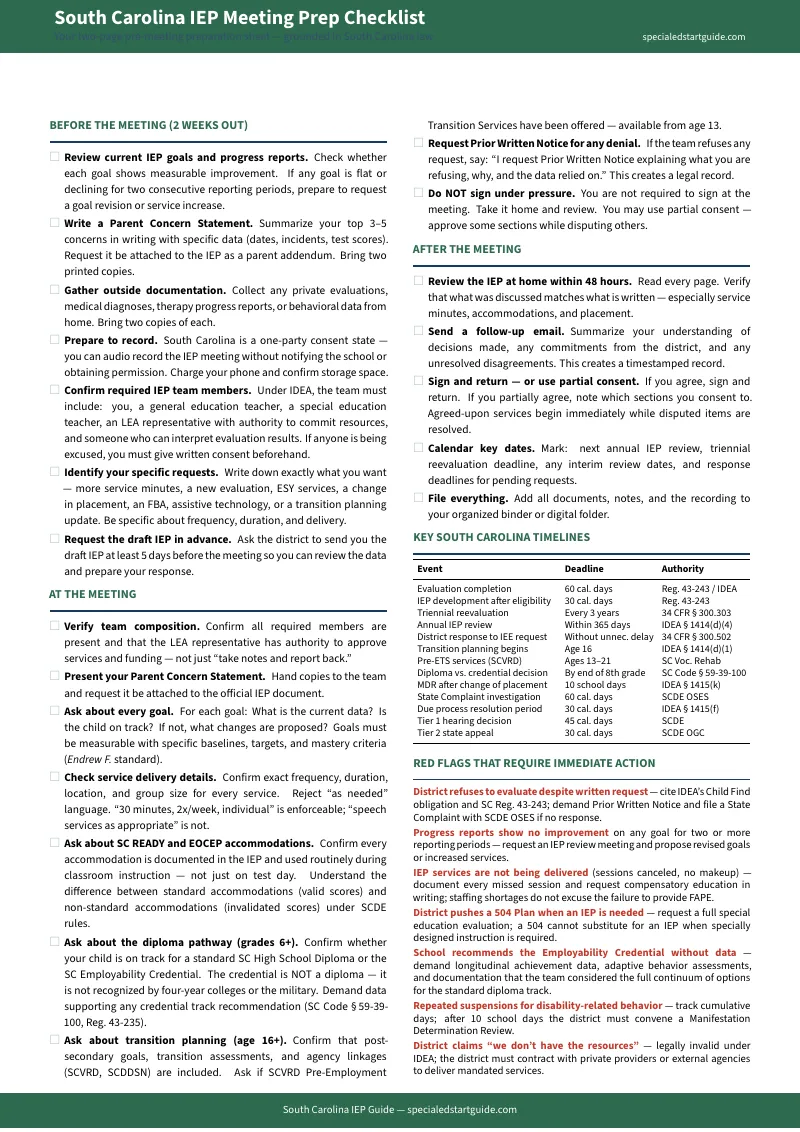
- IEP Meeting Prep Checklist — the before/during/after checklist with South Carolina timelines and Reg 43-243 citations for every step
- Advocacy Letter Templates — copy-paste letters citing exact SC regulation sections for evaluation requests, IEEs, Prior Written Notice demands, formal disagreements, and addendum meeting requests
- Goal-Tracking Worksheet — structured fillable worksheet for measurable progress monitoring between annual reviews
- South Carolina Timeline Cheat Sheet — every legal deadline on one page: 60-day evaluation clock, 30-day IEP development window, annual reviews, triennial reviews, BabyNet transition, and transition planning dates
- IEP Meeting Scripts — word-for-word responses to common IEP team pushback tactics, each citing the specific SC regulation
- Dispute Resolution Roadmap — your formal options in South Carolina's two-tier system: SCDE State Complaint, mediation, local due process hearing, and state-level review
Instant PDF download. Print the templates tonight. Walk into tomorrow's meeting with the law on your side.
Money-back guarantee, no time limit. If the Blueprint doesn't change how you approach IEP meetings in South Carolina, email us for a full refund. No questions asked.
Not ready for the full Blueprint? Download the free South Carolina IEP Meeting Prep Checklist — a printable pre-meeting checklist with the SC timelines, team composition requirements, one-party consent recording rights, and red flags that require immediate action. It's enough to walk into your next meeting prepared, and it's free.
Your child's education is a legal right, not a favor. The district knows SC Regulation 43-243. After tonight, so will you.